Images of Old Hawaiʻi

  • Home
  • About
  • Categories
    • Ali’i / Chiefs / Governance
    • American Protestant Mission
    • Buildings
    • Collections
    • Economy
    • Missionaries / Churches / Religious Buildings
    • General
    • Hawaiian Traditions
    • Other Summaries
    • Mayflower Summaries
    • Mayflower Full Summaries
    • Military
    • Place Names
    • Prominent People
    • Schools
    • Sailing, Shipping & Shipwrecks
    • Voyage of the Thaddeus
  • Collections
  • Contact
  • Follow

February 7, 2024 by Peter T Young Leave a Comment

Fleet Problem Number 13

It is important to learn from our experiences …

“The aircraft was invented in 1903 and, almost immediately, the military started to look at how to use the technology in combat. But different military branches from different nations moved at different speeds, and many navies considered planes an observation platform and nothing more.”

“In World War I, pilots bombed enemy targets by throwing munitions from their planes, but aerial bombing was still considered a stunt by many, and the U.S. Navy brass was convinced that airplanes weren’t a threat to their capital ships.” (Nye)

“Between the wars, aviation pioneers tried to get the Navy and Army to understand how important planes would be in the next war. Army Gen. William ‘Billy’ Mitchell had some success in 1921 when his men sank the captured German battleship Ostrfriesland in a test.” (Nye)

“[F]rom 1923 to 1940, the Navy ran a series of exercises, collectively called the Navy Fleet Problems, that provided opportunities to test new technology, revise outdated doctrine, prepare for future conflict, and advance a common understanding of naval operations.”

“The fact that the Navy learned lessons in areas such as carrier aviation and submarine tactics with little danger to ships, resources, or personnel made the exercises noteworthy.”

“The Fleet Problems represented a unique period when Admirals, those at the highest level of naval command, critiqued their commanders in an open forum to improve the fleet. Likewise, the commanders, motivated by the same reasons, also felt free to point out institutional deficiencies.” (Sun, US Navy Fleet Problems)

Then … “Lights out, radios silenced, two carriers and their escorts slipped through the night, hiding in squalls and dark clouds. Before dawn, they struck.”

“Fighters snarled across the decks, then scout/attack aircraft, then dive bombers, then torpedo planes. Flashing blue flames, they banked to the southwest toward Oahu. It was a Sunday, and all of Hawaii slept.”

“Below lay Pearl Harbor.”

“The fighters dove first. They demolished aircraft on the ground, knocked out guns and pinned officers and men inside their barracks.”

“Then came the bombers and torpedo planes. They sank every battleship and cruiser in the harbor. ‘Everything went beautifully and according to plan’” an officer wrote afterward. ‘Our squadrons struck their targets shortly after it got light, taking them all by complete surprise.’”

“The date was Sunday, the seventh. But the month was February. And the year was 1932. The attacking carriers were the Saratoga and the Lexington. The fighters were Boeing-built U.S. F-4Bs. And the dive bombers were BM-1s. The sneak attack was commanded by of the U.S. Navy.”

“It was just an exercise.” (LA Times)

“Fleet Problem Number 13 was a mock attack by a ‘militaristic, Asian, island nation against the military base at Pearl Harbor.’”

“The exercise was designed to test Pearl’s defenses and assess its vulnerability to an attack.  The attacking force was under the command of Rear Admiral Harry Yarnell.”

“The admiral was a qualified naval aviator, one of the few admirals to have earned his aviator wings at a time when battleship command was still the path to promotions.”

“In 1927, he took command of the aircraft carrier Saratoga and was instrumental in developing carrier tactics. At the time, carriers were classified as ‘fleet scouting elements.’ They were not valued as capital ships and were considered expendable.”

“Yarnell maintained that Japan ‘had always started operations by attacking before a declaration of war.’ Accordingly, he designed an attack plan that utilized carrier aviation to launch a surprise attack on Pearl Harbor.”

“Pearl’s defenders had anticipated that Yarnell would attack with his battleships. Instead, he left his battleships behind and advanced with the carriers Saratoga and Lexington to a point north-northeast of Hawaii.”

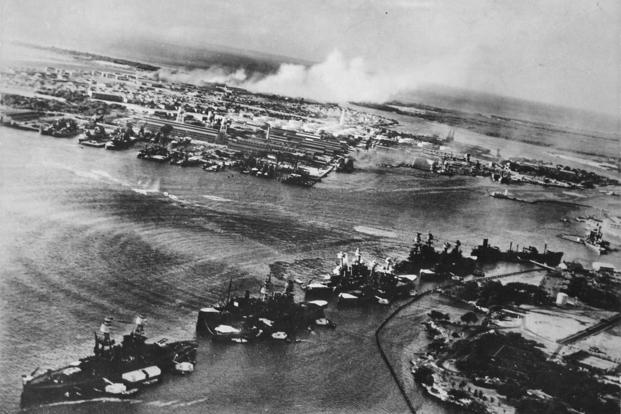
“At dawn, on Sunday February 7, 1932, Yarnell launched his attack with a force of 152 planes from the two carriers. His attack force first attacked the airfields and then proceeded to attack the ships along battleship row.”

“Yarnell achieved total surprise. The airfields were put out of commission, with not a single plane getting airborne during the attack. The attacking force scored multiple hits, they dropped sacks of white flour to simulate bombs, on the battleships.”  (Military-com)

“In 1938, the same wargames were being played again to test Pearl Habor’s defenses. The attacking force was led by Admiral Ernest King, and Admiral Yarnell was working in the background to run the experiment a second time.”

“King took a single aircraft carrier escorted by destroyers to attack Pearl Harbor from the air. Coming in over the Koolau Range, he surprised the military base and won a decisive victory — just as Admiral Yarnell had done so in 1932.”

“As WWII got underway in the Pacific, Japan knew that it could not fend off a full-on assault by the U.S. Navy if the U.S. entered the war. Instead, they needed to launch a pre-emptive strike and hobble the U.S.’s ability to interfere with Japanese operations in the Pacific.”

“Thus, on December 7th, 1941, Japan’s Admiral Yamamoto pulled out the same military plans that Admiral Yarnell used almost 10 years before and launched his own assault on Pearl Harbor. This time, however, his planes would not be carrying ‘flour bombs’ and flares.”

“That Sunday morning, Yamamoto’s planes burst through a wall of clouds over the Koolau Range — and its fighters strafed the U.S. airfields before bombers descended on the island – and only then did the U.S. Navy accept that it should have paid heed to Admirals Yarnell and King when slight embarrassment was the only price it needed to pay.”  (Medium)

“Some think it was distinctly edifying to the Japanese, who [after Yarnell’s decisive exercise] executed what Arthur Radford, a young lieutenant commander and an aide to Yarnell, calls ‘almost a perfect duplicate.’”

“To Americans, however, the exercise was hardly edifying enough. Incredibly, the United States never woke up to the fact that Pearl Harbor–and, therefore, America itself–was vulnerable.”

“In 1932, Radford says, when Yarnell crept up on Hawaii and launched his planes, the exercise was ‘pretty well publicized.’ But Americans paid little attention. The nation was in a seminal transition. Provincial, self-indulgent and distracted by the Great Depression, America was struggling to reawaken to the world.” (LA Times)

© 2024 Ho‘okuleana LLC

Filed Under: Military, Place Names Tagged With: Harry Yarnell, Hawaii, Pearl Harbor, Fleet Problem

January 6, 2024 by Peter T Young Leave a Comment

Buffalo Soldiers Trail

In early 1911, geologist named Thomas A Jaggar convinced Frank A Perret, a world-famous American volcanologist he had met on Vesuvius Volcano in Italy, to travel to Hawai‘i to begin the observations of Kīlauea’s volcanic activity.

From July to October 1911, Perret conducted experiments and documented the lava lake activity within Kïlauea’s Halema‘uma‘u Crater, paving the way for Jaggar to pursue his life’s goal of using multiple scientific approaches and all available tools for the observation and measurement of volcanoes and earthquakes.

In 1911, the first scientific laboratory at Kilauea consisted of a crude wooden shack constructed on the edge of Halema‘uma‘u that was called the Technology Station. The next year saw the construction by Jaggar of the Hawaiian Volcano Observatory. 

When Jaggar came to the Islands, he joined the efforts of George Lycurgus (operator of the Volcano House) and newspaperman Lorrin Andrews Thurston who were working to have the Mauna Loa and Kilauea Volcanoes area made into a National Park. 

Jaggar had tried to lead several expeditions to the top of Mauna Loa in 1914 but was unsuccessful due to the elevation (13,678 feet) and the harsh conditions: rough lava, violent winds, noxious fumes, shifting weather, extreme temperatures and a lack of shelter, water and food.  (Takara)

In September 1915, Jaggar, Thurston and a US Army representative conducted a survey to determine a route for a trail up Mauna Loa.

The following month, a local paper noted, “Soldiers Building Mountain Trail.  Negro soldiers of the Twenty-fifth Infantry to the number of 150 are at work constructing a trail from near the Volcano House to the summit of Mauna Loa.”

“It is estimated that three or four weeks will be devoted to this work. The soldiers are doing the work as a part of their vacation exercises.”  (Maui News, October 29, 1915)

Immediately after the Civil War and the abolition of slavery, many African Americans found themselves newly freed from bondage. In 1866, congress created four military regiments made up of Black troops, the 9th and 10th Cavalry and the 24th and 25th Infantry – they were known colloquially as the Buffalo Soldiers. (NPS)

“Although Native Americans bestowed the name upon the troopers, there are differing accounts as to the reason. One account suggests the name was acquired during the 1871 campaign against the Comanches, when Indians referred to the cavalrymen as “Buffalo Soldiers” because of their rugged and tireless marching.”

“Other accounts state that Native Americans bestowed the nickname on the black troopers because they believed the hair of the black cavalrymen resembled the hair of the buffalo.”

“Another suggests that the name was given because of the buffalo-hide coats worn by the soldiers in cold weather. The troopers took the nickname as a sign of respect from Native Americans, who held great reverence for the buffalo, and eventually the Tenth Cavalry adopted the buffalo as part of its regimental crest.” (Plante)

“The generous cooperation of the United States Army has made the trail to the top of Mauna Loa and the rest houses at the top and midway thereto a certainty.” (Hawaiian Gazette, Sep 24, 1915)

“The overpowering feature of the landscape, however, is the immediate foreground to the north and east. The trail up to Red Crater is through ordinary and rather monotonous lava flows; but from the top of the hill there literally bursts into view a scene of most violent volcanic activity that I have seen anywhere.”

“It is similar to the interior of Haleakala crater; and the top of Hualalai, but while those are old and faded, this is fiery red and inky black.”  (Hawaiian Gazette, Nov 11, 1915)

“During the past summer [in 1915] the promotion committee and Research Association formulated and presented its plan to the authorities of the County of Hawaii and the newly created Hawaii Publicity Committee …”

“… proposing that these two organizations with the assistance of private subscriptions should furnish the money necessary for the material involved, the work to be done by the county prisoners.”

“The county authorities and the publicity committee each agreed to contribute $500 toward the enterprise.  Then the Governor came in with a contribution of $500 from the contingent fund and private subscriptions have been received in excess of $1000.”

“No decision had been arrived at concerning the availability of the county prisoners, however.” (Hawaiian Gazette, Sep 24, 1915)  (The practice in Hawai‘i and elsewhere was to use prison labor for public works projects, including road building.)

(Later Territorial law stated, “All prisoners sentenced to imprisonment at hard labor shall be constantly employed for the public benefit, on public roads or other public works or other wise, as the high sheriff, with the approval and subject to the control of the board of prison directors, may deem best.”)

Then the military offered aid in the form of a “tentative proposition that, if transportation was furnished from Honolulu to Hilo and return, Company E of the Twenty-fifth Infantry, consisting of between 140 and 150 men would volunteer to go to Volcano, and do the work of building the trail and erecting the rest houses without further expense to the promoters or enterprise.”  (Hawaiian Gazette, Sep 24, 1915)

Building the Buffalo Soldiers Trail (now called Mauna Loa Trail) from the 4,000-ft. summit of Kīlauea to the 13,677-ft. summit of Mauna Loa was no easy task. (NPS)

“The soldiers are constructing a trial three feet wide across the a-a, crushing it down with twelve pound hammers, filling in hollow, cutting down ridges and putting on a finish of fine a-a and earth, quarried along the line or parked in gunny sacks, carried on the men’s backs – in some places being carried as far as a quarter of a mile.”

“The Mauna Loa trail and rest house project is making steady and substantial progress. It must be remembered that it is through a section of territory never before inspected, much less traveled over, except the lower portion thereof, and that only by a few surveyors, cattle men and catchers of wild goats.”

“No one wants to run away with the idea that the job which the men of Company E of the Twenty-fifth Infantry have volunteered to do is all picnic. They are having a picnic all right; but incidentally they are doing a lot of good hard work in a pure pro bono publico spirit.”  (Hawaiian Gazette, Nov 11, 1915)

The Buffalo Soldiers built the 18-mile trail to the summit of Mauna Loa. They also built the ten-man Red Hill Cabin and a twelve-horse stable, so scientists could spend extended periods of time studying the volcano.

“[D]uring the period of 1915 to 1921, the trail was managed and maintained by a loose consortium consisting of Hawaii Volcano Research Association, Lorrin Thurston, Hilo businessmen, and Thomas Jaggar, then it was managed by the National Park Service.” (Tuggle)

Between 1930 and 1932, the National Park carried out major improvements and realignments of the Mauna Loa Trail to fall completely within the park boundary. Over the past century, the evolving needs of the National Park and changes in available

technology have resulted in ongoing modifications to the physical footprint of the trail.

The uppermost portion of the original trail footprint has been nearly obliterated since the 1970s by a series of large lava flows in 1975, 1984, and 1985. (Tuggle)  (The inspiration and sources to information here came primarily from a study by Myra Tomonari-Tuggle.)

© 2024 Ho‘okuleana LLC

Filed Under: Economy, General, Military, Place Names, Prominent People Tagged With: Buffalo Soldiers, Hawaii National Park, US Army, Buffalo Soldiers Trail, Mauna Loa Trail, Hawaii, Mauna Loa, Hawaii Volcanoes National Park

December 27, 2023 by Peter T Young Leave a Comment

Suiter Field

In 1779, Captain Cook explored the North Kohala area and noted:  “The country, as far as the eye could reach, seemed fruitful and well inhabited … (3 to 4-miles inland, plantations of taro and potatoes and wauke are) neatly set out in rows.”

“The walls that separate them are made of the loose burnt stone, which are got in clearing the ground; and being entirely concealed by sugar-canes planted close on each side, make the most beautiful fences that can be conceived …”  (Cook Journal)

Fast forward 150-years to a property in this area within two traditional Hawaiian ahupuaʻa (land divisions.) The eastern half of the property is located within the ahupuaʻa of Kealahewa (wrong way) and the western half is located within the ahupuaʻa of Opihipau (opihi (limpets) all gone.)  The property was used by the Hawi Mill and Plantation Company in its sugar operations.

Later, on June 25, 1927, an Executive Order set aside nearly 38-acres of the property for an airplane landing field for the US Air Service to be under the management and control of the War Department.

The airfield is about three miles northwest of the town of Hawi on the northern tip of the coast of the Big Island of Hawaiʻi.  In 1933, the Army named it Suiter Field, in honor of 1st Lieutenant Wilbur C Suiter who was killed in action serving in 135th Aero Squadron.

Suiter was posthumously issued the Distinguished Service Cross and Silver Star Citation for extraordinary heroism in action.  He and his observer (Guy E Morse) fearlessly volunteered for the perilous mission of locating the enemy’s advance unit in the rear of the Hindenburg line.

Disregarding the hail of machine gun fire and bursting anti-aircraft shell, they invaded the enemy territory at a low altitude and accomplished his mission, securing information of the greatest importance.

They at once returned to the lines and undertook another reconnaissance mission, from which they failed to return.  (Morse Field, the military’s air field that was once at South Point was named after 2nd Lieutenant Guy E Morse.)

Suiter Field was first licensed in 1928.  It was also alternatively referred to as Upolu Point Military Reservation, Upolu Landing Field, Upolu Airplane Landing Field and Upolu Airport.

In the early days of aviation in Hawaiʻi, the US Signal Corps maintained a communication station at Suiter Field.  Inter-Island Airways (later known as Hawaiian Air,) which began passenger service in 1929, used the field as an emergency stop on its route to Hilo, as well as to provide air service to the district of Kohala.

On June 26, 1929, Governor’s Executive Order No. 363 added 57-acres to Upolu Airplane Landing Field to be under the control and management of the War Department.  Shortly thereafter, December 16, 1929, the Territorial Aeronautics Commission sought to have the property returned to the Territory for the Upolu aeroplane landing field.

In January 1930, the War Department granted the Territory concurrent use of the Army landing field for official and commercial aviation use.  Within 7-months later, about 97-percent of the land was restored to the Territory.  A couple of months later, about 95 acres were dedicated to establish the Upolu Airport under control of the Territory.

Upolu field was grass on a sandy soil and partially graded.  The Army maintained a barracks and radio station at the field on Federal property. The Upolu Point Airport consisted of one large runway in the shape of an hour glass 3,500 feet long.

Before the bombing of Pearl Harbor on December 7, 1941, a contract had been let and work was ready to start on the new airport – the war stopped that.

During World War II, the Navy occupied Upolu Airport establishing a weather and communication station there.  The facility was used as an auxiliary field to the Naval Air Station, Hilo, for field-carrier-landing practice and other training of carrier pilots.

The Upolu Point Military Reservation included facilities for naval purposes and for the operation and maintenance of military airplanes and airships. These facilities included a 150-foot-wide by 4,000-foot long surfaced runway, an aircraft parking area, a catapult deck, administration buildings, personnel quarters and a bunch of support buildings.

A simulated deck of an aircraft carrier was installed and air-group pilots completed their training by qualifying in day and night deck landings before going aboard the carriers for combat duty.  From July 1944 to May 1947 the facility was used exclusively for naval and other military purposes.

Upolu Airport was returned to the Territory after the war, and air service was provided by scheduled and non-scheduled operators.  Buildings formerly occupied by the Navy were rehabilitated for use as a terminal and for other purposes.

It was used for a time by Inter-Island Airways, Ltd. for small Sikorsky amphibians, but could not be used for large aircraft.  A 1946 Master Plan for Upolu included a 4,000 foot by 150 foot runway.  By 1948, the paved runway was 4,000 feet in length and Upolu was the only airport in that part of the island which met the requirements for scheduled airline operation.

Hawaiian Airlines was the principal user of the airport and made one stop a day en route from Honolulu to Hilo, and one stop en route from Hilo to Honolulu.

A new Master Plan was completed in March 1999. The airfield included a single runway (7-25), taxiway and an aircraft parking apron.  Runway 7-25 was 3,800 feet long and 75 feet wide and aligned in an east-northeast to west-southwest direction.

There has been no scheduled commuter service at the airport since 1986.  There are no cargo facilities at Upolu Airport, no control tower, and no aircraft rescue and firefighting facilities (nor fuel storage facility.)  There are only infrequent aircraft at Upolu Airport; airport management is under the Kona International Airport manager.  (Lots of info here from hawaii-gov.)

© 2023 Hoʻokuleana LLC

Filed Under: Economy, Military Tagged With: Upolu Airport, Upolu Point, Hawaii, Hawaii Island, Kohala, North Kohala, Hawi, Suiter Field

December 16, 2023 by Peter T Young Leave a Comment

Whaling Ship Anchor at +4,000 Feet?

The plaque inscription states, “Found by the salvage ship ‘USS Beaufort ATS-2’ in July 1972 off Lahaina, Maui.  This anchor is believed to have been made around 1850 and used by one of the whaling ships of that era. Presented to the men of the Kilauea Military Camp by the officers and crew of USS Beaufort ATS-2”

The anchor was a gift, so it is appropriate wherever it is; likewise, the gift of a whaling anchor found off Lahaina (at a location 4,000-feet above the ocean) helps tell some of the stories of Hawai‘i’s military and economy – I think questioning why it’s there and looking into it a bit is helpful, and not something necessarily out of place.

The USS Beaufort (named for Beaufort, South Carolina) was the Navy’s largest and most capable submarine rescue and deep-ocean search-and-recovery ship. She was built in the late-1960s and commissioned on January 22, 1972 and spent most of her service in the Western Pacific. She was decommissioned on March 8, 1996.

Hawai‘i’s whaling era began in 1819 when two New England ships became the first whaling ships to arrive in the Hawaiian Islands.  At that time, whale products were in high demand; whale oil was used for heating, lamps and in industrial machinery; whale bone was used in corsets, skirt hoops, umbrellas and buggy whips.

Whalers’ aversion to the traditional Hawaiian diet of fish and poi spurred new trends in farming and ranching.  The sailors wanted fresh vegetables and the native Hawaiians turned the temperate uplands into vast truck farms.

There was a demand for fresh fruit, cattle, white potatoes and sugar.  Hawaiians began growing a wider variety of crops to supply the ships.

In Hawaiʻi, several hundred whaling ships might call in season, each with 20 to 30 men aboard and each desiring to resupply with enough food for another tour “on Japan,” “on the Northwest,” or into the Arctic.

The whaling industry was the mainstay of the island economy for about 40 years.  For Hawaiian ports, the whaling fleet was the crux of the economy.  More than 100 ships stopped in Hawaiian ports in 1824. 

“At present the whale ships visit the Sandwich Islands in the months of March and April and then proceed to the coast of Japan, the return again in October and November remain here about six weeks, and then proceed in different directions …”

“… some to the Coast of California, others cruise about the Equator when they return thither again in March and April and proceed a second time to the Coast of Japan; it usually occupies two seasons on that coast to fill a ship that will carry Three Hundred Tons.”  (Jones report to Henry Clay, Secretary of State, 1827)

“The number of hands generally comprising the Company of a whale ship will average Twenty Five; and owing to the want of discipline, the length and the ardourous duties of the voyage, these people generally become dissatisfied and are willing at any moment to join a rebellion or desert the first opportunity) that may offer …”

“… this has been fully exemplified in the whale ships that have visited these islands, constant disertions have taken place and many serious mutinies both contributing to protract and frequently ruin the voyage.”  (Jones report to Henry Clay, Secretary of State, 1827)

The effect on Hawaiʻi’s economy, particularly in areas in reach of Honolulu, Lāhainā and Hilo, the main whaling ports, was dramatic and of considerable importance in the islands’ history. Over the next two decades, the Pacific whaling fleet nearly quadrupled in size and in the record year of 1846, 736-whaling ships arrived in Hawai‘i.

Then, whaling came swiftly to an end.  In 1859, oil was discovered and a well was developed in Titusville, Pennsylvania; within a few years this new type of oil replaced whale oil for lamps and many other uses – spelling the end of the whaling industry.

At volcano … in 1898, Lorrin Thurston owner of Volcano House and head of the Hawai‘i Promotion Committee (forerunner to the Hawai‘i Visitors and Convention Bureau) worked closely with the Inter-Island Steam Navigation Company to create an excursion business from Honolulu to his hotel at Kīlauea.

Although he sold his interest in Volcano House to hotelier George Lycurgus (1858–1960) in 1904, Thurston continued to promote Kīlauea and Hawai‘i’s other natural sites.

He helped with the establishment of the Hawaiʻi National Park, an entity to encompass both Kīlauea and Haleakalā.  Hawai‘i’s new National Park, established August 1, 1916, was the thirteenth in the new system and the first in a US territory.  (Chapman)

The history of the Park generally mirrors the history of Kīlauea Military Camp (KMC.) Interest in Kīlauea as a military training and rest area began in September 1911, when Companies A and F, Twentieth Infantry, arrived. They were followed two years later by one hundred men from Company D, First Infantry, who camped near the Volcano House.  (Nakamura)

Thurston helped negotiate a lease for about 50-acres of land from Bishop Estate; trustees held the lease (they included Ex offico the Commander of the Army Department of Hawaii; Ex officio the Commanding General of the National Guard of Hawaii; Lieut Col John T. Moir, National Guard, Island of Hawaiʻi; GH Vicars of Hilo and LA Thurston of Honolulu and Hilo).

In the early years, to get there, off-island folks took steamer ships to either Hilo or Punaluʻu (from Hilo they caught a train to Glenwood and walked/rode horses to Volcano. From Ka‘ū, a five-mile railroad took passengers to Pahala and then coaches hauled the visitors to the volcano. Later, the roads opened.

The Kilauea Military Camp is located at an elevation of 4,000-feet, directly on the belt road around the island (the road was later relocated mauka of the Camp.)

KMC greeted its first group of US Army Soldiers from Company A, 2nd Infantry, November 6, 1916. Three buildings for dining and recreation were still unfinished, so the visiting Soldiers were expected to provide their own sleeping tents. A couple weeks later, November 17, KMC was officially opened, and many Soldiers came to this unique site.

Then, WWI broke out and virtually all of the troops in Hawai‘i had transferred to the continental US, many of them then moving on in succeeding months to the trenches of France and Belgium.  (Chapman)

To keep the place going, school summer programs and Boy Scouts stayed at the camp.  Following WWI, the trustees transferred their KSBE lease to the Park Service.  By late-1921, soldiers on recreation leave started to return to the Camp and the facilities started to expand.

As part of the original agreement, the Navy built its own rest and recreation camp on a 14-acre parcel adjacent to KMC in 1926. The Navy camp was transferred to KMC’s control in 1935.  (KMC)

On July 1, 1961, Hawaiʻi National Park’s units were separated and re-designated as Haleakalā National Park and Hawaiʻi Volcanoes National Park.  The relationship between the military and Park Service was not always smooth. 

Today, Kīlauea Military Camp is open to all active and retired armed forces, Reserve/National Guard, dependents, other uniformed services, and current and retired Department of Defense civilians, including Coast Guard civilians and sponsored guests.

© 2023 Ho‘okuleana LLC

Filed Under: Economy, General, Military, Sailing, Shipping & Shipwrecks Tagged With: Visitor Industry, Economy, USS Beaufort, Hawaii, Volcano, Whaling, Kilauea Military Camp

December 7, 2023 by Peter T Young 4 Comments

Postcards, Sails, Sheets, Lights, Ads, Fires and Radio Signals

The attack on the US military installation at Pearl Harbor and other parts of Oʻahu by Japan’s Imperial military was one of the most successful surprise attacks in military history.

But an often-overlooked component of the successful attack is that the Japanese Empire had contracted with Bernard Otto Julius Kuehn, a German Nazi, to spy on the American military operations at Pearl Harbor from 1935 (an early ‘sleeper agent’ in espionage.)

The family had been contracted as agents of the Japanese government with the assistance of the Nazi Propaganda Minister Joseph Goebbels. The arrangement was promoted and negotiated by Goebbels as a byproduct of his relationship with Kuehn’s attractive 17-year old daughter, Susie Ruth.  (Washington Times)

The execution of the plan was reminiscent of “one, if by land, and two, if by sea,” the phrase coined by American poet, Henry Wadsworth Longfellow in his poem, Paul Revere’s Ride.

It references the secret signal during Revere’s ride from Boston to Concord on the verge of American Revolutionary War alerting patriots about the route the British troops would take to Concord (two lanterns were shown, the British rowed over to Cambridge.)

The Kuehns arrived in Hawaiʻi in 1935; they started their spying then.  They blended in, and waited.

No one seriously suspected that Caucasians would carry on espionage for the Empire of Japan, so Kuehn, his wife Friedel, their daughter and son, Hans Joachim, were virtually inconspicuous as a white family on the windward side.

Kuehn had houses in Hawaiʻi, lots of money, but no real job. Investigations by the Bureau and the Army, though, never turned up definite proof of spying.  (FBI)

However, every member of the family contributed towards collecting and documenting military activities at Pearl Harbor from 1935 right up to the day the bombs fell from Japanese aircraft.

Paid for his services, in three years he banked more than $70,000; one payment was $14,000 in $100 bills. They had houses in Lanikai and Kailua; these later served as the means of their intricate, yet simple, signaling system.  (Pearl Harbor Board)

The Kuehn family took various means to gather information.

Kuehn would scout the ships at Pearl Harbor.  Daughter Susie Ruth set up a beauty parlor and used it to gather gossip and random information from wives and girlfriends of the military men stationed at Pearl Harbor.  Mother Friedel kept track of all the notes.

Ten-year-old Hans was dressed in a sailor suit and with his father would walk down near the docks.  Many of the sailors thought the little guy was quite cute and some gave him unofficial “tours” of their ships.

Coached by his father, he would ask specific questions and observe everything he saw. Later he would be systematically debriefed by his parents.

The Kuehn family was not working alone; they worked with other Japanese spies attached to the Japanese consulate.

If the Consulate wanted to contact Kuehn, they would send a postcard signed “Jimmie” to his Post Office Box 1476 in Honolulu.  (Pearl Harbor Board)

On December 2, days before the attack, he provided specific – and highly accurate – details on the fleet in writing. That same day, he gave the consulate the set of signals that could be picked up by nearby Japanese submarines.  (FBI)

The set of signals contained eight combinations, each signal represented a number and each number represented the status of the naval fleet at Pearl Harbor.

No. 1 – battle fleet prepared to leave
No. 2 – scouting force prepared to leave
No. 3 – battle fleet left 1 to 3 days ago
No. 4 – scouting fleet left 1 to 3 days ago
No. 5 – air craft carriers left 1 to 3 days ago
No. 6 – battle fleet left 4 to 6 days ago
No. 7 – scout force left 4 to 6 days ago
No. 8 – aircraft carriers left 4 to 6 days ago

Signals were given that represented these respective code numbers.  Part of how they did this was to shine lights out windows and hang sheets on the laundry line.  These were done from their homes in Lanikai and Kailua (using lights in a dormer window.)

One light shining from the window between 7 and 8 pm meant No. 1; one light from 8 to 9 pm meant No. 2 and so forth for Nos. 3 and 4.  Two lights shining from the window from 7 to 8 meant No. 5, etc.  Hanging sheets on the laundry line carried the similar code.

An alternative display of the code used different patterns in the sail of Kuehn’s boat off Lanikai; a sail with/without a star and numbers at different hours represented corresponding references back to the code.

They also arranged the signal through KGMB Want Ads – different advertised items represented different numbers (ie Chinese rug, chicken farm, beauty parlor operator wanted, etc.)

Two other signaling means included garbage fires on a friend’s property on the side of Haleakala on Maui between certain times, representing different code numbers.  Signals were also sent via shortwave radio.  (Pearl Harbor Board)

Following the fateful attack of December 7, 1941, Honolulu Special Agent in Charge Robert Shivers immediately began coordinating homeland security in Hawaiʻi and tasked local police with guarding the Japanese consulate. They found its officials trying to burn reams of paper. These documents – once decoded – included a set of signals for US fleet movements.  (FBI)

All fingers pointed at Kuehn. He had the dormer window, the sailboat and big bank accounts. Kuehn was arrested the next day and confessed, though he denied ever sending coded signals. (FBI)

On February 21, 1942, just 76 days after the tragic attack on Pearl Harbor, a military court in Honolulu found Bernard Otto Julius Kuehn guilty of spying and sentenced to be shot “by musketry” in Honolulu.  His sentence was later commuted to 50 years of hard labor.

He served time in Leavenworth Penitentiary from December 1, 1942 to June 6, 1946 (when his sentence was commuted in order to deport him.)  On December 3, 1948, he was deported to Buenos Aires, Argentina.  (FBI)

Kuehn was one of 91-people convicted of spying against the United States from 1938 to 1945.  (FBI)

© 2023 Hoʻokuleana LLC

20040901-08 PRG SPY HOUSE There are two houses at 557 Kainalu in Kailua that are built very close to each other. This is the two story A fame house that is on the right side of the property. During the late 1930's it served as a den for a German spy who provided intelligence for the Japanese military leading up to the bombing of Pearl Harbor. The present owner, John Piper (225-3555) bought the houses in 1999. PHOTO BY DENNIS ODA. SEPT. 1, 2004. Nikon D2H Focal Length: 13mm White Balance: Direct sunlight Color Mode: Mode I (sRGB) 2004/09/01 12:35:19.1 Exposure Mode: Shutter Priority AF Mode: AF-C Hue Adjustment: 0¡ JPEG (8-bit) Fine Metering Mode: Multi-Pattern Tone Comp.: Auto Sharpening: Auto Image Size: Large (2464 x 1632) 1/250 sec - f/15 Flash Sync Mode: Not Attached Noise Reduction: OFF Exposure Comp.: 0 EV Lens: 12-24mm f/4 G Sensitivity: ISO 200 Image Comment: [#End of Shooting Data Section]
20040901-08 PRG SPY HOUSE There are two houses at 557 Kainalu in Kailua that are built very close to each other. This is the two story A fame house that is on the right side of the property. During the late 1930’s it served as a den for a German spy who provided intelligence for the Japanese military leading up to the bombing of Pearl Harbor. The present owner, John Piper (225-3555) bought the houses in 1999. PHOTO BY DENNIS ODA. SEPT. 1, 2004. Nikon D2H Focal Length: 13mm White Balance: Direct sunlight Color Mode: Mode I (sRGB) 2004/09/01 12:35:19.1 Exposure Mode: Shutter Priority AF Mode: AF-C Hue Adjustment: 0¡ JPEG (8-bit) Fine Metering Mode: Multi-Pattern Tone Comp.: Auto Sharpening: Auto Image Size: Large (2464 x 1632) 1/250 sec – f/15 Flash Sync Mode: Not Attached Noise Reduction: OFF Exposure Comp.: 0 EV Lens: 12-24mm f/4 G Sensitivity: ISO 200 Image Comment: [#End of Shooting Data Section]
Bernard_Julius_Otto_Kuehns_mug_shot_superimposed_over_USS_SHAW_exploding_-_1941
Bernard_Kuehn_mugshot_1941
Bernard_Kuehn-Friedel_Kuehn-(Gettysburg_Times)

Filed Under: Military Tagged With: WWII, Bernard Otto Julius Kuehn, Kailua, Lanikai, Hawaii, Oahu, Pearl Harbor

  • « Previous Page
  • 1
  • …
  • 11
  • 12
  • 13
  • 14
  • 15
  • …
  • 44
  • Next Page »

Images of Old Hawaiʻi

People, places, and events in Hawaiʻi’s past come alive through text and media in “Images of Old Hawaiʻi.” These posts are informal historic summaries presented for personal, non-commercial, and educational purposes.

Info@Hookuleana.com

Connect with Us

  • Email
  • Facebook
  • LinkedIn
  • Twitter
  • YouTube

Recent Posts

  • ‘Kakela me Kuke’
  • Aliʻiolani Hale
  • Hotel Del Coronado
  • “This does not look like me”
  • ‘Aim High to Reach the Heaven’
  • Presidents’ Day
  • Moku Manu

Categories

  • Hawaiian Traditions
  • Military
  • Place Names
  • Prominent People
  • Schools
  • Sailing, Shipping & Shipwrecks
  • Economy
  • Voyage of the Thaddeus
  • Mayflower Summaries
  • American Revolution
  • General
  • Ali'i / Chiefs / Governance
  • Buildings
  • Missionaries / Churches / Religious Buildings

Tags

Albatross Al Capone Ane Keohokalole Archibald Campbell Bernice Pauahi Bishop Charles Reed Bishop Downtown Honolulu Eruption Founder's Day George Patton Great Wall of Kuakini Green Sea Turtle Hawaii Hawaii Island Hermes Hilo Holoikauaua Honolulu Isaac Davis James Robinson Kamae Kamaeokalani Kameeiamoku Kamehameha Schools Lalani Village Lava Flow Lelia Byrd Liberty Ship Liliuokalani Mao Math Mauna Loa Midway Monk Seal Northwestern Hawaiian Islands Oahu Papahanaumokuakea Marine National Monument Pearl Pualani Mossman Quartette Thomas Jaggar Volcano Waikiki Wake Wisdom

Hoʻokuleana LLC

Hoʻokuleana LLC is a Planning and Consulting firm assisting property owners with Land Use Planning efforts, including Environmental Review, Entitlement Process, Permitting, Community Outreach, etc. We are uniquely positioned to assist you in a variety of needs.

Info@Hookuleana.com

Copyright © 2012-2024 Peter T Young, Hoʻokuleana LLC


Loading Comments...