Images of Old Hawaiʻi

  • Home
  • About
  • Categories
    • Ali’i / Chiefs / Governance
    • American Protestant Mission
    • Buildings
    • Collections
    • Economy
    • Missionaries / Churches / Religious Buildings
    • General
    • Hawaiian Traditions
    • Other Summaries
    • Mayflower Summaries
    • Mayflower Full Summaries
    • Military
    • Place Names
    • Prominent People
    • Schools
    • Sailing, Shipping & Shipwrecks
    • Voyage of the Thaddeus
  • Collections
  • Contact
  • Follow

July 20, 2024 by Peter T Young Leave a Comment

Ka Houpo o Kāne

E ui aku ana au ia oe,
Aia i hea ka Wai a Kane?
Aia i lalo, i ka honua, i ka Wai hu,
I ka wai kau a Kane me Kanaloa
He waipuna, he wai e inu,
He wai e mana, he wai e ola,
E ola no, ea!

One question I ask of you:
Where flows the water of Kane?
Deep in the ground, in the gushing spring,
In the ducts of Kane and Loa,
A well-spring of water, to quaff,
A water of magic power-
The water of Life!
Life! O give us this life!
(Emerson; Unwritten Literature of Hawaii)

Precipitation includes rain, snow, and fog drip. Evapotranspiration is the water that is either evaporated directly into the atmosphere or that which is used by plants and transpired back into the atmosphere. Runoff is the component that contributes to streamflow.

Groundwater recharge is the component of precipitation that percolates into the subsurface and is not lost to the atmosphere via evapotranspiration.  (Intera)

Fresh water travels down into the earth through a process called percolation. On the Hawaiian Islands, water first percolates through soil, if present, then through porous volcanic rock to the water table within the lava. (BWS)

During the volcanic eruptions that created the Hawaiian Islands, molten rock beneath the surface flowed up from the center of the volcanoes; dikes formed when magma stopped flowing to the surface, then cooled over time to form dense, nonporous rock.

Fresh water percolating down between the dikes compartment becomes trapped between the nearly impenetrable walls of the dikes. The water can only escape when its level rises and overflows the walls of the dike, or when great internal pressure causes leakage. Sometimes a freshwater spring will form above ground when such water spews from a dike. (BWS)

Sometimes percolating water becomes trapped when it meets layers of fine volcanic ash or clay-like soil that occur between the remnants of Hawaii’s ancient underground lava flows.  This perched water can no longer seep downward, so it collects and moves sideways, sometimes appearing as a spring (BWS)

“Ka-houpo-o-Kāne (literally, The-bosom-of Kāne), is the sacred region of Mauna Kea (between the 10,000 – 11,000 foot elevation), in which are found the springs fed by Ka-wai-hū-a-Kāne; by a rivulet from Waiau to the head of Pōhakuloa Gulch.” (“Houpokāne is mistakenly written Hopukani on most maps dated after 1900.”) (Maly)

Ka Houpo o Kāne represents the springs of the island of Hawaii. (Vredenburg)  “The area identified as Ka-houpo-o-Kāne is situated below Waiau, on the southwestern slopes of Mauna Kea, in the land of Ka‘ohe.”

“The god Kāne is believed to be foremost of the Hawaiian gods, and is credited with creation, procreation, light, waters of life, abundance, and many other attributes.”

“A land being likened to the chest of Kāne, can imply that the land was cherished and blessed by the god Kāne. … SN Hale‘ole’s tradition of Lā‘ie-i-ka-wai (In Kū ‘Oko‘a 1862-1863), records that “Kahoupokane” was one of three companions of Poli‘ahu. The other two companions were Lilinoe and Waiau.”

“The area identified as Ka-houpo-o-Kāne is situated below Waiau, on the southwestern slopes of Mauna Kea, in the land of Ka‘ohe.” (Maly)

“One of the primary attributes of Kāne are the wai ola (life giving waters), sacred springs and water sources made by Kāne around the islands, to provide for the welfare of the people and the land). Interestingly, at Kahoupo-o-Kāne are found the waters of Pōhakuloa, Hopukani, and Waihū (also known by the name “Ka-wai-hū-a-Kāne”).   (Maly)

“A spring on the southern side of the mountain, called ‘Wai Hu,’ is believed by the natives to be connected with [Lake Waiau].” (Pacific Commercial Advertiser, Sep 14, 1892)

“The few small springs on the glaciated peak of Mauna Kea in Hawaii are fed by ground water perched on and in glacial drift deposits. Their presence is note-worthy because of the light they throw on geologic history and on hydrologic principles rather than for the amount of water produced.”

“Springs in Hawaii fall into two chief categories: (1) high-level springs fed by ground-water bodies perched on or confined by intrusive bodies, ash beds, or modem or ancient soils and (2) basal springs fed from a great body of ground water which is kept in hydrostatic balance with sea water at a few feet above sea-level.” (Wentworth & Powers)

“Conditions on Mauna Kea favor rapid percolation of most rain and meltwater from the winter snow. Toward higher elevations rock-weathering becomes progressively more physical in type.”

“The largest springs on Mauna Kea are found at several points in the Waihu branch of Pohakuloa Valley, on the southwest slope between 8,900 and 10,400 feet.”

“The upper part of the Waihu springs area forms, in summer, a notably green little valley with many small patches of lush grass quite in contrast to the almost complete barrenness of the surrounding terrane, which is above timber line.”

“In the area to the east and up the slope from the springs are numerous small heaps of pre-European stone adz workings.  Certain lava caves contain evidence of habitation, suggesting that the springs were frequented by adz workers.”

“In addition to these larger springs there are some dozens of smaller seeps where trickling water or greener vegetation shows the emergence of small amounts of ground water.” (Wentworth & Powers)

© 2024 Ho‘okuleana LLC

Filed Under: Economy, Hawaiian Traditions Tagged With: Water, Houpo O Kane, Ka-wai-hu-a-Kane, Kahoupokane, Spring, Hawaii, Mauna Kea, Pohakuloa

July 17, 2024 by Peter T Young Leave a Comment

Breakwater

It is called Breakwater (or Breakwaters), not because it served as a breakwater – it actually was a quarry site that produced some of the boulders that helped form the Hilo Bay breakwater. It’s below Kukuihaele, just before you get to the Waipi‘o Valley lookout  and the road down to Waipi‘o.

It’s a place name noted by John Clak in his Hawaiʻi Place Names: Shores, Beaches, and Surf Sites as, “Breakwater. Fishing site, Kukuihaele, Hawai’i. Small peninsula at the base of the sea cliffs between Kukuihaele Light and Waipi’o Valley.”

“The name is linked to the construction of the 2-mile long breakwater in Hilo Bay, which was started in 1908 and completed in 1929. Boulders from the peninsula were loaded on barges and towed to Hilo Bay, where they were used in the construction of the second phase of the breakwater.”

“The basaltic lava flows of Hawaii, where little weathered and sound, furnish an unlimited supply of rock suitable for crushing and for use as coarse aggregate in concrete.”

“Basalt is not so hard in respect to cutting tools as granite, but it is an exceedingly tough rock with a high resistance to impact. In the production of any grade of stone from basaltic lava flows, there is much loss through the necessity for handling the clinkery layers of unsuitable material which lie between the dense parts of successive flows …”

“… and this expense becomes prohibitive in attempting to produce large size dimension stone in most quarries, as well as in production of breakwater stone of large size.”

“Such stone has in some instances been shipped by barge from one Island to another owing to the difficulty of finding suitable local material.” (Historic Inventory of the Physical, Social and Economic, and Industrial Resources of the Territory of Hawaii, 1939)

“The United States entered into a contract in the amount of $400,000 with Delbert E Metzger, on June 12, 1908, for constructing a breakwater at Hilo Harbor, Hilo, Hawaii, the price being $2.48 ½ per ton of 2,000 pounds of stone put in place.”

“The specifications call for a jetty of the rubble mound type, but as it is being built, it resembles more a huge sloping wall of carefully laid masonry. It has a uniform top width of 15 feet, eleven feet so that their longest dimension is perpendicular to the slope.”

“The stone used below three feet below low water must weigh 130 pounds per cubic foot, or more, and all stone above this plane must weigh 150 pounds per cubic foot.”

“This specified weight for the stone sent the contractor nearly thirty miles, to Puna, on the east point of the island, to open a quarry, for while the whole island is virtually built of flows of lava rock and the breakwater itself rests on a reef of it …”

“… there are comparatively few places on the slopes of Mauna Loa where rock of this weight may be found in large quantities.”   (Overland Monthly, July 1909)

Throughout the construction of the Hilo Breakwater boulders for the breakwater came from three primary sources: Kapoho, Waiakea and Kukuihaele.  It’s the latter that is the place that is the subject, here.

“First Blast for Hilo Breakwater. … The first blast for rock for the Hilo breakwater was fired September 3 at the Lyman quarry in Puna. The blast consisted of three tons of dynamite. Thus the actual work on this great enterprise has begun.” (Advertiser, Sept 13, 1908)

“[O]n July 21, 1914, it was announced that a new quarry at Waipio, near Kukuihaele would be opened.” (Warshauer, HTH) 

“Waiulili Peninsula [a rock outcrop] a quarter mile north of Kukuihaele Landing & a quarter mile south of the mouth of Waipi’o Valley is the so-called boulder quarry/breakwater to take boulders to build Hilo Harbor”. (Narimatsu)

“The small breakwater that is being constructed on the Kukuihaele side of Waipio Gulch is progressing well, and the contractors hope to soon have loaded scows on their way to the Hilo structure. Twenty thousand tons of rock, each individual stone of which must weigh eight tons, are required for the particular part of the breakwater contract that will be handled first.”

“There is an ample supply of that kind of rock at the Kukuihaele end and the contractors anticipate no trouble as to that part of the work. The quarry is located on the old trail that winds around the bluff from Kukuihaele to Waipio.” (Hawaii Herald, Aug 14, 1914)

“The two advantages to the contractor which will result from this plan, as it is seen by those who are favoring it are a saving of transportation charges and saving of quarry charges.”

“It is claimed that the quarry at Waipio can be much more easily and cheaply worked than any other one, and that the hauling by water will be about forty cents a ton cheaper than the railroad could do for.” (Hilo Daily Tribune, July 21, 1914)

“[The Hilo breakwater contractor, Delbert Metzger] went out to a cliff face out beyond [Honoka‘a] at Kukuihaele where there was a landing, and in fact he quarried the rock off of the face of a cliff way out there and swung it down to a barge and took the barge then right in …”

“… towed it right up to the breakwater and he had a better deal that way than he would have had if he’d had to haul it by truck. And so he made a heck of a lot more money. He got it practically free – big slabs that came right off the face of the cliff.”

“[Metzger made] a lot of money and decided that he didn’t want to be an engineer anymore – he wanted to be a lawyer – went back to law school and came back out to Hawaii and stopped there on the Big Island.” (Judge Martin Pence, Watumull Oral History) (Metzger later became Federal District Magistrate for South Hilo.) (Melendy)
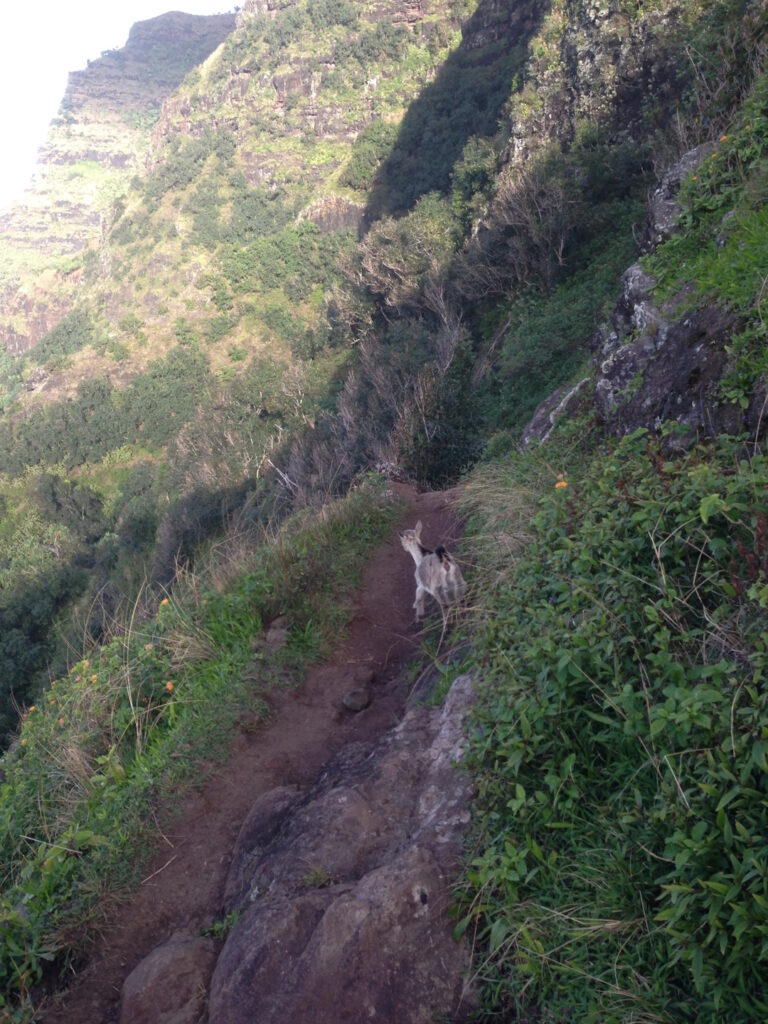
“Huge boulders have fallen from time to time from various causes, and these will admit of easy handling without the necessity of blasting. The distance from the quarry to the Hilo breakwater is about forty-eight miles and the contractors feel sure that the cost of towage will be very reasonable.”

Young Brothers was hired to carry the rocks to Hilo.  “In order to meet the growing demand of the towage business in this harbor, the Young Bros have purchased the tug Breakwater … which it has been using for towing scows from Waipio to the Hilo breakwater.” (Star Bulletin, Aug 2, 1917) The ‘Breakwater’ tugboat was later renamed ‘Mikiala.’

Jack Young was in charge of the work at Hilo and spent the better part of a year skippering the Brothers (the name of their tug) as it towed a scow loaded with rock to be dumped on the breakwater extension.

A news article appearing in the Pacific Commercial Advertiser on December 25, 1911, provides some insights into the job of building the breakwater as the Young Brothers’ crew experienced it:

“The sea had been rough for several days, and finally made it impossible to work. On Monday, the … scow was taken out in tow of the Hukihuki, having on board about 125 tons of rock, which it was to dump on the bottom ….”

“Here the substructure, which has been laid by Lord & Young, forms a kind of artificial reef over which the waves break in stormy weather. On the day in question, the breakers were thundering in at a great rate, and great combers were continually sweeping the deck of the scow.”

“Nevertheless, the Hukihuki bucked through the swirling water, and she had just brought the scow over the substructure, though not in the exact place where the load was to be dumped, when trouble began.”

“The heavy scow was let down, in the trough between two big waves, to such a depth that one of her edges struck the rock of the substructure with such a force that the timbers were splintered and broken, and the water began to pour in through the leak.”

“All thought of depositing the load had to be abandoned, and the Hukihuki maneuvered the disabled craft out of the breakers. The scow was sinking so rapidly that it was impossible to save the load, and good Kapoho rock was jettisoned.”

“By good seamanship the scow was towed to safety, where she is being repaired.”

Contrary to urban legend, the Hilo breakwater was built to dissipate general wave energy and reduce wave action in the protected bay, providing calm water within the bay and protection for mooring and operating in the bay; it was not built as a tsunami protection barrier for Hilo.

It was while Young Brothers was engaged in building the Hilo breakwater that Captain Jack Young met and fell in love with Alloe Louise Marr. She had come to Hilo from Oakland, California, in 1909 with her father, Joseph Thomas Marr, to visit his cousin, Jack Guard.

John Alexander (Jack) Young and Alloe Louise Marr were married in a double wedding ceremony with her cousin, Stephanie Guard and John Fraser on September 20, 1911 at Hilo. (Harry Irwin (later Judge and territorial Attorney General) was Jack’s best man and Florence Shipman (daughter of WH Shipman who later married Roy Blackshear) was bridesmaid.) In 1922, Young Bros. Ltd. contracted the towing to build the breakwater at Nawiliwili harbor hauling by barge the 6-ton rocks from the quarry on the coast of Maui to build the base of the breakwater.

Jack and Alloe Young are my grandparents. I am the youngest brother of the youngest brother of the youngest brother of Young Brothers.  (My grandfather was the youngest of the Young Brothers; my father was the youngest brother in his generation; and I am the youngest brother in our family.)

We never met our grandparents, and they never knew they had grandchildren from their son Kenny; they both had died before they knew my mother was pregnant with my older brother.

© 2024 Ho‘okuleana LLC

Filed Under: Economy, Place Names, Prominent People, Sailing, Shipping & Shipwrecks Tagged With: Hilo Breakwater, Breakwater, Kukuihaele, Hawaii, Jack Young

July 16, 2024 by Peter T Young Leave a Comment

Major Warren’s Hotel

“Major (William R) Warren was Honolulu’s first restauranteur. His establishments, both in Honolulu and California, were famous for their excellent cuisine.”  (Hoyt)

Warren ‘The Major’ – he of the big paunch, red face, and blonde eyebrows – was in the hotel business in 1817 and offered a July 4 dinner in 1818.  (Greer)

Land Commission Award records note, “this lot was first occupied by William R Warren, who originally obtained it from Kaikioʻewa (governor of Kauai) before the year 1819.”  (avakonohiki)

In 1819 he obtained property at what is now Hotel and Bethel Streets, and around 1825 built a structure referred to as the ‘Warren House’ and ‘Major Warren’s Hotel.’  (Schmitt)

It apparently also served as town hall, or general meeting place for the public to assemble and plan for celebrations, or discuss questions of importance in the community, or serving as a ball room. (Thrum)

“(Warren) gave the use of his large dining room to the ‘Oahu Amateur Theatre.’ Major Warren had moved his Honolulu establishment several times, but in 1834 he was located approximately, on the makai-ewa corner of Fort and Beretania Streets, almost opposite the present Catholic Cathedral.  (Hoyt)

So prominent was this Warren name in the community that in 1836, when the naming of the streets was being considered the suggestion was made that ‘the open space near Messrs. Peirce & Brewer’s establishment” (corner of Fort and Hotel) “from Rooke & Peabody’s house to Major Warren’s old stand be named Warren Square.’  (Thrum)

Warren’s pioneering enterprise, ‘Major Warren’s Hotel,’ gave ‘Hotel Street’ its name in downtown Honolulu (although in the 1830s that part of Hotel between Fort Street and the hotel was also called Warren Square.)  (Greer, Clark)

Warren went to California.  “That this boniface had a winning personality may be judged by the following description of him on his departure in February, 1838: ‘A gentleman with a smiling visage, a rotund figure, a disposition like a sunbeam, and a heart as big as the Island of Hawaii was Major Warren.’”  (Thrum)

Dr. Ed. Espiner took over Warren’s interest in the premises and continued for some time without change of name. In December, 1840, Espiner sold the property to Wm. French and the ‘Warren Hotel’ name continued until 1844.

On June 15, 1844, French made a 50/50 partnership deal for operation of the hotel with Ahung, a Chinese. He brought in three Chinese copartners – Atai, Ahsing, and Ahlan – all doing business as Hungtai.  Ahung soon died; at his death Hungwa bought into the enterprise and became the proprietor of the Canton Hotel – featuring Chinese cooks and waiters. (Greer)

Hungwa ran advertisements in the local paper noting, “Canton Hotel.  The undersigned having taken the premise formerly known as the ‘Warren Hotel,’ begs to assure the public that he has spared no expense in fitting up the same for the comfort and convenience of residents and visitors, and solicits a share of the public patronage.  Billiard Room and newly fitted Bowling Alleys attached.” (Polynesian, April 26, 1845)

Samuel Thompson, one of the town’s celebrities, succeeded to it in July, 1849, to maintain it as a first class hotel under the same name.  His term was brief, John Bartlett as proprietor of the ‘Canton’ when it was fitted up and became a noted resort for officers of ships in the flush whaling days.

“Jack Bartlett,” as he was familiarly called, was cash-keeper for many of the officers and he served them honestly.  Bartlett passed away in May, 1858.  Following his death the ‘Canton Hotel’ was maintained by various parties for several years until September of 1865, when Samuel Loller of the International leased the premises and opened up the same January, 1866, under the changed name of Eureka Restaurant (it later changed to Eureka Hotel and Restaurant.)  (Thrum)

In 1878, F. Horn, put his Horn’s Bakery at the property; Horn died August 5th, 1896, but the business was continued by his widow for several years, then she sold it to the New England Bakery business.  (Thrum)

Later, the Aloha Park, then the Collegia Theatre was on the site (across the street from Empire Theatre – the building there still goes by the Empire name.)

Today, the property ( at the mauka-Diamond Head Corner of Hotel and Bethel Streets) is known as the Marine Finance (built in 1910 – it was known as the National Building when National stores occupied a bunch of it;  it’s the home to the Plumbers and Fitters Union and several other shops and offices.

© 2024 Hoʻokuleana LLC


Filed Under: Economy, Buildings Tagged With: Major Warren's Hotel, Aloha Park, Major Warren, Collegia Theatre, Hotel Street, Hawaii, Honolulu, Downtown Honolulu, Canton Hotel

July 13, 2024 by Peter T Young Leave a Comment

Pua Akala

The Polynesian settlers of Hawai‘i brought with them their primary plants used for food and other uses, and four animals, the moa (chicken), ‘īlio (dog), pua‘a (pig), and, inadvertently, the ‘iole (rat). The first three animals were the primary meat of the Hawaiians.

It wasn’t until the arrival of Captain Vancouver in 1793 that cattle were introduced to Hawai‘i. Vancouver dropped one bull and one cow at Kawaihae, and took the remaining five cows to Kealakekua as a gift for King Kamehameha I. The bull died, so it was lucky that a year later Captain Vancouver returned with more cattle, four bulls and eight cows.

A 10 year kapu (taboo) was placed on introduced cattle to feed on the rich green grasslands of Hawai‘i Island. These first cattle, or bullocks, were longhorn cattle and soon grew very wild. The first “ranchers” were bullock hunters, who rode to the uplands of Mauna Kea to shoot cattle or trap them in pits. (DLNR) The meat was used for food and the hides for export.

By the 1820s, there were as many as 30,000 head of cattle on the islands.  Historically, agriculture has played a large role in the economy of the island, and the Islands as a whole. During the 19th and 20th centuries, the main industries were sugar cultivation and cattle ranching. (FWS)

As early as 1831, portions of the land on the slopes of Mauna Kea and neighboring forest lands were being worked by Daniel Castle; and, later, by the Castle and Hitchcock brothers for lumber milling and bullock hunting operations. (Kumu Pono)

The Hitchcock brothers, David Howard Hitchcock and Edward Griffin Hitchcock, were the sons of Harvey Rexford and Rebecca (Howard) Hitchcock, American Protestant missionaries who arrived with the 5th Company of ABCFM missionaries.

In 1875, the Hitchcock brothers purchased the ‘O‘ōkala sugar plantation.  In addition, DH Hitchcock was a land surveyor whose work focused not only on parcels of land being sold, but also on land divisions.

In 1883, the Hitchcock brothers built a house at Puakala at the upper boundary of the ahupua‘a, described as being “heavily timbered with ohia, koa, and other Hawaiian woods.  Wild cattle and hogs abound in the upper woods”. (Tuggle)

“The house is built almost entirely of Koa sawed in the neighborhood … it was put up by Messrs. Devereaux and Tenny, and was finished in July”. (Pua ‘Ākala Guest Book, Oct 16, 1883)

“But Puakala – what of that? It is situated in the hollow of an amphi-theatre of hills. The hills to the west are mostly barren of trees, but well covered … Puaakala grows the finest of koa wood found on the islands. It is far handsomer than mahogany, some of it beautifully dark, some knotted and some curly.”

“The cattle are fast destroying the koa trees with other trees of the original forests … Of this wood, then, the house is built. The boards were sawed by hand and excellently well done, straight and true.”

“There has been no attempt at planing the lumber except for the doors, and this little handwork sends the polish out and shows the hard smooth grain of the wood. The wide boards are battened to keep out the cold, but cracks enough are left to keep the air always fresh and sweet.”

“At one end of the living-room is a capacious stone fire-place 3 x 4 feet. The opposite end of the building is divided into two sleeping rooms.”

“But the sleeping capacity of the house is not limited to these two bed-rooms, for there is an attic and the living room has lounges and a cot-bed to be used in emergencies. In the fire-place a fire is kept burning day and night.” (Paradise of the Pacific, January 1890)

The private koa-plank cabin known as Pua ‘Ākala (also referred to as Puakala) was used as an aristocratic hunting retreat. (Mills) The cabin was in the area known as Puakala or Kapuakala, a place at the upper edge of Papa‘ikou and is also the name of a watercourse in the area.  The Hitchcock family mountain home eventually became known as Pua ‘Ākala Ranch. (Tuggle)

When staying at their mountain home at Pua ‘Ākala, the Hitchcocks hunted wild cattle and pigs, and “the occasional bills of fare written in the [guest] book by appreciative guests always included roast beef, usually pork as well”. (Tuggle)

As described by Kingdom land surveyor, ED Baldwin, “we … headed for Puu Oo, where we found the trail leading around the mountain towards Waimea, which we followed, reaching Puakala – Hitchcock’s mountain house – at five o’clock P.M.”

“This house is sixteen and a half miles in a direct line from Hilo, but about thirty-five by the trail. The Hitchcocks had kindly invited us to make this point our headquarters.”

“What a surprise it was to find, at this distance, such a large comfortable house, built of solid koa, all of which had been sawed out by hand! It was surely mountain luxury to lay off in comfortable rocking chairs before the large, open, old-fashioned fireplace. The elevation at this point is 6,325 feet. …”

“We lived high and well at Puakala; neither did our six cooks spoil the broth; but a specialty from each one helped to swell the bill of fare each meal. One made such fine biscuit, another such soup, another veal pies, another oyster fritters, and another still hit the climax by making akala (wild raspberry) pies.” (Baldwin, Kumupono)

An 1887 entry in the guest book of their mountain house recounts: “A series of hunts ⎯ all successful ⎯ gave the usual spice to the stay here of a short nine days.”

“No thrilling encounters with wild bulls this time but several racy runs after cattle resulted in a total of four bulls, three cows, three yearlings, killed ⎯ two heifers and two small bulls captured ⎯ (one since escaped) with a boar or lean sow shot here and there.” (D Howard Hitchcock, Tuggle)

By the end of the century, there were at least two major ranches in the upper Hakalau Forest area.  Kukaiau Ranch was started by Charles Notley in 1887 and was shortly thereafter sold to John M. Horner.  By 1929, it covered 35,000 acres between 2,300 to 7,600 feet.

The other ranch was Pu‘u ‘Ō‘ō Ranch, which covered 23,000 acres between 5,000 to 6,500 feet.  John Baker started the ranch in 1896. (Tuggle)

In 1902, William ‘Willie’ Herbert Shipman secured leases on the lands of Pāpa‘ikou, Makahanaloa and other Hilo District lands, which were incorporated into the Pu‘u ‘Ō‘ō ranching operation.  (Kumu Pono)

WH Shipman was born on December 17, 1854, at Lahaina, Maui to William Cornelius Shipman and Jane Stobie Shipman. Willie’s parents had signed up as missionaries destined for Micronesia. They stopped over at Lāhaina, Maui because his mother was due to deliver within 2 months. His parents then took a mission station in Kaʻū, Hawaiʻi, based in Waiʻōhinu.

In 1920, WH Shipman, leasing Pi‘ihonua and operating out of Pu‘u ‘Ō‘ō, extended his lease on Makahanaloa, and added the uplands of Pauka‘a and Pāpa‘ikou (the Pua‘ākala house and ranch of the Hitchcocks), to his Pu‘u ‘Ō‘ō Ranch operation. (Kumu Pono)

Pua ‘Ākala Ranch served as a satellite operation to Pu‘u ‘Ō‘ō Ranch. (Roy Shipman Blackshear, Tuggle) WH Shipman, Ltd sold its interest in the Pu‘u ‘Ō‘ō parcel in the 1970s. (Kumu Pono)

Pua ‘Ākala cabin and the surrounding property are now part of the Hakalau Forest National Wildlife Refuge.  The Refuge notes “The cabin is well-suited as a location for interpreting the refuge’s forest resources and Hawaii’s unique history.”

“The cabin’s ties with the land survey and divisions, missionary families, politicians, hunting, Koa forests, birds of the forest, and current management strategies provides a wealth of interpretive materials. It is frequently visited by special use permit holders as they lead guided tours on the refuge.” (Messer)

David Howard (D Howard) Hitchcock, son of David Howard (David) Hitchcock and grandson of American missionaries, has ties to Pua ‘Ākala.  He is perhaps one of the most important and loved artists from Hawaiʻi. Although born and raised in Hawaiʻi, he left the islands to study art in San Francisco and Paris.

Before his formal training abroad, Hitchcock was inspired by other Volcano School painters and was encouraged by Jules Tavernier to endeavor life as an artist. Hitchcock admits to following Tavernier and Joseph Strong around, ‘like a parasite.’  (NPS HAVO)

“Hitchcock was early hailed as ‘our island painter’ and his early canvases met an enthusiastic reception in Hilo and Honolulu. The Honolulu press commented on them at length. His early work, up to his European trip in 1890, shows great indebtedness to (Jules) Tavernier…” (Forbes)

He spoke fluent Hawaiian and traveled extensively throughout the islands, documenting the natural and cultural features in a sketch book and photographs, which he converted into paintings. During his long career he completed more than 1200 paintings, published 700 photographs. (Messer)

D Howard Hitchcock’s lasting mark at Pua ‘Ākala Ranch was a “charming study of akala berries” on a door which survives, well-preserved, in the possession of one of the Shipman descendants. (Roy Shipman Blackshear, Tuggle)

As described 1922 by Charmian London, wife of Jack London, “Puaakala, roofed in red corrugated iron, was otherwise even more picturesque, more hand-made in appearance than the PuuOO eyrie, even the washing-bowl and the bath-tub being dubbed out of koa. …”

“That night, when I shut the koa panel that was my bedroom door, I became aware that Gauguin had not been the only young painter who left his mark upon wood.”

“I found on the inner side an oil, manifestly not new, of a spray of akala berries and leaves. It had been done … by Howard Hitchcock, who has since attracted much attention by his fine canvases of Hawaii.” (Our Hawaii, London) (D Howard Hitchcock painted it on July 13, 1885.)

Click the following link for additional information on Pua ‘Ākala:

Click to access Pua_Akala-Hakalau_Forest_National_Wildlife_Refuge.pdf

© 2024 Ho‘okuleana LLC

Filed Under: Economy, General, Buildings, Place Names, Prominent People Tagged With: Charmian London, Hakalau Forest National Wildlife Refuge, Hakalau, WH Shipman, Pua Akala, Hawaii, David Howard Hitchcock, Jack London

July 6, 2024 by Peter T Young Leave a Comment

Battle of the Equator

Portuguese mariners built an Atlantic empire by colonizing the Canary, Cape Verde, and Azores Islands, as well as the island of Madeira. Merchants then used these Atlantic outposts as debarkation points for subsequent journeys.

From these strategic points, Portugal spread its empire down the western coast of Africa to the Congo, along the western coast of India, and eventually to Brazil on the eastern coast of South America.

It also established trading posts in China and Japan. While the Portuguese didn’t rule over an immense landmass, their strategic holdings of islands and coastal ports gave them almost unrivaled control of nautical trade routes and a global empire of trading posts during the 1400s.

The history of Spanish exploration begins with the history of Spain itself. During the fifteenth century, Spain hoped to gain advantage over its rival, Portugal. The marriage of Ferdinand of Aragon and Isabella of Castile in 1469 unified Catholic Spain and began the process of building a nation that could compete for worldwide power.

Their goals were to expand Catholicism and to gain a commercial advantage over Portugal. To those ends, Ferdinand and Isabella sponsored extensive Atlantic exploration. Spain’s most famous explorer, Christopher Columbus, was actually from Genoa, Italy.

Spain’s drive to enlarge its empire led other hopeful conquistadors to push further into the Americas, hoping to replicate the success of Cortés and Pizarro.

The exploits of European explorers had a profound impact both in the Americas and back in Europe. An exchange of ideas, fueled and financed in part by New World commodities, began to connect European nations and, in turn, to touch the parts of the world that Europeans conquered. (Lumen)

Over the centuries, there was a rivalry between Spain and Portugal, so it is not unexpected that the sailing of the Orteric in 1911 would include ‘The Battle of the Equator.’

The Orteric was carrying Spanish and Portuguese immigrants to Hawai‘i to work in the Islands’ sugar industry.

“The Orteric sailed from London on February 16 and at Oporto picked up a batch of immigrants, taking on 305 there. At Lisbon 260 people were taken on, and at Gibraltar 960 Spaniards were sent on the vessel.”  (Hawaiian Gazette, April 14, 1911)

“The Spanish were easily distinguished from the Portuguese because of their headgear and corduroy clothing.  The hats were wide brimmed, full crowned affairs and the corduroy of many colors ranging from dark brown to snuff yellow, showed hard and age in nearly every instance.”

“They all looked with a few exceptions to be people from agricultural districts. One or two were dapper as if they hailed from some city.  Poverty was the badge of nearly all and their belongings did not amount to much.”

“The Spaniards are in a majority numbering over nine hundred. On the voyage here they and the Portuguese had many disagreeable clashes and had to be kept in separate portions of the ship … trouble began to brew and it was one-sided, for the Spaniards greatly outnumbered the Portuguese.”

“As usual the women were the cause of the pilikia of the men.  The ladies differed and after a little hair pulling the men entered into the fray.” (Hawaiian Gazette, April 14, 1911)

“[A]bout 10 days after leaving Gibraltar there was a riot between the Portuguese and Spanish male passengers, resulting in a pitched battle with knives, clubs, cleavers, and pistols.” (American Marine Engineer, Jan 1912)

“To prevent further trouble the Portuguese passengers were placed aft, while the Spanish passengers were put in the forward part of the vessel.”

“That battle is now referred to among the ships officers as ‘The Battle of the Equator.’ It was quelled by Captain Findlay and the ships officers.”  (Hawaiian Gazette, April 14, 1911)

© 2024 Ho‘okuleana LLC

Filed Under: Sailing, Shipping & Shipwrecks, Economy Tagged With: Orteric, Spain, Portugal, Battle of the Equator, Hawaii, Spanish, Portuguese

  • « Previous Page
  • 1
  • …
  • 44
  • 45
  • 46
  • 47
  • 48
  • …
  • 238
  • Next Page »

Images of Old Hawaiʻi

People, places, and events in Hawaiʻi’s past come alive through text and media in “Images of Old Hawaiʻi.” These posts are informal historic summaries presented for personal, non-commercial, and educational purposes.

Info@Hookuleana.com

Connect with Us

  • Email
  • Facebook
  • LinkedIn
  • Twitter
  • YouTube

Recent Posts

  • Likelike
  • Possibly the Last Human Sacrifice
  • Piggly Wiggly
  • About 250 Years Ago … Shot Heard Round the World
  • The 5th Gate
  • James Walker Austin
  • Hoʻomana Naʻauao

Categories

  • Sailing, Shipping & Shipwrecks
  • Economy
  • Voyage of the Thaddeus
  • Mayflower Summaries
  • American Revolution
  • General
  • Ali'i / Chiefs / Governance
  • Buildings
  • Missionaries / Churches / Religious Buildings
  • Hawaiian Traditions
  • Military
  • Place Names
  • Prominent People
  • Schools

Tags

Albatross Al Capone Ane Keohokalole Archibald Campbell Bernice Pauahi Bishop Charles Reed Bishop Downtown Honolulu Eruption Founder's Day George Patton Great Wall of Kuakini Green Sea Turtle Hawaii Hawaii Island Hermes Hilo Holoikauaua Honolulu Isaac Davis James Robinson Kamae Kamaeokalani Kameeiamoku Kamehameha Schools Lalani Village Lava Flow Lelia Byrd Liberty Ship Liliuokalani Mao Math Mauna Loa Midway Monk Seal Northwestern Hawaiian Islands Oahu Papahanaumokuakea Marine National Monument Pearl Pualani Mossman Quartette Thomas Jaggar Volcano Waikiki Wake Wisdom

Hoʻokuleana LLC

Hoʻokuleana LLC is a Planning and Consulting firm assisting property owners with Land Use Planning efforts, including Environmental Review, Entitlement Process, Permitting, Community Outreach, etc. We are uniquely positioned to assist you in a variety of needs.

Info@Hookuleana.com

Copyright © 2012-2024 Peter T Young, Hoʻokuleana LLC


Loading Comments...