Images of Old Hawaiʻi

  • Home
  • About
  • Categories
    • Ali’i / Chiefs / Governance
    • American Protestant Mission
    • Buildings
    • Collections
    • Economy
    • Missionaries / Churches / Religious Buildings
    • General
    • Hawaiian Traditions
    • Other Summaries
    • Mayflower Summaries
    • Mayflower Full Summaries
    • Military
    • Place Names
    • Prominent People
    • Schools
    • Sailing, Shipping & Shipwrecks
    • Voyage of the Thaddeus
  • Collections
  • Contact
  • Follow

March 31, 2025 by Peter T Young Leave a Comment

Suo Oshima

The Seto Inland Sea is dotted with about 700 islands of various sizes, and Suo Oshima (officially Yashirojima), located in the southeastern part of Yamaguchi Prefecture, is the third largest island. (Kawai, JANM)

Situated off the coast of western Honshu is Suo Oshima, often noted English as “Suooshima” or “Suo-Oshima,” this rural part of Japan is one of the countless landmasses that can be found out on the Seto Inland Sea. Officially part of Yamaguchi Prefecture. (Kimball)

Seto Inland Sea is the largest inland sea of Japan and is surrounded by Honshu. Shikoku, and Kyushu.  Features of the Seto Inland Sea is fast tide due to a big difference of high and low tide There are high tides and two low tides twice a day.

Water level difference between high tide and low tide is called “tidal range” – here, it is 3-10-feet in the east and 10-13-feet in west. (International Environmental Management of Enclosed Coastal Seas (EMECS) Center)

Suo Oshima is home to a series of peaks that are collectively called the “Seto Inland Sea’s Alps”. Comprised of Mt. Monju, Mt. Kano, Mt. Genmeizan, and Mt. Dake, the heights of this mountain quadruplet are nearly 2,300-feet tall.

Back during the Edo Period (1603–1868), Suo Oshima was overpopulated. Due to the mountainous core of the goldfish-shaped island, residents had a hard time finding ample space to live. (Kimball)

“The population is now around 15,000, but at the beginning of the Meiji period there were about 70,000. At that time, politics was in chaos, and there were also natural disasters such as typhoons, so the islanders could not make a living.”

“At the same time, the island had a history of migrant workers, and it was common for people to go out on boats. At that time, the government talked about migrant workers (overseas emigration), and many people applied. For the islanders, it probably felt like going to a faraway place for a long period of time.” (Makoto Kimoto, JANM)

A shortage of laborers to work in the growing (in size and number) sugar plantations in Hawai‘i became a challenge.  The only answer was imported labor.

Starting in the 1850s, when the Hawaiian Legislature passed “An Act for the Governance of Masters and Servants,” a section of which provided the legal basis for contract-labor system, labor shortages were eased by bringing in contract workers from Asia, Europe and North America.

The first to arrive were the Chinese (1852.)  The sugar industry grew, so did the Chinese population in Hawaiʻi.  Concerned that the Chinese were taking too strong a representation in the labor market, the government passed laws reducing Chinese immigration.  Further government regulations, introduced 1886-1892, virtually ended Chinese contract labor immigration.

In 1868, an American businessman, Eugene M Van Reed, sent a group of approximately 150-Japanese to Hawaiʻi to work on sugar plantations and another 40 to Guam. This unauthorized recruitment and shipment of laborers, known as the gannenmono (“first year men”,) marked the beginning of Japanese labor migration overseas.  (JANM)

However, for the next two decades the Meiji government prohibited the departure of “immigrants” due to the slave-like treatment that the first Japanese migrants received in Hawaiʻi and Guam.  (JANM)

In March 1881, King Kalākaua visited Japan during which he discussed with Emperor Meiji Hawaiʻi’s desire to encourage Japanese nationals to settle in Hawaiʻi.

Kalākaua’s meeting with Emperor Meiji improved the relationship of the Hawaiian Kingdom with the Japanese government and an economic depression in Japan served as motivation for agricultural workers to move from their homeland.  (Nordyke/Matsumoto)

The first 943-government-sponsored, Kanyaku Imin, Japanese immigrants to Hawaiʻi arrived in Honolulu aboard the Pacific Mail Steamship Company City of Tokio on February 8, 1885.  Subsequent government approval was given for a second set of 930-immigrants who arrived in Hawaii on June 17, 1885.

With the Japanese government satisfied with treatment of the immigrants, a formal immigration treaty was concluded between Hawaiʻi and Japan on January 28, 1886. The treaty stipulated that the Hawaiʻi government would be held responsible for employers’ treatment of Japanese immigrants.

Many Japanese people living on Suo Oshima opted to move.  From 1885 to 1894, 3,913 people living on the island took advantage of the opportunity and moved to Hawai‘i (about 13.5% of the total of about 29,000 Japanese emigrants to Hawai‘i during that time).  Thus, many of the Japanese now living in Hawaii originally have roots that harken back to Suo Oshima. (Kimball)

After Hawai‘i was annexed by the US, many people from Suo Oshima went to Hawaii, and many Suo Oshima people were active in Hawaiian society. After the war, many donations and goods were brought from Hawaii to Suo-Oshima. (Japan Hawaii Immigration Museum)

To commemorate the connection between Suo Oshima and Hawai‘i, the Japan Hawai‘i Immigrant Museum was opened February 8, 1999 after four years of collecting materials.

Here is a link to the Museum website: https://suooshima-hawaii-imin.com/en

The building of the Japan Hawai‘i Immigrant Museum is a reproduction of the former Fukumoto residence built by the late Chouemon Fukumoto.

After returning to Suo Oshima in 1924, he built the Fukumoto residence, which is now the Japan Hawaii Immigrant Museum, in 1928. (Japan Hawaii Immigration Museum)

Many of the materials displayed in the Immigration Museum were donated by townspeople and their families who had returned from Hawaii. The museum also has historical materials, old documents, and a data search corner for information on the history of immigration to Hawaii. (Japan Hawaii Immigration Museum)

Kauai County and Suo Oshima established a sister city relationship which was signed in June 1963.  “The relationship between Japan and Hawai‘i is an integral part of our state’s historic, cultural, and economic well-being – just look at our food, our customs, and our people,” said Mayor Kawakami.

“Through our 60 years of friendship, we have come to share a mutual understanding of each other’s government, economy, agriculture, tourism, and community. And as we celebrate together this milestone, we continue our promise to pass along our customs with the next generation, keeping both Japan and Hawai‘i culture and tradition alive.” (Kauai County)

© 2025 Ho‘okuleana LLC

Filed Under: Place Names, Economy Tagged With: Suo Oshima, Japan Hawaii Immigrant Museum, Hawaii, Sugar, Japan

March 24, 2025 by Peter T Young Leave a Comment

Bishop, Baldwin, Rewald, Dillingham & Wong

OK, this is pretty recent history, but it’s worth recalling – especially when you look at the name dropping of some of the notable names of Hawaiʻi’s past and the apparent lack of confirmation of the families who were part of “the deal.”

The saga of Bishop, Baldwin, Rewald, Dillingham & Wong began in 1977, when Ronald Ray Rewald, following a minor criminal conviction and the bankruptcy of a sporting-goods concern in Milwaukee, Wisconsin, moved to Hawaiʻi.

Rewald was born in 1942 and grew up in Milwaukee, Wisconsin.  A natural born athlete, he was a sought after professional football player.  He signed with the Cleveland Browns and trained with the Chiefs, but an ankle injury during training kept him from ever being an NFL superstar.

The faux investment entity was incorporated in 1979.  Using names of the past (as well as his and that of his partner in crime, Sunlin LS Wong) 36-year-old Rewald rubbed elbows with the likes of Governor George Ariyoshi and actor Jack Lord, before his company started to cave in.

Rewald and Wong formed “Bishop, Baldwin, Rewald, Dillingham & Wong” and quickly fell into favor with many who invested millions of dollars on behalf some of Honolulu’s most prominent businesses and families.

Rewald moved into a sprawling estate near Kuliouou and traveled around town in a black stretch limo that featured a coat of arms and Rewald’s initials on the doors.

The names Bishop, Baldwin and Dillingham were established old-money names of Hawaiʻi that the schemers put on their letterhead to create the illusion of credibility.  One local businessman noted, “It was as if he arrived in Manhattan and had a firm called Rockefeller, Harriman, Cabot, Forbes and Roosevelt.”

It represented itself as being “one of Hawaiʻi’s oldest and largest privately-held international investment and consulting firms”, dealing only in “secured, safe, non-risk” investments.

Before it fell, over 400-people “invested” $22-million, that Rewald used it to buy property around the island and generally came across as a hugely successful local financier, promising 20% returns on investments and claiming a waiting list of two years to contribute funds.

The firm’s sales materials indicated that investors’ funds were “fully accessible without charge, cost, penalties, time deposits or restrictions.”  However, “investors” started demanding return of their funds.

Feeling pressured, and apparently seeing that the light at the end of the tunnel was an on-coming train, Rewald slit his wrists in the Sheraton Waikīkī … and lived.

As soon as he was released from the hospital, he was arrested and charged with theft by deception under Hawaiʻi criminal law.

Rewald’s partner Wong cooperated with the authorities pled guilty and did 2-years in a federal penitentiary.

Rewald faced federal criminal charges of swindling more than $22 million in what government prosecutors characterize as a “Ponzi scheme.”

A Ponzi scheme has no actual earnings, but to keep investor interest, periodic payments are made (using their own money or the money paid by subsequent investors, rather than from profit earned by the individual or organization running the operation.)

This “investment” strategy was named after Charles Ponzi, who became notorious for using the technique in 1920. Ponzi did not invent the scheme (i.e., Charles Dickens’ 1844 novel Martin Chuzzlewit and 1857 novel Little Dorrit each described such a scheme.)

However, the intrigue grew when claims of the Central Intelligence Agency (CIA) was blamed for the fiasco.

During his trial, the case took a bizarre turn when Rewald claimed his investment company was a CIA front.  The allegations of a CIA cover-up caught the national media’s attention, which sparked a legal battle between the CIA and ABC News.

ABC News launched a review and investigation of the tangled Ronald R. Rewald story that forced the network into an unprecedented legal conflict with the Central Intelligence Agency.

The review was supported and directed by ABC News President Roone Arledge and Vice President David Burke.

However, as Rewald’s trial progressed, little evidence supporting his or ABC’s charges came to light.  Among the more explosive charges in the ABC reports were that the CIA used Rewald’s company for an illegal arms deal with Taiwan, plotted to kill Rewald and threatened the life of an investor in his firm.  ABC later retracted the Rewald murder charge, a move that prompted a $145-million libel suit by the source of the story.

In his defense case, Rewald acknowledged many of the government’s accusations against him.  Rewald declined to testify in his own defense when Federal District Judge Harold M Fong ruled that much of his story would be inadmissible.

In the end, it turned out to be nothing but a common Ponzi scheme.  The con ran for a few years up until 1983, when Bishop, Baldwin, Rewald, Dillingham & Wong met the fate that all Ponzi’s do … implosion.

After an 11-week trial involving over 140-witnesses and 98-charges stemming from theft by deception, Rewald was sentenced to 80 years.

Rewald was released on parole from the Federal Correctional Institution on Terminal Island in California in June 1995.  He wasn’t eligible for parole until October 2015, but was released early, possibly because of a back injury.

Following his release, Rewald lived in Los Angeles and reported to his probation officer in Studio City. The probation office closed his case in 2000.

Rewald later was the director of operations of a talent and literary agency, Agency for the Performing Arts, in Beverly Hills. APA also has offices in New York City and Nashville.

Ronald Rewald died in California in December 2017 after living 23 years as a free man out of the limelight; he was 76. (Gomes)  (Lots of information here from various published reports on the matter.)

© 2025 Hoʻokuleana LLC

Filed Under: Prominent People, Economy Tagged With: Hawaii, Ron Rewald, Ponzi, Dillingham, Baldwin, Bishop, Rewald, Dillingham & Wong

March 21, 2025 by Peter T Young Leave a Comment

Kukui

Early Polynesians traveling and settling in Hawaiʻi brought with them shoots, roots, cuttings and seeds of various plants for food, cordage, medicine, fabric, containers, all of life’s vital needs.

“Canoe crops” (Canoe Plants) is a term to describe the group of plants brought to Hawaiʻi by these early Polynesians.  Domesticated animals, including pigs, dogs and chickens were also introduced.

Kukui was one of these canoe crops.

Hawaiians had many uses for the big seeds, which are borne in large quantities – as many as 75-100 pounds annually – by a large tree. The seed shells, black when mature and white earlier, were made into lei and now into costume jewelry and curios.  (CTAHR)

“The multiplicity of its uses to the ancient Hawaiians for light, fuel, medicine, dye and ornament and to the continued value to the people of modern Hawaiʻi, as well as the distinctive beauty of its light green foliage which embellishes many of the slopes of our beloved mountains, causes the kukui tree to be especially treasured by the people of the Fiftieth State of the United States as an arboreal symbol of Hawaiʻi…”  (Territorial Legislature Resolution, May 1, 1959; Hawaii House of Representatives)

From this property of the kukui comes its kaona, its spiritual import. The tree of light has become a symbol of enlightenment, protection, guidance, and peace, and as such its mana (spiritual power) flows through Hawaiian culture and its ceremonies.

The tree is considered to be the kinolau, or form, of Kamapuaʻa, the pig god, the lover of fire goddess Pele (perhaps due to light’s affinity with fire) and so a pig’s head carved from kukui wood is placed on the altar to Lono at the annual Makahiki festival.

It was used to embellish and fortify canoes. Kukui wood was used for the manu, or bird, the removable figurehead of the canoe.  Burn the seed and a fine black soot (pau) was produced that could dye kapa (bark cloth) or paint designs on the canoe prow.

The inner bark provided a red-brown dye for ‘olona cordage, the outer could provide kapa while the gum from the bark strengthened and helped waterproof the kapa.  (Stein)

In ancient times, kukui was woven into the thatched house to confer its blessings, and for modern houses a bundle of thatch mixed with kukui is used in the ceremony.    (Stein)  The kukui has multiple uses, including light, fuel, medicine, dye and ornament.  (Choy)

But of all the uses of the kukui, none is more appropriate than the property that gives it its name, for “kukui” means “light” or “torch,” and its English name is “the candlenut tree” that is the focus of this summary.

“Oil extracted from the seeds was traditionally used by Hawaiians as a preservative for surfboards.  The oil can also be used as a basis for paint or varnish, burned as an illuminant, made into soap, and used for waterproofing paper.”  (CTAHR)

The raw kernels were used to polish wooden bowls. Oiling inside and outside of the bowls made them waterproof so they could last longer. The oil was also put on the runners of the wooden holua sled to make the sled go faster. (DOE)

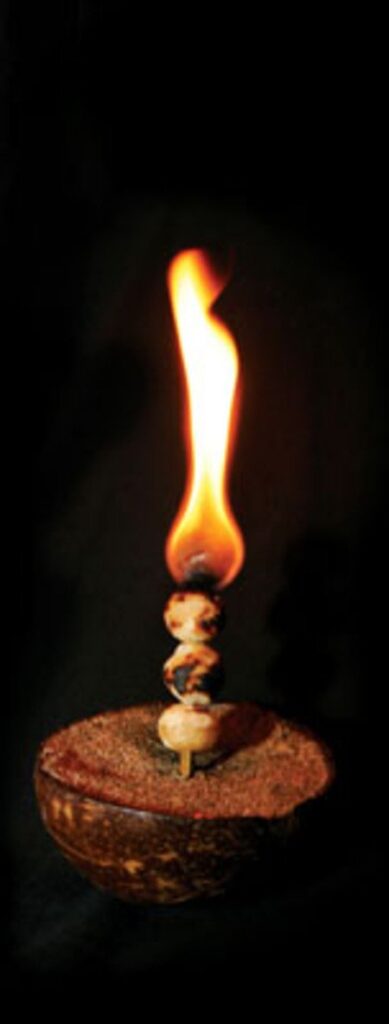
“The oily kernels are dried and strung on a skewer such as a coconut leaf midrib (lama kū – torch.)  Each nut in the string burns for about 3-minutes and emits a somewhat fragrant smoke.”  (CTAHR)

These same more rigid midribs (of coconut frond – or bamboo) furnished the rods on which it was the task of children to string kukui nut kernels; these were burned as candles (lama).  (Krauss)

“When (the Hawaiians) use them in their houses, ten or twelve are strung on the thin stalk of the cocoa-nut leaf, and look like a number of pealed chesnuts on a long skewer.  The person who has charge of them lights a nut at one end of the stick, and hold it up, till the oil it contains is consumed, when the flame kindles on the one beneath it, and he breaks off the extinct nut with a short piece of wood, which serves as a pair of snuffers.  Each nut will burn two or three minutes, and, it attended, give a tolerable light.”  (Ellis, 1826)

“Large quantities of kukui, or candle nuts, were hanging up in long strings in different parts of his house. … Sometimes the natives burn them to charcoal, which they pulverize, and use tattooing their skin, painting their canoes, surf-boards, idols or drums; but they are generally used as a substitute for candles or lamps.”

“When employed for fishing by torchlight, four or five strings are enclosed in the leaves of the pandanus, which not only keeps them together, but adds to the light they give.”  (Ellis, 1826)

“As the sky darkened, men prowled the shallow waters of lagoons with torches and spears. ‘Candles’ were made by stringing dried nutmeats of the oily kukui nut on thin skewers of bamboo.”

“The top nut was ignited, and as it burned out it ignited the nut below it. For a fishing torch, clusters of these candles were lighted and carried in a bamboo tube (candlenut torch.)”  (HPA)

Reportedly, on March 17, 1930, Territorial Governor Lawrence McCully Judd issued a proclamation declaring the coconut palm or niu (Cocos nucifera) the official tree of the Territory of Hawai’i.  (Choy)

But on May 1, 1959, the 30th Territorial Legislature passed Joint Resolution No. 3, which designated the kukui the official tree.  (Choy)  State law, HRS §5-8, designated the Kukui as the State tree.

© 2025 Hoʻokuleana LLC


Filed Under: Economy, General, Hawaiian Traditions Tagged With: Hawaii, Kukui, Canoe Crop

March 20, 2025 by Peter T Young Leave a Comment

Amelia Earhart’s Crash in Hawaii

Amelia Earhart came to Hawaiʻi twice (December 27, 1934 to January 11, 1935 (to make her record flight from Hawaiʻi to the continent) and March 17 through March 20, 1937 (as part of the first plan to fly around-the-world.))

“Over the Christmas holiday (1934,) Amelia Earhart and George Putnam, along with Mr. and Mrs. Paul Mantz, arrived in Honolulu on December 27, having sailed on the Matson liner SS Lurline. Amelia’s Lockheed Vega was secured on the ocean liner’s deck.  The group spent two weeks vacationing in Hawaiʻi.”  She visited Hilo and planted a banyan tree on “Hilo Walk of Fame.”

Five days after planting the banyan tree, she took off from Wheeler Field, Oʻahu and after 18-hours and 15-minutes, Amelia and “Old Bessie, the Fire Horse,” made a perfect landing at Oakland Airport at 1:31, January 12, 1935,  she was engulfed by a cheering crowd of 5,000-enthusiastic supporters.

It was another record flight for Amelia – the very first person, man or woman, to fly solo between Hawaiʻi and the American continent and the first civilian airplane to carry a two-way radio. (Plymate)

A commemorative plaque to honor her trans-pacific solo flight was put up on Diamond Head Road.  Documents of that flight were placed in a copper box and inserted into the plaque’s base on March 6.  It was dedicated on March 14, 1937.

The last Hawaiʻi visit was part of her planned flight around-the-world.  She assembled a team to make an around-the-world flight (navigators Fred Noonan and Captain Harry Manning, as well as technical advisor/assistant navigator Paul Mantz.)  It wouldn’t be the first around-the world flight, but it would be the longest, taking an equatorial route.

They set out from Oakland on St. Patrick’s Day (March 17, 1937) and headed for Hawaiʻi on the first leg of their journey.  After 15-hours and 47-minutes they landed at Wheeler Field.  (From there they would travel on to Howland Island in the South Pacific, and then on to Australia.)  The plane was moved to Luke Field on Ford Island for take-off on the next leg.

“At 3:45 am, March 20, 1937, we opened the Hangar and placed the airplane on the Line. Mrs. Putnam and crew arrived about 4:30 am. Mr. Mantz requested an additional seventy-five gallons of gasoline, making a total of 590 gallons furnished.”

“At 4:45 am Press representatives arrived and established themselves in my office without advance notice. As soon as this was brought to my attention I notified these gentlemen that all telephone charges were to be reversed and positively not charged to me or to the Government. …”

“At 5:00 am Mr. Mantz thoroughly inspected the airplane, tested the engines, and shut them off. The flood lights were turned on and Mrs. Putnam inspected the runway from the cockpit of the airplane.”

“A light rain during the night had wet the runway. The lights were turned off and Mr. Noonan and Mr. Manning boarded the airplane. Mrs. Putnam [Amelia Earhart] started the engines at 5:30 am and at 5:40 am taxied Northeast down the Navy side of the runway to the lower end accompanied by Mr. Young and Mr. Mantz on the ground with flashlights.”

“After Mrs. Putnam had taxied about one-third of the way down the runway a Grumman Amphibian taxied out from the Navy Hangars and followed her airplane down the Field. …”

“The sky toward Honolulu was dark and Koolau Range was barely discernable against the background of dark clouds. Off Barbers Point, however, the sky was surprisingly bright with good visibility. Smoke from two dredges at the mouth of Pearl Harbor was plainly noticeable. A scattered broken ceiling was perhaps 3,000 feet.”

“General Yount assured himself that the crash truck and ambulance were placed on the alert. Mrs. Putnam made a 180 degree left turn at the far end of the runway and momentarily halted the airplane on the center line of the runway.”

“The air being still, there was but the usual lag in sound travel and as soon as the airplane moved forward I heard the steady synchronous roar characteristic of full throttle application.” (Statement of First Lieutenant Donald D. Arnold, Air Corps, Engineering Officer, Hawaiian Air Deport, Luke Field; TIGHAR)

“At 5:53 am on March 20, 1937, she began the take-off roll.  The twin-engine plane gained momentum.  Suddenly, at the 1,000 foot mark the right tire blew.  The strain broke completely the right landing gear sending the Electra severely to one side.”

“Forced into a hard dip, the right wing was badly damaged.  One gas tank was punctured, allowing fuel to spew onto the terrain.  The right engine case was cracked badly and the rear end of the fuselage torn and dented.”

“Cool-headed as ever, Miss Earhart and her flying companions climbed unceremoniously out of the aircraft  They were unhurt, thanks to the pilot’s expert handling of her controls.  Ten seconds more and the plane would have been airborne, lamented the female air-hero!” (Hovart)

“I heard her say to the crew, ‘The ship functioned perfectly at the start. As it gained speed the right wing dropped down and the ship seemed to pull to the right.’”

“‘I eased off the left engine and the ship started a long persistent left turn and ended up where it is now. It was all over instantly. The first thing I thought of was the right oleo or the right tire letting go. The way the ship pulled it was probably a flat tire.’” (Statement of First Lieutenant Donald D. Arnold; TIGHAR)

“On Saturday morning, March 20, I was standing at the edge of the runway approximately half way between each end with a 1 qt. fire extinguisher on the alert in case of an accident.”

“The motors on the Earhart plane sounded as if they were opened up to about half throttle. The plane proceeded up the runway approximately 100 yards when both motors were given full throttle.”

“Very shortly thereafter I noticed a slight tendency to turn to the right, immediately the motors sounded as if one had been slightly reduced in speed.”

“The plane began a turn to the left which was very pronounced and at an angle approximately 45 degrees to parallel with the runway both motors were turned off, the plane proceeded approximately 10 feet and started to turn in a very short circle, the landing gear collapsed and the plane slid backwards a short distance. Then I immediately ran in to render aid.” (Eyewitnees account by EL Heidlebaugh; TIGHAR)

“Within six hours after the crackup, Miss Earhart was aboard the Malolo heading for San Francisco.  ‘I’ll be back,’ she declared determinedly.” (Hovart)

“On May 21, 1937, Amelia Earhart and navigator Fred Noonan began a round-the-world flight, beginning in Oakland, California, and traveling east in a twin-engine Lockheed Electra. They departed Miami on June 1 and reached Lae, New Guinea, on June 29, having flown 21 of 30 days and covered 22,000 miles. They left Lae on July 2 for their next refueling stop, Howland Island.” (Smithsonian)

“The flight was expected to be arduous, especially since the tiny coral atoll was difficult to locate. To help with navigation, two brightly lit US ships were stationed to mark the route. Earhart was also in intermittent radio contact with the Itasca, a U.S. Coast Guard cutter near Howland.”

“Late in the journey, Earhart radioed that the plane was running out of fuel. About an hour later she announced, “We are running north and south.” That was the last transmission received by the Itasca. The plane was believed to have gone down some 100 miles from the island, and an extensive search was undertaken to find Earhart and Noonan.”

“However, on July 19, 1937, the operation was called off, and the pair was declared lost at sea.” (Britannica)

© 2025 Ho‘okuleana LLC

Filed Under: General, Prominent People, Economy Tagged With: Hawaii, Amelia Earhart, Ford Island

March 15, 2025 by Peter T Young Leave a Comment

Mr Takashiba

When we were kids, during the summers, we used to load the jeep and trailer on a Young Brothers’ barge and head to different neighbor islands to camp. After a while, we ended up repeatedly coming to Kona.

On one of those Kona trips, sixty years ago, we headed up mauka and our father got us all out and said we were going to build a house here.  It turns out we ended up building on a different lot, up Donkey Mill Road, the first left after the dip.  We planted macadamia nuts on a 20-acre KSBE lease.  Well, ‘we’ didn’t do the planting, it was all arranged through Mr Takashiba.

Yoshitaka Takashiba was “the son of immigrants from Fukui-ken, Japan, was born on May 23, 1913, in Captain Cook, Kona, Hawaii.”

His father, Koshu Takashiba, a rice farmer in Fukui-Ken, left Japan in about 1909, in search of work, and had intended to go to Canada; rather, they stopped and stayed in Kona.

Koshu Takashiba was Issei (first generation) – born in Japan and emigrated to the Islands from 1885 to 1924 (when Congress stopped all legal migration).   The term Issei came into common use and represented the idea of a new beginning and belonging.

The children of the Issei, like Yoshitaka Takashiba, were Nisei, the second generation in Hawaiʻi and the first generation of Japanese descent to be born and receive their entire education in America, learning Western values and holding US citizenship.

Yoshitaka was the eldest of five children.  In Kona, the family was engaged in coffee farming.  “As a youth, Yoshitaka helped on the family coffee farm and attended Konawaena School.  In 1927, at the age of 14, he quit school to assume more responsibilities on the farm.”

“In 1933, he married Chiyoko, and three years later, began growing and marketing tomatoes to supplement their [coffee] income.  In 1945, he started macadamia nut seedlings which he eventually planted in the fields three years later.”

Mr Takashiba was a man with only an eighth grade education but was a patient pioneer in the macadamia nut industry in Kona and a leader of several agricultural cooperatives.  I learned a lot from him – I suspect to his dismay, though, one of the things I learned was that when I grew up, I was not going to be a farmer.

But Mr Takashiba was a great farmer, friend, and contributor to the future of Kona that we live in now.  He did an oral history interview for the ‘Social History of Kona’ project – I’ll let him tell some more of his story …

“At the time that I was growing up it’s not like now, you can see all the opportunities and you can see what [is available]. Even at the local you can see the mechanics and carpenters, electrician, all that kind.”

“I don’t know how the teenagers now feel but we were not exposed in that kind of opportunities so we didn’t have any idea what our future will be and we weren’t thinking about our future, it’s just day by day.”

“So we weren’t thinking what I will be in the future.  In general, I kind of like growing things so I didn’t think too much about feeling that I want to get out of farming or that sort. … [and] my parents insisted that I should take care of the farm.”

“[T]he coffee was the main production so most of the local farmers were Japanese and like I’m nisei, I was brought up in such that my family came from Fukui-ken and they were farming and they were real conservative.”

“Every inch of the farm was put in production so I was trained in such that every inch of the soil is valuable and most of the farmers, the nisei farmers were taught in such that they were reluctant in cutting any coffee trees.”

“So even how narrow [the farm road] is, even the two coffee trees touched the jeep or whatever the vehicle is, they are forced to go through that line without cutting the coffee trees.”

“[M]ainly the object was to keep the families’ children in the farm. Not as of employing the children. So the families’ children did a lot of work. In fact they did better than the adults did.”

“[I]f you have a teenager then they will start working at the time that their parents start working and they would end up at the time that the parents end up. So in other words, if you work 12 hours then the teenager will work 12 hours, whereas a hired hand will only work eight hours.”

“[W]e were brought up in that locality that most of the farmers, in fact, all of the farmers were Japanese. After we left school our conversation was in Japanese mostly so actually when I went to school the English was not as fluent as of what we spoke Japanese.”

In 1945, Mr Takashiba started getting into macadamia nuts … by 1947 he stopped coffee farming – “Too much labor in picking.”

“[M]y friend coached me that in the future, macadamia nuts might be one of the important product in Kona. So with that two things, sort of encourage me to plant the macadamia nuts.”

“At that time the university, the university experiment station was doing some research on macadamia nuts and they were collecting various variety that were grown in Kona and elsewhere in the state of Hawaii.”

“I was told that the macadamia nuts would not germinate too fast so I had a patch of tomatoes growing and under the tomatoes I started the seedling of macadamia nuts. In other words, I planted the tomatoes and macadamia nut seed at the same time.”

“While the tomatoes were growing, the macadamia nuts were ready to germinate and then it germinated about four months after I planted the seed. So by the time the tomatoes were out of production the macadamia nut plant was just ready to sprout or some were couple inches grown up.”

“Some of [his friends] said, ‘Oh, you damn fool.’ … After I planted my macadamia nut and the university felt that macadamia nuts would be one of the industries for Kona they [university] were propagating a lot of grafted macadamia nuts.”

“And at the start they were selling for $1.50 per plant which was about three to four years old. Some of them bought and planted at that time but at that time that the university was selling the seedlings, I had already planted in my orchard so I didn’t go and buy them.”

“But at the time that they had this macadamia nut grafted and ready to be planted in the orchard, some of them were sold but some were start getting overgrown so they used to give the farmers free. And that’s when quite a number of the farmers planted the macadamia nut because they were getting the plant free.”

“But some of them planted macadamia nut free and as the trees started producing, they weren’t too strong market so they cut all the trees. So when I visit those farmers, they said, ‘Gee, Takashiba, if I had that macadamia nuts I think I would be in the same category with you but damn fool me, I cut the tree. ‘  I think there were a couple of farmers that had cut the trees.”

He got involved with the Kona Macadamia Nut Club that evolved into the Kona Macadamia Nut Cooperative, an organization he later led. (The duty of the cooperative “was to get the farmer’s macadamia nut together and sell to the buyers as a cooperative”.)

“From the very young stage I was real interested in cooperative, I know once I went to a gathering where at that time Japan was real active in cooperatives. … so, I was from the very kid days, I was interested in getting the farmers together and marketing together.”

“For that reason I was real active in this cooperative so I did a lot of sacrificing job. I had a truck, I went out to collect the nuts with my own expense and then market it together to whoever bought the nut from us. That’s how I was involved in that supervisor/manager at the same time.”

“The macadamia nut, we don’t have that world market price [Kona coffee prices were based on Brazilian and Columbian coffee prices] so the [macadamia nut] price was sort of controlled by the buyer. Hawaiian Host is one of the buyer and we have Menehune and Honokaa and Keaau. But the  biggest buyer is Hawaiian Host, Honokaa and Keaau.”

As for his vision of the future … “the Japanese style is that, what do you call, you leave everything for the children. They try work hard and they leave for the children. They wish that, or they try to train the children in such that in the future it will be [a certain way].”

“But I feel that you cannot control the children as much as what you think you’d like to control. And then even you want them to be in a good position, if you cannot support them to get into that position it’s your ability.”

“So my thinking is you should worry about that but I think the main thing is to have them well educated. Then the thing is, if you educate the children as of what you should and from there on I think it’s their ability or their responsibility to get whatever they want to.”

“If they want to be lazy and they have the education and if they don’t want to use the education to get some money then that’s their business not the parents. You cannot tell them you should do this, you should do that and if they don’t do, then how can we control it.”

“So I think beyond that is, we’d like to see them in successful position but I think you cannot push them to do this or to do that.  I think as long as we give them the education then from there on it’s their kuleana.” (Yoshitaka Takashiba)

A successful man, with an eighth-grade education, gets it … the future is framed by working hard and getting an education, and taking personal responsibility for your actions (and occasionally taking some risks).  Yoshitaka Takashiba passed away on August 22, 2011 at the age of 98.

© 2025 Ho‘okuleana LLC

Filed Under: Prominent People, Economy Tagged With: Hawaii, Kona, Coffee, Macadamia Nuts, Yoshitaka Takashiba, Cooperative

  • « Previous Page
  • 1
  • …
  • 17
  • 18
  • 19
  • 20
  • 21
  • …
  • 240
  • Next Page »

Images of Old Hawaiʻi

People, places, and events in Hawaiʻi’s past come alive through text and media in “Images of Old Hawaiʻi.” These posts are informal historic summaries presented for personal, non-commercial, and educational purposes.

Info@Hookuleana.com

Connect with Us

  • Email
  • Facebook
  • LinkedIn
  • Twitter
  • YouTube

Recent Posts

  • Drying Tower
  • Kamehameha’s Wives
  • About 250 Years Ago … Boston Tea Party
  • Kīkā Kila
  • DUKW (Duck)
  • Henry Martyn Whitney
  • About 250 Years Ago … John Kendrick – American Patriot Who Died in Honolulu

Categories

  • Hawaiian Traditions
  • Military
  • Place Names
  • Prominent People
  • Schools
  • Sailing, Shipping & Shipwrecks
  • Economy
  • Voyage of the Thaddeus
  • Mayflower Summaries
  • American Revolution
  • General
  • Ali'i / Chiefs / Governance
  • Buildings
  • Missionaries / Churches / Religious Buildings

Tags

Albatross Al Capone Ane Keohokalole Archibald Campbell Bernice Pauahi Bishop Charles Reed Bishop Downtown Honolulu Eruption Founder's Day George Patton Great Wall of Kuakini Green Sea Turtle Hawaii Hawaii Island Hermes Hilo Holoikauaua Honolulu Isaac Davis James Robinson Kamae Kamaeokalani Kamanawa Kameeiamoku Kamehameha Schools Lalani Village Lava Flow Lelia Byrd Liliuokalani Mao Math Mauna Loa Midway Monk Seal Northwestern Hawaiian Islands Oahu Papahanaumokuakea Marine National Monument Pearl Pualani Mossman Queen Liliuokalani Thomas Jaggar Volcano Waikiki Wake Wisdom

Hoʻokuleana LLC

Hoʻokuleana LLC is a Planning and Consulting firm assisting property owners with Land Use Planning efforts, including Environmental Review, Entitlement Process, Permitting, Community Outreach, etc. We are uniquely positioned to assist you in a variety of needs.

Info@Hookuleana.com

Copyright © 2012-2024 Peter T Young, Hoʻokuleana LLC


Loading Comments...