Images of Old Hawaiʻi

  • Home
  • About
  • Categories
    • Ali’i / Chiefs / Governance
    • American Protestant Mission
    • Buildings
    • Collections
    • Economy
    • Missionaries / Churches / Religious Buildings
    • General
    • Hawaiian Traditions
    • Other Summaries
    • Mayflower Summaries
    • Mayflower Full Summaries
    • Military
    • Place Names
    • Prominent People
    • Schools
    • Sailing, Shipping & Shipwrecks
    • Voyage of the Thaddeus
  • Collections
  • Contact
  • Follow
You are here: Home / Categories

October 18, 2024 by Peter T Young Leave a Comment

Devil Pups

The basis for the name was conceived during World War I when German soldiers gave the United States Marines opposing them in battle the name “Devil Dogs,” because of their battlefield accomplishments and valor of the Marines [and “never give up” spirit].  (Devil Pups)

The Marines who organized this youth citizenship program chose the term “Devil Pups” to describe the quality of teen who can complete this program. (Southern Utah Devil Pup)

“Devil Pups are [14] – to 17-year-old high school students from all over California [and, now, beyond] who assemble each summer here for 10-day physical fitness and citizenship training sessions.  Sometimes the Pups are referred to as junior Marines.”

“They also are taken to Marine training sessions and to firing ranges, where they observe weapon firing, tanks, artillery and aerial  firing. But otherwise they have little contact with firearms.”  (LA Times, Advertiser, Aug 24, 1970)

‘‘The Idea caught on and in the summer of 1954 we were able to send 30 boys to Camp Pendleton for a one-week trial program of training in physical fitness and respect for authority and the flag.’” (San Bernardino County Sun, Aug 20, 1982)

“Duncan Shaw, a Los Angeles Marine Corps reserve officer [and] president of the Devil Pups since it was inaugurated, said, ‘The idea started here when we read of some high school boys who had torn the American flag, kicked it around and generally behaved like idiots.’”

“‘We thought maybe we could do something about it in a small way by starting a health education and citizenship program for teen-agers. … Since then the program has grown and has been most successful.’”

“‘We have liaison officers in each town of any size who work with the Boy Scouts, the Salvation Army and other groups and clubs to select boys for the program. A boy, however,  does not have to belong to a club to get on the program so long as his parents’ permission is given.’”

“‘We are not trying to run a juvenile delinquency school.  Any deserving boy is welcome. We simply put them through a regimented program of health education and citizenship, try to develop a competitive spirit and give them lectures on the American flag and what it means to be an American.’” (Evening Vanguard, Nov 18, 1964)

“One of the more enthusiastic supporters of the Devil Pups program is Richard Charest, 16, of Anaheim, Calif., who was impressed by the physical fitness aspects.  ‘I think we ought to get more of these idiots off the streets – who are fouling up on drugs – and involve them in a program like this.”

“This would clean up the United States. There is a lot of garbage out there in the streets and we ought to clear them out by involving them and teaching them about citizenship and the flag,’ he said.” (LA Times, Advertiser, Aug 24, 1970)

“‘We had considerable trouble with the Devil Pups that first year. Nearly all of them were juvenile delinquents and weren’t about

to be changed in one week. They almost tore their building apart.’”

“‘Today’s Devil Pups are the pick of the crop, from all parts of the community, to be sure, but to be accepted, they must show their interest in the program. Then they are interviewed and and tested physically before they are sent here to camp,’ [Maj. Tom Vener, USMCR] said.” (San Bernardino County Sun, Aug 20, 1982)

The program is not a ‘mini boot camp’ or recruiting organization for the Marine Corps.  The 10-day program is a combination of outdoor physical exercises, inspirational classroom lectures and demonstrations of Marine Corps operations.

The activities during both increments are overseen by our Encampment Commander and his executive staff (employees of Devil Pups, Inc.). Each day, the running, diving, and hiking exercises are balanced with inspiring classroom sessions. The “Role Model” classroom segments are conducted by an assortment of board members, veterans, and Devil Pups alumni. (Devil Pups)

“Since 1954 we have not asked our participants to pay tuition to attend our program. We spend the entire year raising the funds we need which go towards the cost of the camp including counselor fees, food, transportation, clothing, insurance, fundraising, office supplies, and more.”

“Devil Pups, Inc. raises 100% of the funds for 100 youth to attend our camp every year, which is budgeted at a rough cost of $975 per Pup. We want every Pup not to be hindered from acceptance due to financial reasons, and have been doing so since we started 70 years ago. We want them all to have an equal opportunity to participate.”  (Devil Pups)

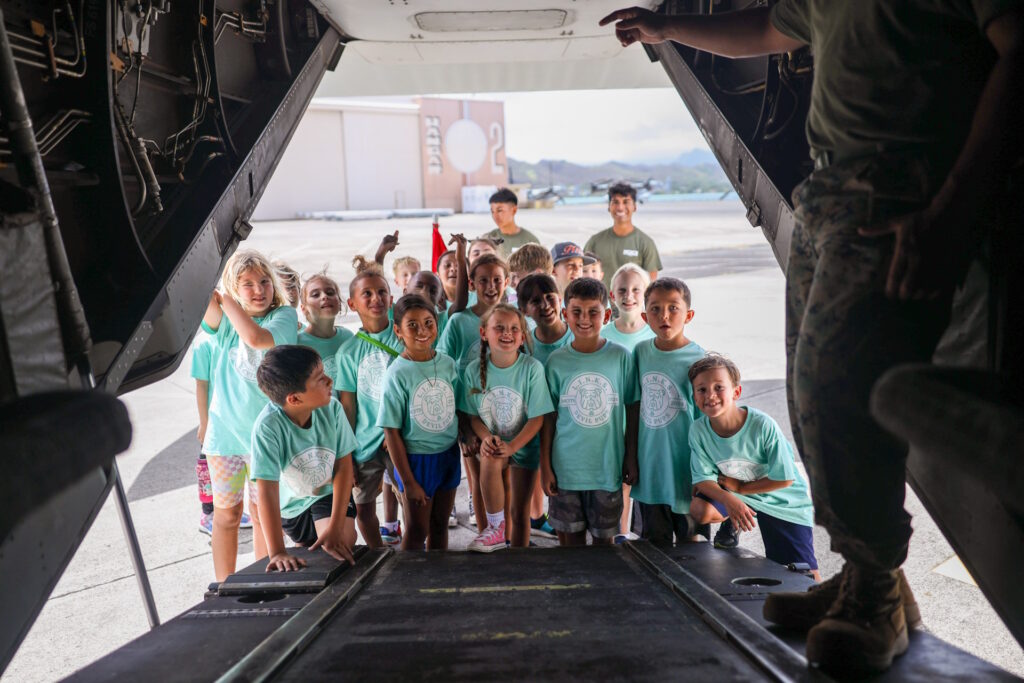
For at least the last couple of years including on August 16, 2024, “The [MCBH Lifestyle Insights, Networking, Knowledge, and Skills (LINKS) program of the] Marine Corps Family Team Building hosted the [Little] Devil Pups workshop, which included a miniature physical fitness test, water gun shooting range, vehicle and aircraft tours, and a readiness class.”

This was for children with parents living or working at MCBH; the MCBH included a Homecoming Run, a resource fair and homecoming sign making.

“The Devil Pups Youth Program For America is all about helping young boys and girls build confidence and learn about responsibility while taking on new challenges.” (U.S. Marine Corps by Lance Cpl. Samuel Estridge)

© 2024 Ho‘okuleana LLC

Filed Under: General, Military Tagged With: Devil Pups, Hawaii, Marine Corps Base Hawaii, MCBH, Marines, Military, Devil Dogs

October 17, 2024 by Peter T Young Leave a Comment

Nāuhi Cabin

The early Polynesian settlers to Hawaiʻi brought sugar cane with them and demonstrated that it could be grown successfully in the islands.

Fast forward … Hawai‘i’s economy turned toward sugar in the decades between 1860 and 1880; these twenty years were pivotal in building the plantation system.

Sugar‐cane farming gained this prestige without great difficulty because sugar cane soon proved to be the only available crop that could be grown profitably under the severe conditions imposed upon plants grown on the lands which were available for cultivation.  (HSPA 1947)

In 1876, the legislature of Kamehameha III passed a law declaring all “forest lands” to be government property in an effort to conserve the forests from further encroachment on the seaward side by the plantations’ need for fuel and on the mountain side from grazing animals.

Founded in 1895, the Hawaiian Sugar Planters’ Association (HSPA), dedicated to improving the sugar industry in Hawai‘i, has become an internationally recognized research center.  (It was in 1996 when HSPA expanded its research interest besides sugarcane and acquired its current name Hawai‘i Agriculture Research Center (HARC), expanding its research on tropical crops and forests.)

Interestingly, it was the sugar growers, significant users of Hawai‘i’s water resources, who led the forest reserve protection movement.  On May 13, 1903, the Territory of Hawaiʻi, with the backing of the Hawaiʻi Sugar Planters’ Association, established the Board of Commissioners of Agriculture and Forestry.  (HDOA)

The Forest Reserves were established as a cooperative arrangement between the Hawaiʻi Sugar Planters Association and the territorial government.

Plantations needed wood for fuel, but they also needed to keep the forests intact to draw mist precipitation from the trade winds, which in turn fed the irrigation systems in the cane fields below.

Their own consumption of fuel had clearly been contributing to the decline of the forest at lower elevations, where flume systems transported large quantities of wood, as well as cane.  (Mills)

The link between tree-planting and the sugar planters can be seen particularly clearly in the career of Harold Lyon, who arrived in Hawai‘i in 1907 as a plant pathologist in the employ of the Hawaiian Sugar Planters’ Association (HSPA).

Lyon was a strong voice for forests; neglect of the islands’ forests would be “suicidal,” for ‘‘everything fails with the failure of our water supply’’.

Johnny Ah San, who worked as a territorial forester, noted, “And then HSPA had a man down at Nāuhi Nursery, and they planted trees. Then before the war [WWII], Roosevelt had the WPA [Works Progress Administration], so the men planted trees in the forest.” (Johnny Ah San; Maly)

The Nāuhi (‘the yams’) facility was interchangeably referred to as a Nursery and Experimental Station (and, apparently, also called Nāuhi Camp). The Hilo Forest Reserve was the site of cooperative reforestation efforts by the HSPA and Territorial foresters and later by the Civilian Conservation Corps under the direction of the Bureau of Forestry.

Over 100 varieties of temperate trees and plants were tested at the Experiment Station at Nāuhi; many of which succeeded to the point of naturally reproducing.

Nāuhi Cabin (a small building with three out-structures) was part of the Nāuhi Gulch Experiment Station, which was established in 1924. It is located in the ahupua‘a of Honohina at about 5,100 feet above sea level.  A nursery that was part of the Experiment Station is no longer standing. (Tuggle)

The purpose of Nāuhi Gulch Experiment Station, which operated until the beginning of World War II, was to “introduce, propagate and plant out in the adjacent forest lands various species and varieties of temperate zone, both northern and southern, trees and other plants”.

To this end, over 78 varieties of fruit trees and over 30 varieties of other temperate zone trees and plants were tested. Surrounding the cabin now is a wild landscape of feral garden flowers like roses, daisies, and nasturtiums, as well as apple, pear, and plum trees.

In 1941, wild pigs in the Nāuhi gulch-Pihā area were noted by Lyon: “Of special interest to us at this time are your remarks regarding the prevalence of wild hogs in the Nāuhi Gulch-Pihā region. They undoubtedly do a great deal of damage there.”

“If, for any reason, this Territory is compelled to produce its own food supply, we could organize a campaign which would remove most of these hogs from the forest and, at the same time, yield a goodly amount of excellent food for our people.” (Tuggle)

The cabin was part of a complex that included several buildings and an orchard on 47 acres of land leased from Lili‘uokalani Trust. In 1945, Territorial forester Bryan reported on the conditions at the by-then abandoned station (Bryan 1945):

“There has been no work done at this station for a considerable period of time, and it is in a run-down state at the present time. Fences are in need of repairs, wild pigs are numerous and have done some damages in the orchard, and it will require considerable labor and effort to bring it back to its former appearance.”

Nāuhi Cabin has been used by the National Biological Survey. Formed in 1993, their mission was to gather, analyze, and disseminate the biological information necessary for the sound stewardship of natural resources and to foster understanding of biological systems and the benefits they provide to society. It is now known as USGS’s Biological Resource Division (BRD).

© 2024 Ho‘okuleana LLC

Filed Under: Economy, General, Place Names Tagged With: Hakalau Forest National Wildlife Refuge, Nauhi Cabin, Hawaii, Hilo

October 16, 2024 by Peter T Young Leave a Comment

October 16

On this date …

In 1758, American lexicographer Noah Webster was born in Hartford, Connecticut.  (Missionaries to Hawai‘i used his teaching technique in turning the Hawaiian language from solely an oral language to also a written form.)

In 1793, during the French Revolution, Marie Antoinette, the queen of France, was beheaded.

In 1859, radical abolitionist John Brown led a raid on the U.S. arsenal at Harpers Ferry in what was then a part of western Virginia. (Ten of Brown’s men were killed and five escaped. Brown and six followers were captured; all were executed.)

In 1962, the Cuban missile crisis began as President John F. Kennedy was informed that reconnaissance photographs had revealed the presence of missile bases in Cuba. (AP)

In the Islands, there were also happy and not-so-happy events on this date …

Victoria Kaʻiulani Kawekiu I Lunalilo Kalaninuiahilapalapa Cleghorn was born on October 16, 1875. She was the only child of Princess Miriam Likelike (the sister to King Kalākaua and Queen Liliʻuokalani).

Ka‘iulani’s father, Archibald Scott Cleghorn, was a Scottish businessman.  At the age of 15, Kaʻiulani was proclaimed Crown Princess of Hawaiʻi by Queen Liliʻuokalani and was a future ruler of Hawaiʻi. (KSBE)

One of her godmothers, Princess Ruth Keʻelikōlani, gave her the famed 10-acre Waikīkī estate, ‘Āinahau, as a birthday.  Originally called Auaukai, Princess Likelike (Kaʻiulani’s mother) named it ʻĀinahau; Princess Kaʻiulani spent most of her life there.

The stream that flowed through ʻĀinahau and emptied into the ocean between the Moana and Royal Hawaiian Hotels (where the present Outrigger Hotel is located,) was called ʻApuakehau (the middle of three rivers that used to run through Waikīkī.)

The family built a two-story home on the estate.  At first the home was used only as a country estate, but Princess Kaʻiulani’s family loved it so much, it soon became their full-time residence.

Kaʻiulani became a friend of author Robert Louis Stevenson.  He had come to Hawaiʻi due to ill health.  In his writings, Robert Louis Stevenson endearingly recalled that Princess Victoria Kaʻiulani was “…more beautiful than the fairest flower.”

He was a frequent guest and used to read passages of poetry to the young Princess under the banyan tree.  Reportedly, the first banyan tree in Hawaiʻi was planted on the grounds of ʻĀinahau.

As many as fifty peacocks, favorites of the young Princess, were allowed to roam freely on the grounds.

Ka‘iulani was the self-proclaimed “favorite niece” of Mr. Charles Reed Bishop, husband of Bernice Pauahi Bishop.

Her aunt, Princess Pauahi, had passed away on Kaʻiulani’s birthday (October 16) in 1884.

Pauahi Pākī was born on December 19, 1831 in Honolulu, Hawai‘i to high chiefs Abner Pākī and Laura Kōnia Pākī. She was the great-granddaughter of Kamehameha I.  (KSBE)

Pauahi was hānai (adopted) to her aunt, Kīnaʻu (the eldest daughter of Kamehameha, who later served as Kuhina Nui as Kaʻahumanu II, a position similar to a Prime Minister.)  Pauahi lived with Kīnaʻu for nearly eight years, then Kīnaʻu died suddenly of mumps (April 4, 1839).

High Chief Caesar Kapaʻakea and his wife High Chiefess Analeʻa Keohokālole had three children, a daughter was Lydia Liliʻu Kamakaʻeha (born September 2, 1838), the onters, as noted were Likelike (Ka‘iulani’s mother) and Kalakaua.

Liliʻu was hānai (adopted) to the Pākīs, who reared her with their birth daughter, Pauahi. The two girls developed a close, loving relationship.

“…their only daughter, Bernice Pauahi … was therefore my foster-sister. … I knew no other father or mother than my foster-parents, no other sister than Bernice.”  (Lili‘uokalani)

They lived on the property called Haleʻākala, in a two-story coral house that Pākī built on King Street.  It was the ‘Pink House,’ (the house was name ʻAikupika (Egypt.))  It later became the Arlington Hotel.

In the months after Queen Liliʻuokalani was overthrown in 1893, Mr. Bishop, Cleghorn, and her kahu, Theophilus Davies, tried to get Kaʻiulani on the throne as a compromise with the newly self-instated Provisional Government in order to maintain Hawaiian leadership in the islands, to no avail. (KSBE)

Sadly, Kaʻiulani died, March 6, 1899.

© 2024 Ho‘okuleana LLC

Filed Under: Ali'i / Chiefs / Governance, Prominent People Tagged With: Hawaii, Princess Ruth, Princess Ruth Keelikolani, Kaiulani

October 15, 2024 by Peter T Young Leave a Comment

Papaʻāpoho

Papaʻāpoho describes a flat area with a depression or hollow, which is how the island of Papaʻāpoho is shaped.  It’s over 1,000-miles from Honolulu.

This 23.4-million-year-old island is over 1.2-miles across and has a land area of approximately 400-acres, making it the third largest island within the Papahānaumokuākea Marine National Monument (to the northwest of the Main Hawaiian Islands.)

Like its name, the island has an elevated rim (its highest point is a 40-foot-high sand dune) surrounding a broad central depression; its lowest point is a depression to the south that runs as a channel toward the ocean.

“This is a low, sandy island, elevated from 20 to 40 feet above the sea. It is about 1 1/4 miles long, and the northern part one mile wide; the surface is covered with green coarse grass.”

“There is what has been a lagoon near the southern part of the island, in the centre of which fresh water was found by digging 5-feet. Birds, fish, seal and turtle abound here, but not so plentiful as at Laysan Island.”  (Paty, Polynesian, June 6, 1857)

At 10 pm, October 15, 1805, Urey Lisiansky (Yuri Fyodorovich Lisyansky,) an officer in the Imperial Russian Navy and commanding officer of the exploratory sloop-of-war Neva, ran aground on the island.  Captain Lisiansky jettisoned some of the ship’s cargo to free themselves from the shallow waters.

“This island promises nothing to the adventurous voyager but certain danger in the first instance, and almost unavoidable destruction in the event. It stands in the middle of a very perilous coral bank, and, exclusive of a small eminence on the eastern part, lies almost on a level with the sea.”  (A Voyage Round the World, Lisiansky, 1805)

 “As there is no water, so neither are any trees to be seen on this island. We found, however, several large trunks of trees on the beach, which, no doubt, had been thrown up by the sea. … They were like the red-wood tree, that grows on the banks of the river Columbia in America. I am at a loss what conclusion to draw from the appearance of these trunks of trees in so remote a place.”  (A Voyage Round the World, Lisiansky, 1805)

“I also found on the beach a small callabash, which had a round hole cut on one side of it. This could not have been drifted from a great distance, as it was fresh and in good preservation.”  (A Voyage Round the World, Lisiansky, 1805)

Before leaving, Lisiansky named the island and shoal; “To the south-east point of the bank where the vessel grounded, I gave the name of Neva; while the island itself, in compliance with the unanimous wishes of my ship’s company, received the appellation of Lisiansky.”  (A Voyage Round the World, Lisiansky, 1805)

The spelling Lisianski (not Lisyansky) was officially adopted by the US Geographic Board, October 1, 1924. Other names by which the island has been called include: Lisiansky, Lysianski, Lassion and Pell.  (Thrum)

In 1857, King Kamehameha IV asked Captain John Paty to make a voyage of exploration to the Northwestern Hawaiian Islands.  In part, he was sent to investigate the possibility of guano deposits on islands there (for fertilizer for the growing agricultural economy back on the Main Hawaiian Islands.

In addition, he confirmed or corrected the existence (or not) of many islands noted on old charts; “A considerable portion of the time absent has been consumed in looking after islands and banks which do not exist, or are erroneously marked on Blunt’s charts.”  (Paty, Polynesian, June 6, 1857)

In the course of his voyage on the schooner “Manuokawai,” on May 11, 1857, Paty took possession of Lisianski Island for the Hawaiian Kingdom (he had previously annexed Laysan, its nearest neighbor, on May 1, 1857.)

In 1890, George D Freeth, an Englishman who had visited the area as early as 1864, and George N Wilcox, who had previously managed a guano operation on Jarvis Island, formed the North Pacific Phosphate and Fertilizer Company.

March 31, 1893, the Provisional Government of the Hawaiian Islands adopted Act 22, confirming the contract between the Minister of Interior and North Pacific for a license for the removal of guano and phosphates from Lisianski (and Laysan.)

Guano mining (1890s,) the release of rabbits (1903) and mice caused ecological damage to Lisianski, as well as the loss of a breeding population of land birds (the Laysan duck was first reported on Lisianski Island in 1828.)

Feather collecting began on Lisianski about 1904. In response to public outcry about the feather trade, Theodore Roosevelt established the Hawaiian Island Bird Reservation, which included Lisianski, in 1909.

An armed party landed on the island in 1910. They arrested feather poachers and confiscated and destroyed about 1.4 tons of feathers, representing 140,400 birds.  (NOAA)

Today, with poaching at an end, the rabbits exterminated, and the vegetation again spreading over its low sandy surface, Lisianski once more is becoming a populous bird sanctuary.  (janeresture)

It is home to a large Bonin petrel colony (over three-quarters of the Bonin Petrels that nest in Hawaii nest here) and sooty tern colony, as well as a variety of other seabirds.

Lisianski has the only grove of Pisonia grandis trees in the entire Hawaiian Archipelago; this tree is dispersed by seabirds and is favored as a nesting site for many tree-nesting seabird species.

The reefs of Lisianski and surrounding Neva Shoals are called “coral gardens” by some scientists because of their abundance of coral and the variety of growth forms assumed by their colonies, including structures resembling spires, castles, and a variety of other shapes.

Hawaiian monk seals and green sea turtles are common visitors to Lisianski’s sandy white beaches. Migratory shorebirds seen on the island include the kolea (golden plover,) ulili (wandering tattler,) and kioea (bristle-thighed curlew.) The volcanic island is undergoing the slow process of erosion.  (NOAA)

Click HERE for a link to a ‘street view’ of Lisianski.

© 2024 Hoʻokuleana LLC


Filed Under: Place Names, Sailing, Shipping & Shipwrecks Tagged With: Yuri Fyodorovich Lisyansky, GN Wilcox, John Paty, Papaapoho, Lisianski, Hawaii, Papahanaumokuakea Marine National Monument, Kamehameha V, NWHI

October 14, 2024 by Peter T Young Leave a Comment

Boiling Pots

There are two rivers in the Hawaiian Islands bearing the name of Wailuku. One is on the Island of Maui, flowing out of a deep gorge in the side of the extinct volcano ‘Īao. The other Wailuku River is on the Island of Hawaii.

The Wailuku is the longest river in Hilo (twenty-six miles.) Its course runs from the mountains to the ocean. The Wailuku is the boundary between Hilo Palikū in the north and Hilo One on the south.

Hawaiians were impressed by this Wailuku and wove a dramatic tale around several interesting geologic features within the river.

Hina, the moon goddess and mother of Maui, lived in the cave beneath Rainbow Falls, concealed by the mist of the falls. Each day she beat and dried her kapa in the sun.

Far above the cave, in the bed of the river, dwelt Kuna. [Kuna is a variety of freshwater eel [or Mo‘o (dragon)] said to have been introduced from abroad. (Parker)]  That portion of the river runs bears to this day the name ‘Waikuna’ or ‘Kuna’s river.’

Kuna often tormented Hina by sending over great torrents of water or by rolling logs and boulders down the stream. This would block the stream below the falls to dam the river and drown Hina.

Hina was frequently left with but little protection, and yet from her home in the cave feared nothing that Kuna could do. Precipices guarded the cave on either side, and any approach of an enemy through the falling water could be easily thwarted.

During a particularly intense storm, Mo‘o Kuna moved a huge boulder over the falls and into the river, where it fit perfectly and prevented water from flowing farther. Water level beneath the falls began to rise.

Hina, realizing her danger, signaled her son. With two powerful strokes, he paddled his canoe from Maui to the mouth of the Wailuku. He rushed upstream and split the damming boulder with a single blow, thereby saving his mother.

By this time, Kuna had fled upstream. Maui found Kuna hiding in a hole beneath the river. He tried to spear Kuna, but Kuna escaped. Finally, Kuna found deep hiding holes and thought to be safe.

Maui again found Kuna and called upon Pele to send lava into the river to drive out Kuna.  The red-hot burning stones in the water made the pools boiling and the steam was rising in clouds – Kuna uttered incantation after incantation, but the water scalded and burned Kuna.

Kuna leaped from the pools and fled down the river. The waters of the pools are no longer scalding, but they have never lost the tumbling, tossing, foaming, boiling swirl which Maui gave to them when he threw into them the red-hot stones with which he hoped to destroy Kuna, and they are known today as the ‘Boiling Pots.’  (Westervelt, USGS)

Despite the name, the water is not normally hot. The only time in the modern history of the river that the water was heated was in 1855 and 1856 when a lava flow from Mauna Loa advanced across the Saddle between that volcano and Mauna Kea. Lava flowed into the Wailuku River channel, but did not cross it, about 4 miles above the Boiling Pots. (BIVN)

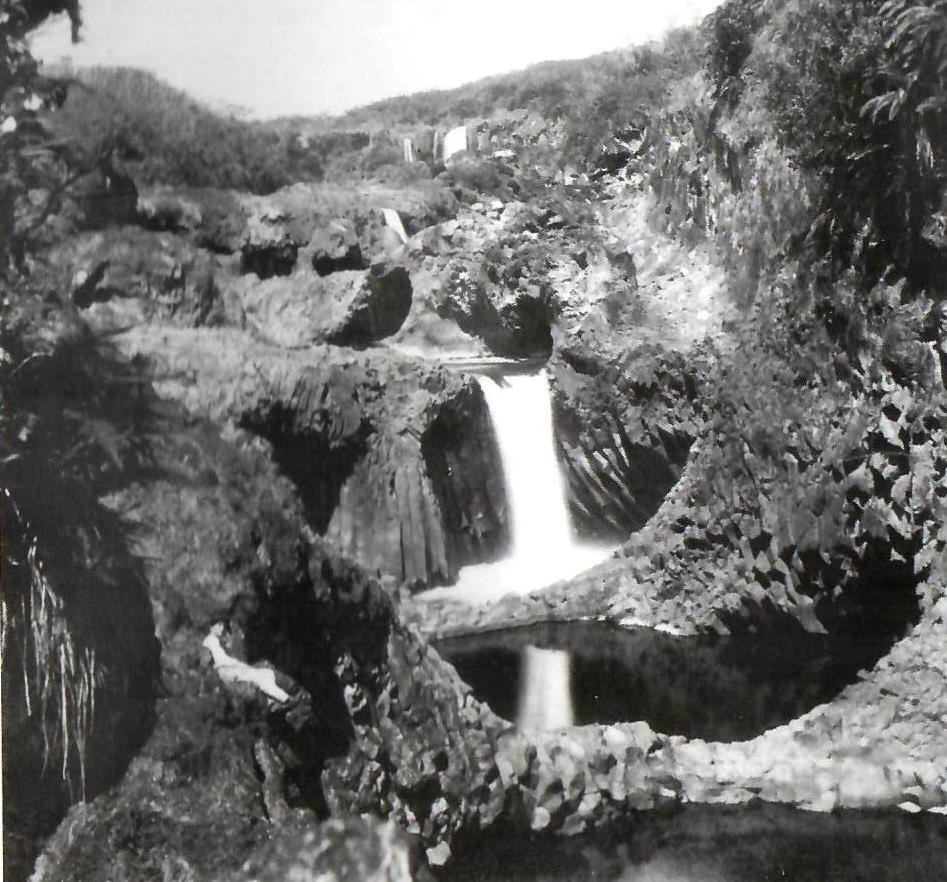
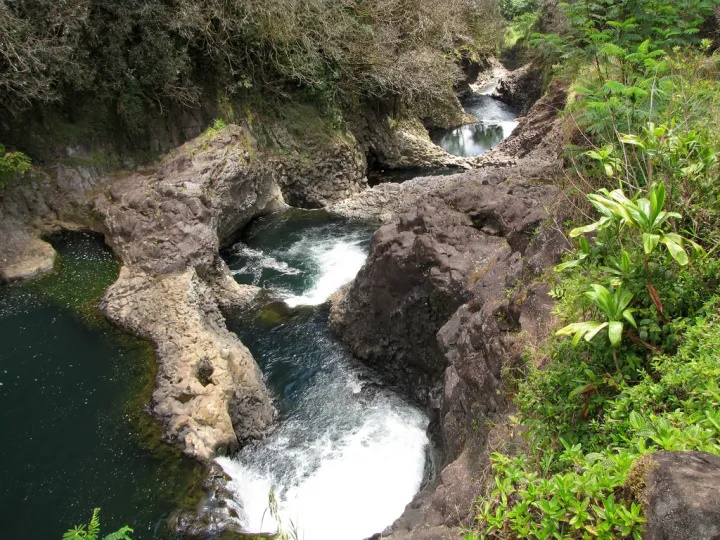
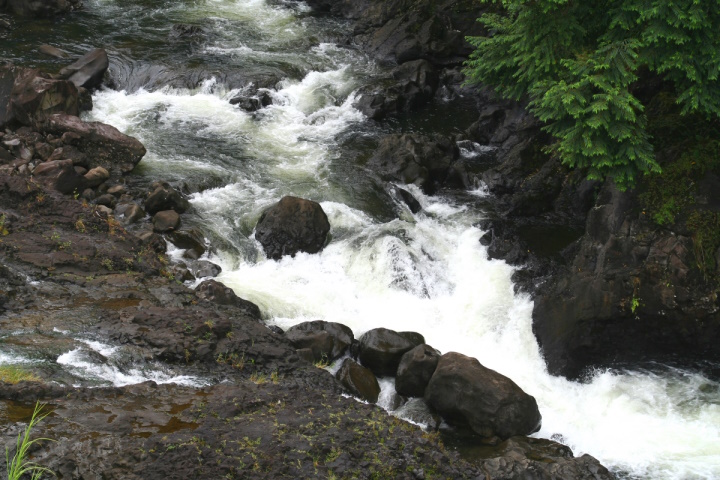
The Boiling Pots is about 1.5 miles upstream from Rainbow Falls and is a succession of eroded, hollowed out terraced pools that fill with the flow of the river. When the river is engorged with storm runoff, the ‘pots’ fill to the brim, become turbulent and appear to ‘boil.’  (HawaiianAir)

The Wailuku River is an important landmark to geologists, because it marks the approximate boundary between the lava flows of Mauna Kea and Mauna Loa. It is the state’s longest river and the southernmost that carries water all year.

According to the USGS, the river was formed by at least two lava flows coming from Mauna Kea, the oldest, the ‘Anuenue flow (as old as 10,500 years), is the same flow that formed the thick lip of Rainbow Falls and most of the rounded, gray boulders at Boiling Pots.

Tracing the flows up and down the Wailuku tells a geologic story of a river that had already deeply cut into Mauna Kea and Mauna Loa flows when it was filled by the ‘Anuenue flow over 10,000 years ago. Many of these boulders are frozen into a younger pahoehoe flow, named after the Punahoa ahupua‘a and about 3,100 years old.

The filling caused the river to shift in many places and resume its erosional downcutting before lava again ventured into the river 3,100 years ago. (The Hawaiian and the geologic versions of the Wailuku River story have many similarities, including the pools – ‘pots.’ (USGS)

The pots, each about 50-feet in diameter, are eroded into the 10,500 year old Mauna Loa lava flow. When the water is low, the river does not flow over some of the pot rims but it continues to flow through them. (USGS)

An average of 275-million gallons of water flows through the Wailuku to Hilo daily – during intense storms, the discharge can be more than 20 times greater. On average, the Wailuku transports approximately 10 tons of suspended sediment into Hilo Bay each day.

About a half mile up the river from the boiling pots is Peʻepeʻe Falls.  Waiānuenue Avenue (rainbow (seen in) water) is named for the most famous waterfall, Ka Wailele ʻO Waiānuenue, Rainbow Falls on the Wailuku River.

DLNR operated the Wailuku River State Park, here. There are two separate park areas, Boiling Pots and Rainbow Falls. Flash flooding is common, and because there are no lifeguards, many have perished in the river by getting sucked into the water and becoming trapped within concealed lava tubes and caves.

The best way to experience this beautiful and deadly natural phenomena is from a cement overlook, just a short walk from the paved parking lot.

© 2024 Ho‘okuleana LLC

Filed Under: General, Place Names Tagged With: Hawaii, Hilo, Wailuku River, Boiling Pots

  • « Previous Page
  • 1
  • …
  • 101
  • 102
  • 103
  • 104
  • 105
  • …
  • 663
  • Next Page »

Images of Old Hawaiʻi

People, places, and events in Hawaiʻi’s past come alive through text and media in “Images of Old Hawaiʻi.” These posts are informal historic summaries presented for personal, non-commercial, and educational purposes.

Info@Hookuleana.com

Connect with Us

  • Email
  • Facebook
  • LinkedIn
  • Twitter
  • YouTube

Recent Posts

  • The Alii, the Missionaries and Hawaii
  • Canec
  • Flying the American Flag
  • April Fool
  • Beauty Hole
  • Junior … Intermediate … Middle
  • Ossipoff Meets Mid-19th Century

Categories

  • General
  • Ali'i / Chiefs / Governance
  • Buildings
  • Missionaries / Churches / Religious Buildings
  • Hawaiian Traditions
  • Military
  • Place Names
  • Prominent People
  • Schools
  • Sailing, Shipping & Shipwrecks
  • Economy
  • Voyage of the Thaddeus
  • Mayflower Summaries
  • American Revolution

Tags

Albatross Al Capone Ane Keohokalole Archibald Campbell Bernice Pauahi Bishop Charles Reed Bishop Downtown Honolulu Eruption Founder's Day George Patton Great Wall of Kuakini Green Sea Turtle Hawaii Hawaii Island Hermes Hilo Holoikauaua Honolulu Isaac Davis James Robinson Kamae Kamaeokalani Kameeiamoku Kamehameha Schools Lalani Village Lava Flow Lelia Byrd Liberty Ship Liliuokalani Mao Math Mauna Loa Midway Monk Seal Northwestern Hawaiian Islands Oahu Papahanaumokuakea Marine National Monument Pearl Pualani Mossman Quartette Thomas Jaggar Volcano Waikiki Wake Wisdom

Hoʻokuleana LLC

Hoʻokuleana LLC is a Planning and Consulting firm assisting property owners with Land Use Planning efforts, including Environmental Review, Entitlement Process, Permitting, Community Outreach, etc. We are uniquely positioned to assist you in a variety of needs.

Info@Hookuleana.com

Copyright © 2012-2024 Peter T Young, Hoʻokuleana LLC


Loading Comments...