Images of Old Hawaiʻi

  • Home
  • About
  • Categories
    • Ali’i / Chiefs / Governance
    • American Protestant Mission
    • Buildings
    • Collections
    • Economy
    • Missionaries / Churches / Religious Buildings
    • General
    • Hawaiian Traditions
    • Other Summaries
    • Mayflower Summaries
    • Mayflower Full Summaries
    • Military
    • Place Names
    • Prominent People
    • Schools
    • Sailing, Shipping & Shipwrecks
    • Voyage of the Thaddeus
  • Collections
  • Contact
  • Follow

January 13, 2023 by Peter T Young Leave a Comment

1960 Kapoho Eruption

The eruption in Kilauea Iki had ended on December 21, but the shallow reservoir beneath the summit of Kilauea volcano was gorged with magma. Rather than removing pressure, the eruption had, for all intents and purposes, created more.

The end of 1959 was an uneasy time for the staff at the Hawaiian Volcano Observatory.  During the last week of the year, a swarm of earthquakes started in Pāhoa (more than 1,000 earthquakes were recorded by the Pāhoa station on January 12.)

The 1960 Kapoho eruption and its predecessor, the 1959 summit eruption in Kilauea Iki Crater, together formed a summit-flank sequence. The Kapoho eruption caused havoc in lower Puna, an idyllic rural community until the lava fountains and flows covered farm land and villages.

The size and frequency of the earthquakes increased; at 8 am, January 13, the ground was severely cracked along the fault through Kapoho town.  Movement along the fault was literally pulling the town apart.

The ground was constantly shaking. The roughly 300-residents undertook voluntary evacuation, which was completed by early evening.  At 7:35 pm, January 13, 1960, a red glow above Kapoho confirmed the start of the eruption.

Within half an hour, fountaining was nearly continuous along a nearly ½ – mile long fissure.  After a couple hours, the activity focused with central fountains – for the next 11-hours powerful steam blasts roared from the vents.

The resulting fallout coated everything with a thin film of fine, wet, glassy ash. Salt crystals formed as the water evaporated; they testified to the brackish nature of the groundwater.

By noon on January 14, the steam blasts had ended and lava fountaining was confined to many sources along a 650-foot long section of the fissure.  An ʻaʻa flow, 18-feet thick and nearly 1,000-feet wide reached the ocean – a bench formed 300-feet beyond the old shoreline.

In an attempt to save Warm Springs, bulldozers pushed a rock dike; shortly after, lava overtopped it and filled the pool.

Kapoho, a bit uphill of the fissure, was near all this activity but had not been touched by lava. Pumice and lava were wreaking havoc on nearby homes and farms (papaya, coconut, orchid and coffee groves.)

ʻAʻa continued to enter the ocean; it was also spreading southward.  Bulldozers worked in forming a barrier to protect Kapoho, Kapoho School, an area of expensive homes and real estate at Kapoho Beach Lots.  By January 20, lava had reached the barrier and overtopped it on January 23; a second barrier was shoved aside on January 27.

A third barrier held the flow, but lava then moved underground, beneath the end of the barrier, emerging near Kapoho School. The buildings began to burn at 10 am and the school was lost shortly after noon.

The barrier itself remained intact, and it survived until February 5, when it was finally overtopped and almost totally buried by lava that eventually covered the Kapoho cemetery.  More coastal houses were lost.

Despite notable developments in the vent area, Kapoho village remained virtually intact except for a blanket of pumice and ash that covered everything.

For seven hours on the afternoon of January 27, the heaviest pumice fall of the entire eruption rained down on the area during strong kona winds.

However, it was the lava flow that would doom the town.

Late that night, the rapidly moving ʻaʻa flow moved through the streets, overwhelmed building after building. By midnight January 27, most of Kapoho had been destroyed; a couple days later (January 30) the town was gone.

The eruption ended slowly. Dribbles of lava continued to enter the sea north of Cape Kumukahi as late as February 13. High fountains continued until February 15, when lava was spraying upward from the main vent area to heights of 600-feet.  It gradually subsided and on the morning of February 19, the eruption stopped.

Volcanologists concluded that the Kapoho eruption was tied to events at Kilauea’s distant summit.  On January 17, four days after the Kapoho eruption had started, the summit began to subside (deflate, by analogy with a balloon) as magma was leaving the storage reservoir and heading down the east rift zone to the Kapoho area.

The eruption was the first during the modern era of volcano monitoring at Hawaiʻi Volcanoes Observatory. As a result, probably more fundamental ideas were reached from it than from any other single eruption in Hawaiʻi.

The main lesson, and really the only one that bears repeating over and over again, is clear. What happened then will happen again. That lesson should never be lost.  (All information here is from USGS.)

© 2022 Hoʻokuleana LLC

Filed Under: General, Place Names Tagged With: Volcano, Warm Springs, Waiwelawela, Puna, Kapoho, Cape Kumukahi, Pahoa, Kilauea Iki, Kilauea, Hawaii

October 20, 2022 by Peter T Young Leave a Comment

Pāhoa

Early settlement patterns in the Islands put people on the windward sides of the islands, typically along the shoreline.  However, in Puna on the Island of Hawaiʻi, much of the district’s coastal areas have thin soils and there are no good deep water harbors. The ocean along the Puna coast is often rough and windblown.

As a result, settlement patterns in Puna tend to be dispersed and without major population centers. Villages in Puna tended to be spread out over larger areas and often are inland, and away from the coast, where the soil is better for agriculture.  (Escott)

This was confirmed on William Ellis’ travel around the island in the early 1800s, “Hitherto we had travelled close to the sea-shore, in order to visit the most populous villages in the districts through which we had passed. But here receiving information that we should find more inhabitants a few miles inland, than nearer the sea, we thought it best to direct our course towards the mountains.”  (Ellis, 1823)

An historic trail once ran from the modern day Lili‘uokalani Gardens area in Hilo to Hāʻena along the Puna coast. The trail is often referred to as the old Puna Trail and/or Puna Road. There is an historic trail/cart road that is also called the Puna Trail (Ala Hele Puna) and/or the Old Government Road.

This path was essentially the main thoroughfare through the Puna district before the late-1800s.  Pāhoa was oʻioʻina (a resting place) on the trail.  (Papakilo)  Then it grew to become the principal town of lower Puna.

The evolving trail (first by foot, then by horse, cart and buggy, and finally by automobile) likely incorporated segments of the traditional Hawaiian trail system often referred to as the ala loa or ala hele.  (Rechtman)

The full length of the Puna Trail, or Old Government Road, might have been constructed or improved just before 1840. The alignment was mapped by the Wilkes Expedition of 1804-41.  (Escott)

People who traditionally had lived along the Puna coast were moving toward Hilo and into the more fertile upland areas of Puna in order to find paid work and to produce cash crops for local markets and for export.

The focus began to shift to the center of the Puna District and the developing sugar and related industries near ʻŌlaʻa, Hilo and the volcano region.

Before the turn of the century, railroad operations began – with lines running into Hilo. A main railroad line and several feeder lines were constructed in the early-1900s from Keaʻau to locations in lower Puna District.

The major line ran from Hilo through Keaʻau to the Kapoho area.  A branch line ran from the ʻŌlaʻa Sugar Mill up past present day Glenwood. A second branch line ran to Pāhoa town.

Some suggest this is how Pāhoa received its name.  “Then the train was put in from Hilo to Puna. One spur went up into Pāhoa; it was like a dagger into the forest. I‘m told this is how Pāhoa got its name. (Pāhoa means dagger.)”  (Edwards; Cultural Surveys)

People began to work in the inland areas to grow sugarcane. The new road, the Pāhoa branch of the railroad, sugarcane agriculture and a logging venture all combined to create Pāhoa as a population center in the region.  (Rechtman)

Macadamia nuts and papaya were introduced in 1881 and 1919; at the turn of the century, large-scale coffee cultivation was attempted.  Over 6,000-acres of coffee trees were owned by approximately 200-independent coffee planters.

This fledgling industry couldn‘t compete with more successful ventures located in other districts, and after a few decades the coffee industry in Puna was abandoned.  (Cultural Surveys, Rechtman)

By 1901, sugar dominated the island’s industry and landscape, and Hilo was the epicenter of production and export. Railroads connected sugar mills and sugar plantations in Hilo, the Hāmākua and Puna. The railroad also connected the mills to the wharves at Hilo Bay.

Early on, one of the major export items transported by the railroad was timber.  Starting in 1907, the Hawaiian Mahogany Company began cutting trees to clear land for sugarcane. The logs were brought to Pāhoa Town to be milled, then sent to Hilo Harbor and eventually shipped to the US Mainland as railroad ties for the Santa Fe Railroad.

The lumber mill facilities and the railroad line that served them were located near the center of town where the Akebono Theater is located.

In 1909, the company was renamed Pāhoa Lumber Company. In 1913, the main mill facilities were lost in a fire; it was rebuilt that year the company was renamed the Hawaiian Hardwood Company.

The company closed down in 1916 when the Santa Fe Railroad ended its contract to buy lumber. The defunct company then leased its mill facilities, buildings and railroad tracks to the expanding ʻŌlaʻa Sugar Company.  (Rechtman)

Today, Pāhoa Town has a main street – the former highway route before the construction of the by-pass road – that still retains much of the original street-wall of plantation-era structures, as well as some significant stand-alone buildings.

Most of the uses are commercial or civic.  The County has acquired a large tract of land within Pāhoa Town, which presents a significant opportunity for community revitalization and a possible catalyst for economic activity.  (Puna CDP)

© 2022 Hoʻokuleana LLC

Filed Under: Economy, General, Place Names Tagged With: Hawaii, Hawaii Island, Puna, Pahoa, Sugar, Coffee, Macadamia Nuts

November 3, 2018 by Peter T Young 1 Comment

Kaimū

The name literally means ‘gathering [at the] sea [to watch surfing].’ This land section and village, at Kalapana, Hawaiʻi, was noted for its surf and its black sand beach. The black sand was formed by steam explosions that occurred when a lava flow entered the ocean in about 1750. (Pukui)

“Kaimu is pleasantly situated near the sea shore, on the SE side of the island, standing on a bed of lava considerably decomposed, and covered over with a light and fertile soil. It is adorned with plantations, groves of cocoa-nuts and clumps of kou trees.”

“It has a sandy beach, where canoes may land with safety; and according to the houses numbered to-day contains 725 inhabitants. Including the villages in the immediate vicinity, along the coast, the populations would probably amount to 2,000; and, if water could be procured near at hand, it would form an eligible missionary station.”

“There are several wells in the village, containing brackish water, which has passed from the sea, through the cells of the lava, undergoing a kind of filtration, and it is collected in hollows scooped out to receive it. The natives told us, that, at the distance of about a mile, there is plenty of fresh water.” (Ellis from 1823)

“The most important reason that settlement in the Kalapana area was on the coast was the availability of fresh food from the sea. Fishing was on the shore, which also hosted gathering of shellfish, crabs and limu, and from canoes.”

“Taro and breadfruit were major crops of the better watered coastal areas in the east but especially in the forested uplands. Bananas, sugar cane, and ‘awa were also grown in the uplands.” (Hawai‘i County)

“We passed a potato patch in the broken lava which exceeded anything I had seen. Not a particle of soil was anywhere to be seen, and the holes dug among the stones to receive the potatoes were some of them six feet in depth-thus securing a degree of moisture and shelter from the sun-though no more soil than at the surface.”

“There are but few people in this region. They are miserably poor, & for some time past have been almost in a state of famine. They get their living by fishing, making salt, & getting fern roots & a few potatoes in the mountains.”

“Their salt works are on the naked lava near the sea, the water of which is evaporated in little cups or vessels made of the Ki leaf & holding of course but a minute quantity of water.”

“These are laid in parallel rows over several acres, & the water poured into them a little at a time from Calabashes. The process is an extremely slow one, tho’ the salt is s[aid] to be excellent for the table. It is sold at the exceedingly low prices of 25 cts a bag, which will contain I sh’d judge ½ a bushel or more” (Chester Lyman, 1846)

“At the beach the road enters first the village of Kaimu, exclusively Hawaiian, with a large grove of cocoanut trees surrounding a fine semi-circular sand beach. Care should be exercised in bathing on account of the under tow.”

“Less than a mile further on, westwards, lies the village of Kalapana, one of the largest Hawaiian villages in the Islands. There are no white inhabitants, and only a couple of Chinese stores. Here is the headquarters for a couple of stages, which make irregular trips to Pahoa (Rate: 75 cents a passenger one way.)” (Kinney, 1913)

The district of Puna is distinguished as one of the least awarded private lands from the 1848 Māhele and Kuleana Act. Only 19 awards of private land were made in the entire district.

Of these, 16 awards were made in large tracts to 10 chiefs who lived outside of Puna, and three small parcels were granted, to commoners Baranaba, Hewahewa and Haka (Territory of Hawai`i 1929.)

The small number of land awards was not because Puna had a small population. In 1854, four years after the Kuleana awards were granted, the estimated population for Puna was 2,702 (Hawaii Mission Children’s Library 1854.)

Moreover, the 1858 tax records for Puna shows that 894 males over the age of 20 paid poll taxes in Puna ten years after the deadline for filing for land awards (Hawai‘i State Archives 1858.)

An examination of the possible reasons why almost the entire population of Puna did not enjoy the benefits of the Māhele and Kuleana Act lends an understanding of why Hawaiians living in the district remained outside of the mainstream of Hawai`i’s economic and social development.

First, Puna was isolated from the mainstream of economic, social and political developments. It is possible that the Hawaiians in Puna were not aware of the process or did not realize the significance of the new law.

Second, it is possible that the Puna Hawaiians did not have a way to raise the cash needed for the land surveys, which cost between $6 to $12. Wages at the time were normally between 12 1/2 cents and 33 cents a day.

However, there were few wage-earning jobs in Puna. Cash would have to be raised from selling extra fish or other products, which was difficult given the subsistence living of many Hawaiians.

Third, at least some Puna Hawaiians filed their land claims after the deadline. In an 1851 petition to the legislature, several Puna residents asked to be issued land grants without penalty, as they had filed their claims after February 14, 1848 (Allen 1979).

Under the Māhele, the bulk of Puna lands were designated as public lands either to the monarchy, as “Crown” lands or to the government of the Hawaiian Kingdom. (McGregor)

In March 1990, Kīlauea’s ongoing Puʻu ʻŌʻō-Kupaianaha eruption (that began on January 3, 1983) entered its most destructive period of the 20th century when lava flows turned toward Kalapana, an area cherished for its historic sites and black sand beaches.

By the end of the summer, the entire community, including a church, store, and 100 homes, were buried beneath 50-80 feet of lava.

As the lava flows advanced eastward, they took to the sea, replacing the palm-lined Kaimū Bay with a plain of lava that now extends nearly 1,000-feet beyond the original shoreline.

In late 1990, a new lava tube finally diverted lava away from Kalapana and back into the National Park. (USGS)

Follow Peter T Young on Facebook 

Follow Peter T Young on Google+ 

Follow Peter T Young on LinkedIn  

Follow Peter T Young on Blogger

© 2018 Hoʻokuleana LLC

Kaimu-Beach-lava entering
House_at_Kaimu,_Hawaii,_in_1888-WC
Black_Sand_Beach_1959-WC
Young woman at Kaimu Black Sand beach, Kalapana-PP-29-10-017-1935
Two young women on Kaimu Black Sand beach, Kalapana-HAL_Promotion-PP-29-10-019
Kaimu Black Sand Beach, Kalapana-PP-29-9-002
Kaimu Beach-1915
Kaimu Beach-1915
Sunrise at Kaimu Black Sand beach, Kalapana-PP-29-10-002
Kaimu Black Sand Beach, Kalapana-PP-29-10-008
Kaimu Black Sand Beach, Kalapana-PP-29-9-003
Kaimu Black Sand Beach, Kalapana-HVB-PP-29-9-006
Pauline Wessel on Kaimu Black Sand beach, Kalapana-PP-29-10-023-1935
Kalapana Store-pre-lava flow
Kalapana Lava flow-USGS-1990
Kalapana Store-post-lava_flow
Kalapana Store-post-lava flow
Kaimu Black Sand Beach, Kalapana
New_Beach_on_Kaimu_Bay_2009-WC

Filed Under: General, Place Names Tagged With: Hawaii, Hawaii Island, Volcano, Puna, Kalapana, Puu Oo, Kaimu

September 22, 2018 by Peter T Young Leave a Comment

Ka ua moaniani lehua o Puna

The rain that brings the fragrance of the lehua of Puna (Pukui 1983:172, verse 1587)

Puna is known for its groves of hala and ʻōhiʻa-lehua trees. This ʻōlelo no‘eau refers to the forests of Puna, which attract clouds to drench the district with many rains, refreshing and enriching the Puna water table, and sustaining the life cycle of all living things in Puna. (McGregor)

While the Puna moku (district) does not have running streams, it does have many inland and shoreline springs continuously fed by rains borne upon the northeast tradewinds. (McGregor)

Another ‘Ōlelo Noe‘au notes “Puna paia ʻala i ka hala. Puna, with walls fragrant with pandanus blossoms. Puna, Hawai’i, is a place of hala and lehua forests.

In olden days the people would stick the bracts of hala into the thatching of their houses to bring some of the fragrance indoors. (Pukui 1983:301, verse 2749)

“Puna on Hawaiʻi Island was the land first reached by Pāʻao, and here in Puna he built his first heiau for his god Ahaʻula and named it Ahaʻula [Wahaʻula.]”

“It was a luakini (large heiau where human sacrifice was offered). From Puna, Pāʻao went on to land in Kohala, at Puʻuepa. He built a heiau there, called Moʻokini.” (Kamakau)

One story tells that Hāʻena, a small bay near the northern boundary of Puna, is said to be the birthplace of hula. The goddess Hiʻiaka is said to have been instructed to dance hula on the beach there.

Puna is said to inspire hula because of the natural movements of waves, wind and trees. (Other stories suggest hula was started in other areas of the Islands.) (McGregor)

Early settlement patterns in the Islands put people on the windward sides of the islands, typically along the shoreline. However, in Puna, much of the district’s coastal areas have thin soils and there are no good deep water harbors. The ocean along the Puna coast is often rough and windblown. (Escott)

As a result, settlement patterns in Puna tend to be dispersed and without major population centers. Villages in Puna tended to be spread out over larger areas and often are inland, and away from the coast, where the soil is better for agriculture. (Escott)

This was confirmed on William Ellis’ travel around the island in the early 1800s, “Hitherto we had travelled close to the sea-shore, in order to visit the most populous villages in the districts through which we had passed.”

“But here receiving information that we should find more inhabitants a few miles inland, than nearer the sea, we thought it best to direct our course towards the mountains.” (Ellis, 1826)

Alexander later (1891) noted, “The first settlement met with after leaving Hilo by the sea coast road, is at Keaʻau, a distant 10 miles where there are less than a dozen inhabitants …”

“… the next is at Makuʻu, distant 14 miles where there are a few more, after which there is occasionally a stray hut or two, until Halepuaʻa and Koaʻe are reached, 21 miles from Hilo, at which place there is quite a village”. (Alexander in Escott)

“Nearly all the food consumed by the residents of this District is raised in the interior belt to which access is had by the ancient paths or trails leading from the sea coast.”

“The finest sweet potatoes are raised in places that look more like banks of cobble stones or piles of macadam freshly dumped varying from the size of a walnut to those as large as ones fist. In these holes there is not a particle of soil to be seen”. (Alexander, 1891)

Puna was famous as a district for some of its valuable products, including “hogs, gray tapa cloth (‘eleuli), tapas made of māmaki bark, fine mats made of young pandanus blossoms (‘ahuhinalo), mats made of young pandanus leaves (ʻahuao), and feathers of the ʻōʻō and mamo birds”. (McGregor)

An historic trail once ran from the modern day Lili‘uokalani Gardens area to Hāʻena along the Puna coast. The trail is often referred to as the old Puna Trail and/or Puna Road. There is an historic trail/cart road that is also called the Puna Trail (Ala Hele Puna) and/or the Old Government Road. (Escott)

It likely incorporated segments of the traditional Hawaiian trail system often referred to as the ala loa or ala hele. The full length of the Puna Trail, or Old Government Road, might have been constructed or improved just before 1840. The alignment was mapped by the Wilkes Expedition of 1804-41. (Escott)

With Western contact, extensive tracts of Puna’s landscape were transformed, first with sandalwood export, which began in 1790 and reached its peak between 1810 and 1825. (Puna CDP)

After Hawai‘i’s first forestry law in 1839 restricted the removal of sandalwood trees, cattle ranching and coffee cultivation became the leading commercial activities. By 1850, agriculture diversified with the cultivation of potatoes, onions, pumpkins, oranges and sugar molasses. (Puna CDP)

Before 1900, coffee was the chief agricultural crop in the area. Over 6,000-acres of coffee trees were owned by approximately 200-independent coffee planters and 6 incorporated companies. (HSPA)

Soon, sugarcane was in large-scale production. The dominant operation in Puna was the Puna Sugar Company, whose plantation fields extended for ten miles along both sides of Highway 11 between Keaʻau and Mountain View, as well as in the Pāhoa and Kapoho areas.

Initially founded in 1899 as Olaʻa Sugar Company, it was later (1960) renamed Puna Sugar Company. The coffee trees were uprooted to make way for sugarcane.

ʻŌhiʻa forests also had to be cleared, field rock piled, land plowed by mules or dug up by hand with a pick. Sugarcane was in large-scale production; the sugar mill operation ran for just over 80 years, until 1984.

Macadamia nuts and papaya were introduced in 1881 and 1919, respectively. Since the closure of the Puna Sugar Company, papaya and macadamia nut production have become the leading crops of Puna. About 97% of the state’s papaya production occurs in Puna, primarily in the Kapoho area.

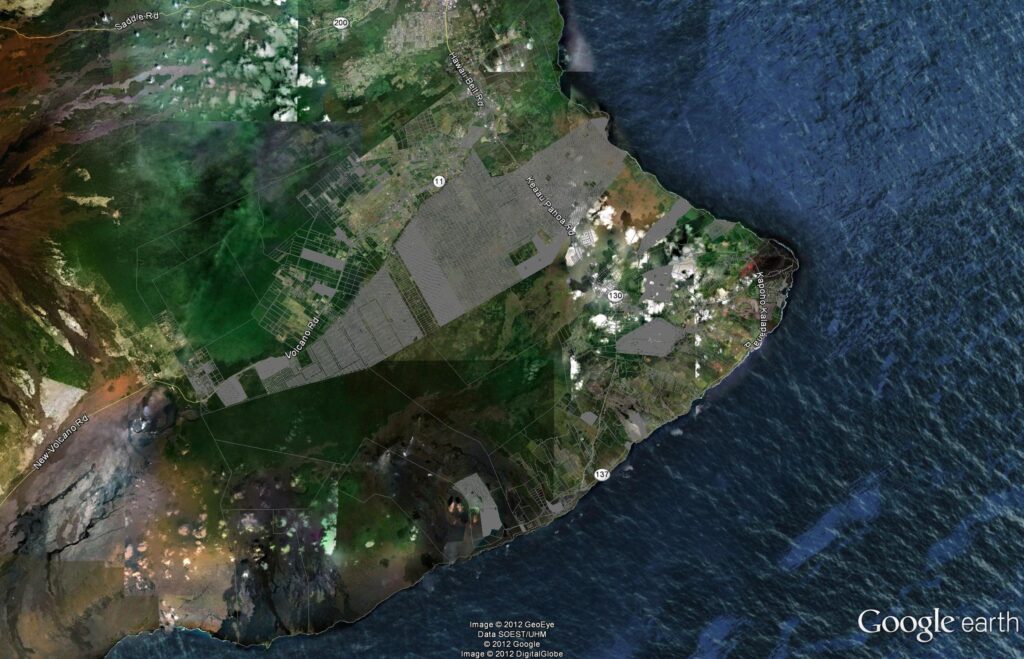
Another thing growing in Puna is housing. Between 1958 and 1973, more than 52,500-individual lots were created – at least 40-substandard Puna subdivisions were created.

As a comparison, Oʻahu is about 382,500-acres in size; the district of Puna on the island of Hawaiʻi is about 320,000-acres in size – almost same-same.

Follow Peter T Young on Facebook 

Follow Peter T Young on Google+ 

Follow Peter T Young on LinkedIn  

Follow Peter T Young on Blogger

© 2018 Hoʻokuleana LLC

Forest_Scenery-Puna,-(WC)_c._1884
Hawaiian_Paradise_Park-8,800-lots-GoogleEarth
Puna_District-showing_parcels-GoogleEarth
Puna-Non-Conforming_Subdivisions-(Puna_CDP)-Map

Filed Under: Hawaiian Traditions, Place Names Tagged With: Ohia, Hala, Hawaii, Hawaii Island, Puna, Lehua

May 5, 2018 by Peter T Young Leave a Comment

E Nihi ka Helena i ka Uka o Puna

Walk carefully in the uplands of Puna (Kumupaʻa)

Walking in the mauka regions of Puna can be extremely hazardous because of the numerous lava cracks hidden by vegetation in the forest (some with over 30-feet vertical drops and 30+ feet wide).

Sometimes, when walking in the mauka forests of Puna, there is abundant uluhe fern; you effectively walk ‘on’ uluhe, not ‘through’ it. You could find yourself walking over the edge of a crack, before you know it.

Local residents have reported numerous incidents in which individuals and dogs have fallen into the lava cracks and suffered serious injury. In addition, in the event of an emergency, there is no cellular phone service, and difficulty of emergency rescue, etc.

It is not just cracks from old flows that are a problem. Starting in June 27, 2014, lava from the Puʻu ʻŌʻō vent had been over-running Wao Kele o Puna.

We must also be cognizant of the ongoing eruption; the flow that headed to Pāhoa ran through Wao Kele o Puna. While the flow is not causing problems in Pāhoa at this time, outbreaks recently covered portions of Wao Kele o Puna.

The flow has since been redirected makai of the vent and not affecting Wao Kele o Puna. (Information in this section is from the USGS website, searched December 27, 2016)

Kīlauea’s ongoing Puʻu ʻŌʻō eruption, which began in January 1983, ranks as the most voluminous outpouring of lava from the volcano’s East Rift Zone in the past five centuries.

By December 2012, flows had covered 125.5 km2 (48.4 mi2) with about 4 km3 (1 mi3) of lava, and had added 202 hectares (500 acres) of new land to Kīlauea’s southeastern shore. Lava flows had also destroyed 214 structures, and resurfaced 14.3 km (8.9 mi) of highway, burying them with as much as 35 m (115 ft) of lava.

The eruption can be roughly divided in to five time periods. From 1983 to 1986, a series of short-lived lava fountains built a cinder-and-spatter cone later named Puʻu ʻŌʻō.

In 1986, the eruption shifted 3 km (1.8 mi) northeastward along Kīlauea’s east rift zone, where a nearly continuous outpouring of lava built a broad shield, Kupaianaha, and sent flows to the coast for more than five years.

In 1992, the eruption moved back uprift and new vents opened on the southwestern flank of Puʻu ʻŌʻō. Over the next 15 years, nearly continuous effusion of lava from these vents sent flows to the ocean, mainly within Hawaiʻi Volcanoes National Park.

The most significant change during the 1992–2007 interval was a brief uprift fissure eruption and the corresponding collapse of Puʻu ʻŌʻō’s west flank in January 1997.

In June 2007, an hours-long, unwitnessed eruption uprift of Puʻu ʻŌʻō led to renewed collapse within the cone and a brief hiatus in activity.

When the eruption resumed in July 2007, new vents opened between Puʻu ʻŌʻō and Kupaianaha, sending flows to Kīlauea’s southeastern coast until early 2011.

This activity was terminated by another short-lived eruption uprift of Puʻu ʻŌʻō in March 2011. Activity at Puʻu ʻŌʻō then resumed with a brief breakout from the western flank of the cone in August 2011, followed by the opening of a new, persistent vent on Puʻu ʻŌʻō’s northeast flank in September 2011. Flows from this latter vent remained active on Kīlauea’s southeastern flank as of December 2012.

On June 27, 2014, new vents opened on the northeast flank of the Puʻu ʻŌʻō cone that fed a narrow lava flow to the east-northeast.

On August 18, the flow entered a ground crack, traveled underground for several days, then resurfaced to form a small lava pad. The sequence was repeated twice more over the following days with lava entering other cracks and reappearing farther downslope.

In this way, the flow had advanced approximately 8.2-miles from the vent, or to within 0.8-miles of the eastern boundary of the Wao Kele o Puna Forest Reserve, by the afternoon of September 3, 2014.

Lava emerged from the last crack on September 6, 2014, forming a surface flow that initially moved to the north, then to the northeast, at a rate of 1,300-ft/day). This flow advanced downslope before stalling in Pāhoa on October 30 about 170-yards from Pāhoa Village Road. Breakouts upslope continued to widen the flow within the Wao Kele o Puna property.

Puʻu ʻŌʻō continues to erupt, but the lava flow from it has stopped running through Wao Kele o Puna, but remains as a reminder of the risks associated with the nearby Puʻu ʻŌʻō eruption.  The present volcanic activity in the uplands of Puna remind us of the message and warnings of the ‘Ōlelo No‘eau.

Follow Peter T Young on Facebook 

Follow Peter T Young on Google+ 

Follow Peter T Young on LinkedIn  

Follow Peter T Young on Blogger

© 2018 Hoʻokuleana LLC

Upland Puna Crack
Upland Puna Crack
Upland Puna Crack
Upland Puna Crack
Upland Puna Crack
Upland Puna Crack
PuuOo-eruption-flow-USGS
PuuOo eruption-flow
PuuOo eruption-flow
Lava_Flow-Former_Geothermal_Site-BigIslandVideoNews
Puu_Oo_Eruption-06-30-15-USGS
Leilani Estate fissure-eruption-flow on roadway
Leilani Estate fissure-eruption on roadway
USGS Mapping of Rift Zone-fissures in Leilani Estates-05-04-18

Filed Under: Economy, General, Place Names Tagged With: Hawaii Island, Puna, Puu Oo, Hawaii

  • « Previous Page
  • 1
  • 2
  • 3
  • 4
  • Next Page »

Images of Old Hawaiʻi

People, places, and events in Hawaiʻi’s past come alive through text and media in “Images of Old Hawaiʻi.” These posts are informal historic summaries presented for personal, non-commercial, and educational purposes.

Info@Hookuleana.com

Connect with Us

  • Email
  • Facebook
  • LinkedIn
  • Twitter
  • YouTube

Recent Posts

  • Oklahoma
  • May Day
  • US Marine Hospital
  • By Horse, Car & Plane
  • John Rollin Desha
  • Rycroft
  • ‘Killed By Indians’

Categories

  • General
  • Ali'i / Chiefs / Governance
  • Buildings
  • Missionaries / Churches / Religious Buildings
  • Hawaiian Traditions
  • Military
  • Place Names
  • Prominent People
  • Schools
  • Sailing, Shipping & Shipwrecks
  • Economy
  • Voyage of the Thaddeus
  • Mayflower Summaries
  • American Revolution

Tags

Albatross Al Capone Ane Keohokalole Archibald Campbell Bernice Pauahi Bishop Charles Reed Bishop Downtown Honolulu Eruption Founder's Day George Patton Great Wall of Kuakini Green Sea Turtle Hawaii Hawaii Island Hermes Hilo Holoikauaua Honolulu Isaac Davis James Robinson Kamae Kamaeokalani Kameeiamoku Kamehameha Schools Lalani Village Lava Flow Lelia Byrd Liberty Ship Liliuokalani Mao Math Mauna Loa Midway Monk Seal Northwestern Hawaiian Islands Oahu Papahanaumokuakea Marine National Monument Pearl Pualani Mossman Quartette Thomas Jaggar Volcano Waikiki Wake Wisdom

Hoʻokuleana LLC

Hoʻokuleana LLC is a Planning and Consulting firm assisting property owners with Land Use Planning efforts, including Environmental Review, Entitlement Process, Permitting, Community Outreach, etc. We are uniquely positioned to assist you in a variety of needs.

Info@Hookuleana.com

Copyright © 2012-2024 Peter T Young, Hoʻokuleana LLC


Loading Comments...