Images of Old Hawaiʻi

  • Home
  • About
  • Categories
    • Ali’i / Chiefs / Governance
    • American Protestant Mission
    • Buildings
    • Collections
    • Economy
    • Missionaries / Churches / Religious Buildings
    • General
    • Hawaiian Traditions
    • Other Summaries
    • Mayflower Summaries
    • Mayflower Full Summaries
    • Military
    • Place Names
    • Prominent People
    • Schools
    • Sailing, Shipping & Shipwrecks
    • Voyage of the Thaddeus
  • Collections
  • Contact
  • Follow

January 8, 2026 by Peter T Young 1 Comment

Russell Hubbard

Russell Hubbard was born in Hamden (then part of New Haven,) Connecticut on October 18, 1784, the eldest son of Deacon and General John and Martha Hubbard, of Hamden, Connecticut (and grandson of the Rev. John Hubbard of Meriden.)

He is said to have studied for the ministry after graduation from Yale, but a fondness for travel drove him abroad. (Dexter, Yale)

Hubbard had gone to sea following his graduation in 1806, hoping that a change of air and climate could resolve some unspecific health concerns.

In 1807, Hubbard, aboard the Triumph (Captained by Caleb Brintnall) anchored in Kealakekua Bay. There, ʻŌpūkahaʻia, a Hawaiian who had recently lost his parents in the island war that was waging, was contemplating his future.

“For some time I began to think about leaving that country, to go to some other part of the world. I did not care where I shall go to. I thought to myself that if I should get away, and go to some other country, probably I may find some comfort, more than to live there, without father and mother.”

“About this time there was a ship come from New York; – Captain Brintnall the master of the ship. As soon as it got into the harbour, in the very place where I lived, I thought of no more but to take the best chance I had, and if the captain have no objection, to take me as one of his own servants and to obey his word.”

“After supper the captain made some inquiry to see if we were willing to come to America; and soon I made a motion with my head that I was willing to go. This man was very agreeable, and his kindness was much delighted in my heart, as if I was his own son, and he was my own father. Thus I still continue thankful for his kindness towards me.”

“My parting with them (grandmother, aunt & uncle) was disagreeable to them and to me, but I was willing to leave all my relations, friends and acquaintance; expected to see them no more in this world.”

“We set out on our journey …” (ʻŌpūkahaʻia)

“Among these men I found a very desirable young man, by name Russell Hubbard, a son of Gen H of New Haven. This Mr Hubbard was a member of Yale College.”

“He was a friend of Christ. Christ was with him when I saw him, but I knew it not. ‘Happy is the man that put his trust in God!’ Mr Hubbard was very kind to me on our passage, and taught me the letters in English spelling-book.” (ʻŌpūkahaʻia)

After travelling to the American North West, then to China, they landed in New York in 1809. They continued to New Haven, Connecticut. ʻŌpūkahaʻia was eager to study and learn – seeking to be a student at Yale.

“In this place I become acquainted with many students belonging to the College. By these pious students I was told more about God than what I had heard before … Many times I wished to hear more about God, but find no body to interpret it to me.”

“I attended many meetings on the sabbath, but find difficulty to understand the minister. I could understand or speak, but very little of the English language.” (ʻŌpūkahaʻia)

ʻŌpūkahaʻia “was sitting on the steps of a Yale building, weeping. A solicitous student stopped to inquire what was wrong, and Obookiah (the spelling of his name, based on its sound) said, ‘No one will give me learning.’”

The student was Edwin Dwight, distant cousin of the college president. “(W)hen the question was put him, ‘Do you wish to learn?’ his countenance began to brighten and … he served it with eagerness.” (Haley)

ʻŌpūkahaʻia latched upon the Christian religion, converted to Christianity in 1815 and in 1817 became the first student at the Foreign Mission School established at Cornwall, by the American Board of Commissioners for Foreign Missions.

Unfortunately, ʻŌpūkahaʻia died in 1818. A story of his life was written (“Memoirs of Henry Obookiah”.) This book was put together by Edwin Dwight (after ʻŌpūkahaʻia died.) It was an edited collection of ʻŌpūkahaʻia’s letters and journals/diaries. This book inspired the New England missionaries to volunteer to carry his message to the Sandwich Islands (Hawaiʻi.)

ʻŌpūkahaʻia is also associated with another book. It is believed ʻŌpūkahaʻia classmates (and future missionaries,) Samuel Ruggles and James Ely, after ʻŌpūkahaʻia’s death, went over his papers and began to prepare material on the Hawaiian language to be taken to Hawaiʻi and used in missionary work.

The work was written by Ruggles and assembled into a book – by Herman Daggett, principal of the Foreign Mission School – and credit for the work goes to ʻŌpūkahaʻia.

Just as Russell Hubbard used an English spelling book to start ʻŌpūkahaʻia with his studies aboard the Triumph, ʻŌpūkahaʻia’s “work served as the basis for the foreign language materials prepared by American and Hawaiian students at the Foreign Mission School in Cornwall, Connecticut, in the months prior to the departure of the first company of missionaries to Hawai’i in October 1819.” (Rumford)

In his journal, ʻŌpūkahaʻia first mentions grammar in his account of the summer of 1813: “A part of the time (I) was trying to translate a few verses of the Scriptures into my own language, and in making a kind of spelling-book, taking the English alphabet and giving different names and different sounds. I spent time in making a kind of spelling-book, dictionary, grammar.” (Schutz)

But his spelling was unique …

References to Webster’s ‘Spelling’ book appear in the accounts by folks at the New England mission school. As you know, English letters have different sounds for the same letter. For instance, the letter “a” has a different sound when used in words like: late, hall and father.

Noah Webster devised a method to help differentiate between the sounds and assigned numbers to various letter sounds – and used these in his Speller. (Webster did not substitute the numbers corresponding to a letter’s sound into words in his spelling or dictionary book; it was used as an explanation of the difference in the sounds of letters.)

The following is a chart for some of the letters related to the numbers assigned, depending on the sound they represent.

Long Vowels in English (Webster)
..1…..2…..3……4…….5……6……..7…….8
..a…..a…..a……e…….i…….o……..o…….u
late, ask, hall, here, sight, note, move, truth

It seems ʻŌpūkahaʻia used Noah Webster’s Speller in his writings and substituted the numbers assigned to the various sounds and incorporated them into the words of his grammar book (essentially putting the corresponding number into the spelling of the word.)

Some believe this manuscript is the first grammar book on the Hawaiian language. However, when reading the document, many of the words are not recognizable. Here’s a sampling of a few of the words: 3-o-le; k3-n3-k3; l8-n3 and; 8-8-k8.

“Once we know how the vowel letters and numbers were used, ʻŌpūkahaʻia’s short grammar becomes more than just a curiosity; it is a serious work that is probably the first example of the Hawaiian language recorded in a systematic way. Its alphabet is a good deal more consistent than those used by any of the explorers who attempted to record Hawaiian words.” (Schutz)

Using ʻŌpūkahaʻia’s odd-looking words mentioned above, we can decipher what they represent by substituting the code and pronounce the words accordingly (for the “3,” substitute with “a”(that sounds like “hall”) and replace the “8” with “u,” (that sounds like “truth”) – so, 3-o-le transforms to ʻaʻole (no;) k3-n3-k3 transforms to kanaka (man;); l8-n3 transforms to luna (upper) and 8-8-k8 transforms to ʻuʻuku (small.)

“It might be said that the first formal writing system for the Hawaiian language, meaning alphabet, spelling rules and grammar, was created in Connecticut by a Hawaiian named Henry ʻŌpūkahaʻia. He began work as early as 1814 and left much unfinished at his death in 1818.” (Rumford)

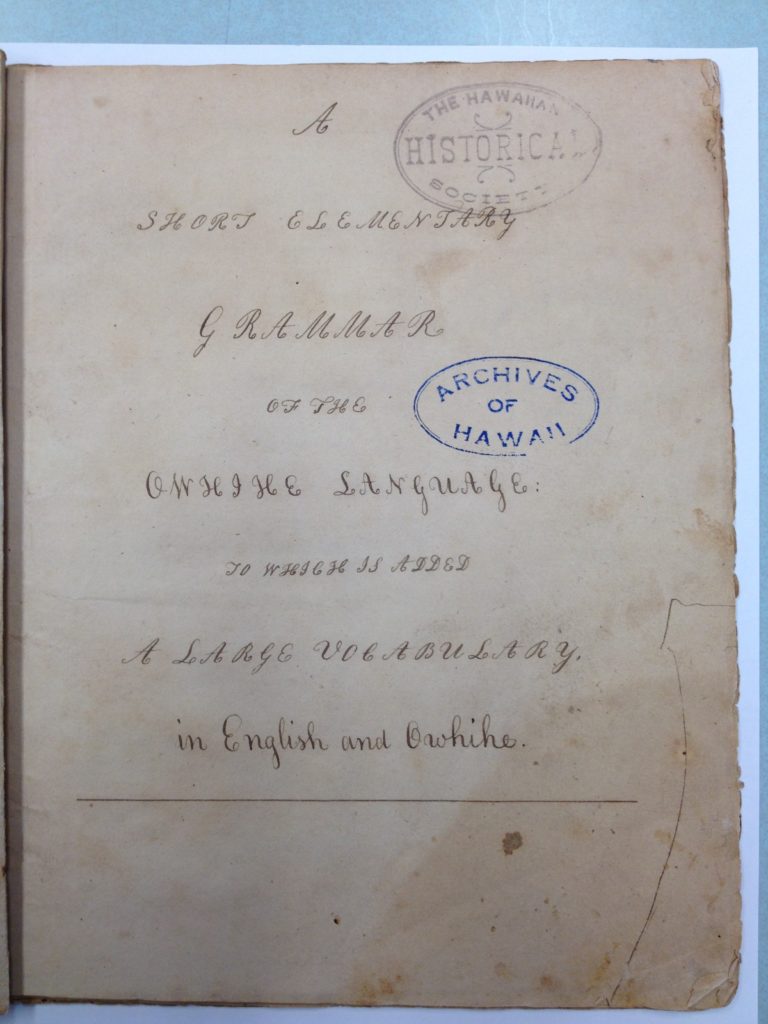
I encourage you to review the images in the folder; I had the opportunity to review and photograph the several pages of ʻŌpūkahaʻia’s grammar book. (Special thanks to the Hawaiian Mission Houses Historic Site and Archives and the Hawaiian Historical Society.)

Back to Russell Hubbard, who first taught ʻŌpūkahaʻia the letters … “in November or December, 1810, in his 27th year, (he was) lost at sea, with his next younger brother, on board the brig Triton, on a voyage from New Haven to the West Indies.” (Dexter, Yale)

© 2026 Hoʻokuleana LLC

Filed Under: General, Missionaries / Churches / Religious Buildings, Prominent People Tagged With: Noah Webster, Henry Opukahaia, Edwin Welles Dwight, Russell Hubbard, Yale, Hawaii

April 11, 2025 by Peter T Young Leave a Comment

Morse and the Missionaries

Jedidiah Morse was a country boy from Woodstock, Connecticut who attended Yale during the American Revolution. In the middle of his college career, a spiritual awakening came to Yale.

Jedidiah fell under conviction of sin, and, in the spring of 1781, gave his life to Christ – this energized him in all parts of his life.

Daniel Webster said Jedidiah was “always thinking, always writing, always talking, always acting.” Jedidiah’s motto was “better wear out than rust out.”  (Fisher)  Morse was a pastor, a graduate of Yale and a former teacher of young girls in New Haven.  (Spoehr)

Recognizing the inadequacy of the textbooks available in America at the time, Morse compiled and published the first American geography book.  Morse has been informally accredited by some as being “the father of American geography.”

Jedidiah and his sons started the first Sunday school in New England. (The family continued this kind of work when they moved to Connecticut; his son, Samuel, became the first Sunday school superintendent in New Haven.)    (Fisher)

Morse had set up a separate Theological Seminary at Andover in 1805. The Andover Seminary served as the recruitment and educational base of operations for a new American project, international missions to evangelize the world as the “School of Nations”.

In 1810, a group of Americans (including Rev. Jedidiah Morse) established the American Board of Commissioners of Foreign Missionaries (ABCFM) at Farmington, Connecticut.  (Wesser)

Jedidiah brought all the separate strands of the Christian community in New England together to found Andover Theological Seminary.  Out of Andover’s first graduating class came America’s first foreign missionaries, and the school became known as a missionary training ground. (Fisher)

To them, Christianity was not a “personal religious question” or “feeling,” but rather as a profound philosophical passion to “do good works”.  (Wesser)

Morse was an abolitionist and friend of the black community in Boston, when abolitionists were few. Also, a significant portion of his life was spent looking for ways to benefit Native Americans and preparing the way for missions among them.  (Fisher)

ABCFM accounted for 80% of all missionary activities in America; reformed bodies (Presbyterians and Congregationalists, in particular) made up nearly 40% of the participants.

On October 23, 1819, the Pioneer Company of American Protestant missionaries from the northeast US set sail on the Thaddeus for the Sandwich Islands (now known as Hawai‘i.)  There were seven American couples sent by the ABCFM to convert the Hawaiians to Christianity in this first company.

These included two Ordained Preachers, Hiram Bingham and his wife Sybil and Asa Thurston and his wife Lucy; two Teachers, Mr. Samuel Whitney and his wife Mercy and Samuel Ruggles and his wife Mary; a Doctor, Thomas Holman and his wife Lucia; a Printer, Elisha Loomis and his wife Maria; and a Farmer, Daniel Chamberlain, his wife and five children.

With the missionaries were four Hawaiian students from the Foreign Mission School, Thomas Hopu, William Kanui, John Honoliʻi and Prince Humehume (son of Kauaʻi’s King Kaumuali‘i.)

Prior to departure, a portrait of each of the company had been painted by Samuel Morse; engravings from these paintings of the four native “helpers” were later published as fund-raisers for the Sandwich Islands Mission and thereby offer a glimpse of the “Owhyhean Youths” on the eve of their Grand Experiment.  (Bell)

Over the course of a little over 40-years (1820-1863) (the “Missionary Period”,) about 180-men and women in twelve Companies served in Hawaiʻi to carry out the mission of the ABCFM in the Hawaiian Islands.

In addition to his religious endeavors, son, Samuel, showed enough artistic promise for his father to send him abroad to study painting after he graduated from Yale University in 1810.

Painting provided Samuel with pocket money to help pay his term bills at Yale. He became one of the small handful of important American painters in his generation, and many famous depictions of notable Americans are his work.

The portrait of Noah Webster at the front of many Webster dictionaries is his, as are the most familiar portraits of Benjamin Silliman, Eli Whitney, and General Lafayette.  (Fisher)

The problem was not a lack of talent, for Morse showed great promise as a painter, but he offered Americans grand paintings with historical themes, when all his paying patrons really wanted were portraits of themselves.

Eventually Morse accepted many portrait commissions, but even they did not bring the steady income he needed to support himself and his family.

At the same time, Morse was also deeply involved in trying to make a go of his newfound vocation as a daguerreotypist. Morse enthusiastically embraced this startling new technology and became one of the first to practice photography in America.  (LOC)

Morse the artist also became known as “the Father of American photography.” He was one of the first in the US to experiment with a camera, and he trained many of the nation’s earliest photographers.  (Fisher)

Oh, one more thing about Samuel Morse, while he did not invent the telegraph, he made key improvements to its design, and his work would transform communications worldwide.

First invented in 1774, the telegraph was a bulky and impractical machine that was designed to transmit over twenty-six electrical wires. Morse reduced that unwieldy bundle of wires into a single one.

Along with the single-wire telegraph, Morse developed his “Morse” code. He would refine it to employ a short signal (the dot) and a long one (the dash) in combinations to spell out messages.

Following the routes of the quickly-spreading railroads, telegraph wires were strung across the nation and eventually, across the Atlantic Ocean, providing a nearly-instant means of communication between communities for the first time.

Newspapers, including as the Associated Press joined forces to pool payments for telegraphed news from foreign locales. Railroads used the telegraph to coordinate train schedules and safety signaling. Morse died in 1872, having advanced a practical technology that truly transformed the world.  (PBS)

© 2025 Hoʻokuleana LLC

Filed Under: Missionaries / Churches / Religious Buildings, Prominent People Tagged With: Samuel Morse, Photography, Hiram Bingham, American Board of Commissioners of Foreign Missions, Noah Webster, ABCFM, Sybil Bingham, Jedidiah Morse, Morse Code, Pioneer Company, Hawaii

April 12, 2023 by Peter T Young 1 Comment

Threes and Eights

No, it’s not a typo (I don’t mean black Aces and Eights, Wild Bill Hickock’s “dead man’s hand”;) this relates to Noah Webster, Henry ʻŌpūkahaʻia, and Hawaiian grammar and spelling.

How in the world are these in common? … Let’s look.

Noah Webster (1758-1843) was the man of words in early 19th-century America. He compiled a dictionary which became the standard for American English; he also compiled The American Spelling Book, which was the basic textbook for young readers in early 19th-century America.

ʻŌpūkahaʻia, in 1809, boarded a sailing ship anchored in Kealakekua Bay and sailed to the continent.  ʻŌpūkahaʻia latched upon the Christian religion, converted to Christianity in 1815 and studied at the Foreign Mission School in Cornwall, Connecticut (founded in 1817) – he wanted to become a missionary and teach the Christian faith to people back home in Hawaiʻi.

A story of his life was written (“Memoirs of Henry Obookiah” (the spelling of his name prior to establishment of the formal Hawaiian alphabet, based on its sound.))  This book was put together by Edwin Dwight (after ʻŌpūkahaʻia died.)  It was an edited collection of ʻŌpūkahaʻia’s letters and journals/diaries.

This book inspired the New England missionaries to volunteer to carry his message to the Sandwich Islands.

On October 23, 1819, the pioneer Company of missionaries from the northeast United States, set sail on the Thaddeus for the Sandwich Islands (now known as Hawai‘i) – they first landed at Kailua-Kona on April 4, 1820.  (Unfortunately, ʻŌpūkahaʻia died suddenly (of typhus fever on February 17, 1818) and never made it back to Hawaiʻi.)

OK, so what about the 3s and 8s – and Hawaiian grammar and spelling?

It turns out that a manuscript was found among Queen Emma’s private papers (titled, “A Short Elementary Grammar of the Owhihe Language;”) a note written on the manuscript said, “Believed to be Obookiah’s grammar”.

Some believe this manuscript is the first grammar book on the Hawaiian language. However, when reading the document, many of the words are not recognizable.  Here’s a sampling of a few of the words: 3-o-le; k3-n3-k3; l8-n3 and; 8-8-k8.

No these aren’t typos, either.  … Let’s look a little closer.

In his journal, ʻŌpūkahaʻia first mentions grammar in his account of the summer of 1813: “A part of the time [I] was trying to translate a few verses of the Scriptures into my own language, and in making a kind of spelling-book, taking the English alphabet and giving different names and different sounds. I spent time in making a kind of spelling-book, dictionary, grammar.”  (Schutz)

So, where does Noah Webster fit into this picture?

As initially noted, Webster’s works were the standard for American English.  References to his “Spelling” book appear in the accounts by folks at the New England mission school.

As you know, English letters have different sounds for the same letter.  For instance, the letter “a” has a different sound when used in words like: late, hall and father.

Noah Webster devised a method to help differentiate between the sounds and assigned numbers to various letter sounds – and used these in his Speller.  (Webster did not substitute the numbers corresponding to a letter’s sound into words in his spelling or dictionary book; it was used as an explanation of the difference in the sounds of letters.)

The following is a chart for some of the letters related to the numbers assigned, depending on the sound they represent.

Long Vowels in English (Webster)
..1……..2…….3………4……….5…….6………7……….8
..a……..a…….a………e……….i……..o………o……….u
late, ask, hall, here, sight, note, move, truth

Using ʻŌpūkahaʻia’s odd-looking words mentioned above, we can decipher what they represent by substituting the code and pronounce the words accordingly (for the “3,” substitute with “a”(that sounds like “hall”) and replace the “8” with “u,” (that sounds like “truth”) – so, 3-o-le transforms to ʻaʻole (no;) k3-n3-k3 transforms to kanaka (man;); l8-n3 transforms to luna (upper) and 8-8-k8 transforms to ʻuʻuku (small.)

It seems Henry ʻŌpūkahaʻia used Webster’s Speller in his writings and substituted the numbers assigned to the various sounds and incorporated them into the words of his grammar book (essentially putting the corresponding number into the spelling of the word.)

“Once we know how the vowel letters and numbers were used, ʻŌpūkahaʻia’s short grammar becomes more than just a curiosity; it is a serious work that is probably the first example of the Hawaiian language recorded in a systematic way. Its alphabet is a good deal more consistent than those used by any of the explorers who attempted to record Hawaiian words.” (Schutz)

“It might be said that the first formal writing system for the Hawaiian language, meaning alphabet, spelling rules and grammar, was created in Connecticut by a Hawaiian named Henry ʻŌpūkahaʻia.  He began work as early as 1814 and left much unfinished at his death in 1818.” (Rumford)

“His work served as the basis for the foreign language materials prepared by American and Hawaiian students at the Foreign Mission School in Cornwall, Connecticut, in the months prior to the departure of the first company of missionaries to Hawai’i in October 1819.”  (Rumford)

It is believed ʻŌpūkahaʻia classmates (and future missionaries,) Samuel Ruggles and James Ely, after ʻŌpūkahaʻia’s death, went over his papers and began to prepare material on the Hawaiian language to be taken to Hawaiʻi and used in missionary work (the work was written by Ruggles and assembled into a book – by Herman Daggett, principal of the Foreign Mission School – and credit for the work goes to ʻŌpūkahaʻia.)

Lots of information here from Rumford (Hawaiian Historical Society) and Schutz (Honolulu and The Voices of Eden: A History of Hawaiian Language Studies.)

I encourage you to review the images in the folder; I had the opportunity to review and photograph the several pages of ʻŌpūkahaʻia’s grammar book.

© 2023 Hoʻokuleana LLC


Filed Under: Missionaries / Churches / Religious Buildings, General Tagged With: Hawaii, Noah Webster, Henry Opukahaia, Hawaiian Mission Houses Historic Site and Archives, Hawaiian Language, Hawaiian

December 16, 2019 by Peter T Young Leave a Comment

Webster’s Way

On July 14, 1826, the missionaries established a 12-letter alphabet for the written Hawaiian language, using five vowels (a, e, i, o, and u) and seven consonants (h, k, l, m, n, p and w) in their “Report of the committee of health on the state of the Hawaiian language.” The report was signed by Bingham and Chamberlain. The alphabet continues in use today.

“To one unacquainted with the language it would be impossible to distinguish the words in a spoken sentence, for in the mouth of a native, a sentence appeared like an ancient Hebrew or Greek manuscript-all one word.”

“It was found that every word and every syllable in the language ends with a vowel; the final vowel of a word or syllable, however, is often made so nearly to coalesce or combine with the sound of the succeeding vowel, as to form a dipthongal sound, apparently uniting two distinct words.”

“The power of the vowels may be thus represented: – a, as a in the English words art, father; e, as a in pale, or ey in they; i, as ee or in machine; o, as o in no; u, as oo in too. They are called so as to express their power by their names – Ah, A, Ee, O, Oo.”

“The consonants are in like manner called by such simple names as to suggest their power, thus, following the sound of the vowels as above – He, Ke, La, Mu, Xu, Pi, We.” (Bingham)

Learning the Language by Syllables

Noah Webster (1758-1843) was the man of words in early 19th-century America. He compiled a dictionary which became the standard for American English; he also compiled The American Spelling Book, which was the basic textbook for young readers in early 19th-century America.

In the beginning part of his American Spelling Book, several signed a ‘Recommendation,’ stating, “Having examined the first part of the new Grammatical Institute of the English Language, published by Mr. Noah Webster we are of opinion, that it is far preferable, in the plan and execution, to Dilworth’s or any other Spelling Book, which has been introduced into [o]ur schools.”

The Speller’s Preface notes the priority in learning, “The syllables of words are divided as they are pronounced, and for this obvious reason, that children learn the language by the ear. Rules are of no consequence but to printers and adults. In Spelling Books they embarrass children, and double the labour of the teacher.”

“The whole design of dividing words into syllables at all, is to lead the pupil to the true pronunciation: and the easiest method to effect this purpose will forever be the best.” (Webster’s Speller)

“As far back as one can trace the history of reading methodology, children were taught to spell words out, in syllables, in order to pronounce them.” Webster wrote.

And so it was with the American Protestant Missionaries teaching the Hawaiians to read and write their own language.

Just as American schoolchildren spelled aloud by naming the letters that formed the first syllable, and then pronouncing the result: “b, a – ba,” so did Hawaiian learners. (However, back then, Webster used ‘y’ as a vowel; the missionaries did not.)

Pī ʻā pā

In the initial instruction, the missionaries taught by first teaching syllables – adding consonants to vowels, just as Noah Webster noted in his speller.

The classroom exercise of spelling aloud also focused on syllables: Pupils first pronounced each letter of the syllable, and then put the sounds together and pronounced the syllable.

This practice of spelling aloud gave the Hawaiian alphabet its name. Just as American schoolchildren taught with Webster’s speller began their recitation by naming the letters that formed the first syllable, and then pronouncing the result: “B, A – BA,” so did Hawaiian learners.

The early missionary teacher said to his pupil, b, a – ba; the Hawaiian would repeat, pronouncing “b” like “p” and said “pī ʻā pā; hence the word that is now known as the Hawaiian alphabet and the name of the book. (Schütz 2017a:12)

Webster’s way of teaching was practiced in Hawai‘i, as described by Andrews, “The teacher takes a Piapa (i.e., speller, primer,) sits down in front of a row or several rows of scholars, from ten to a hundred perhaps in number, all sitting on the ground, furnished perhaps with Piapas, perhaps not.”

“The teacher begins: says A. The scholars all repeat in concert after him, A. The teacher then says E. They repeat all together, as before E, and so on, repeating over and over, after the teacher, until all the alphabet is fixed in the memory, just in the order the letters stand in the book; and all this just as well without a book as with one. The abbs and spelling lesson are taught in the same way.” (Schütz 1994:163)

The Hawaiian version also used the names of the letters and the resultant syllable: bē ā – bā; by 1824, this had become the Hawaiian word for ‘alphabet’. However, after b had been eliminated from the alphabet, p took its place in this new name.

One result of applying this methodology to Hawaiian is that it produced a new word: Pi a pa. From that time on, the word for ‘alphabet’ has been pī‘āpā, first appearing with this spelling (minus the kahakō and ‘okina) in a book title in 1828.

The purpose of all these first exercises was to teach the mechanics of pronouncing words, one by one – syllable by syllable.

This is a summary; click HERE for more on Webster’s Way.

Follow Peter T Young on Facebook 

Follow Peter T Young on Google+ 

Follow Peter T Young on LinkedIn  

Follow Peter T Young on Blogger

© 2019 Hoʻokuleana LLC

Schütz 1994. Albert Schütz – The voices of Eden: A history of Hawaiian language studies. 1994 Honolulu: University of Hawai‘i Press.

Schütz 2017a. Albert Schütz – Reading between the lines: A closer look at the first Hawaiian primer (1822). In Palapala-He puke pai no ka ‘olelo me ka mo ‘olelo Hawai’i (A journal for Hawaiian language and literature)

Pi-a-pa-01
Pi-a-pa-01
Pi-a-pa-02-03
Pi-a-pa-02-03
Pi-a-pa-04-05
Pi-a-pa-04-05
Pi-a-pa-06-07
Pi-a-pa-06-07
Pi-a-pa-08-09
Pi-a-pa-08-09
Pi-a-pa-10-11
Pi-a-pa-10-11
Pi-a-pa-12-13
Pi-a-pa-12-13
Pi-a-pa-14-15
Pi-a-pa-14-15
Pi-a-pa-16
Pi-a-pa-16

Filed Under: General, Missionaries / Churches / Religious Buildings, Hawaiian Traditions, Schools, Economy Tagged With: Literacy, Pi-a-pa, Collaboration, Hawaii, Noah Webster, Education

March 3, 2018 by Peter T Young Leave a Comment

Pī ʻā pā

“We are happy to announce to you that, on the first Monday of January (1822), we commenced printing, and, with great satisfaction, have put the first eight pages of the Owhyhee spelling book into the hands of our pupils”. (Joint letter of the missionaries, February 1, 1822)

Native Hawaiians immediately perceived the importance of “palapala” – document, to write or send a message. “Makai” – “good” – exclaimed Chief Ke‘eaumoku, to thus begin the torrent of print communications that we have today. (HHS)

“On January 7, 1822, on the mission press set up in the (Levi) Chamberlains’ thatched house we commenced printing the language in order to give them letters, libraries, and the living oracles in their own tongue, that the nation might read and understand the wonderful works of God. … Most of the printing done at the islands has been done by native hands.” (Bingham)

The first printing was pages of the pī ‘ā pā; the name of the first little primer or spelling book printed in the Hawaiian language. It included the alphabet, numerals, punctuation marks, lists of words, verses of scriptures and a few short poems.

In the initial instruction, the missionaries taught by first teaching syllables – adding consonants to vowels, just as Noah Webster noted in his speller.

“As far back as one can trace the history of reading methodology, children were taught to spell words out, in syllables, in order to pronounce them.” Webster wrote.

“The teacher begins with vowels: says A. The scholars all repeat in concert after him, A. The teacher then says E. They repeat all together, as before E, and so on, repeating over and over, after the teacher, until all the alphabet is fixed in the memory”. (ABCFM 1834)

The classroom exercise of spelling aloud also focused on syllables: Pupils first pronounced each letter of the syllable, and then put the sounds together and pronounced the syllable.

This practice of spelling aloud gave the Hawaiian alphabet its name. Just as American schoolchildren taught with Webster’s speller began their recitation by naming the letters that formed the first syllable, and then pronouncing the result: “B, A – BA,” so did Hawaiian learners.

The early missionary teacher said to his pupil, b, a – ba; the Hawaiian would repeat, pronouncing “b” like “p” and said “pī ʻā pā; hence the word that is now known as the Hawaiian alphabet and the name of the book. (Schutz)

Then, on July 14, 1826, the missionaries established a 12-letter alphabet for the written Hawaiian language, using five vowels (a, e, i, o, and u) and seven consonants (h, k, l, m, n, p and w) in their “Report of the committee of health on the state of the Hawaiian language.” The report was signed by Bingham and Chamberlain. The alphabet continues in use today.

“To one unacquainted with the language it would be impossible to distinguish the words in a spoken sentence, for in the mouth of a native, a sentence appeared like an ancient Hebrew or Greek manuscript-all one word.”

“It was found that every word and every syllable in the language ends with a vowel; the final vowel of a word or syllable, however, is often made so nearly to coalesce or combine with the sound of the succeeding vowel, as to form a dipthongal sound, apparently uniting two distinct words.”

“There are, on the other hand, abrupt separations or short and sudden breaks between two vowels m the same word. The language, moreover, is crowded with a class of particles unknown In the languages with which we had any acquaintance.”

“There were also frequent reduplications of the same vowel sound, so rapid, that by most foreigners the two were taken for one.”

“In the oft recurring names of the principal island, the largest village, and of the king of the leeward islands, ” Owhyhee,” ” Hanaroorah,” and” Tamoree,” scarcely the sound of a single syllable was correctly expressed, either in writing or speaking, by voyagers or foreign residents.”

“Had we, therefore, followed the orthography of voyagers, or in adopting an alphabet made a single vowel stand for as many sounds as in English, and several different vowels for the same sound, and given the consonants the ambiguity of our c, s, t, ch, gh, &c., …”

“… it would have been extremely difficult, if not impracticable to induce the nation to become readers, in the course of a whole generation, even if we had been furnished with ample funds to sustain in boarding-schools, all who would devote their time and labor to study.” (Bingham)

“The power of the vowels may be thus represented: – a, as a in the English words art, father; e, as a in pale, or ey in they; i, as ee or in machine; o, as o in no; u, as oo in too. They are called so as to express their power by their names – Ah, A, Ee, O, Oo.”

“The consonants are in like manner called by such simple names as to suggest their power, thus, following the sound of the vowels as above – He, Ke, La, Mu, Xu, Pi, We.” (Bingham)

“There were some difficulties to be encountered in distinguishing several consonant sounds, and to determine which of two characters in the Roman or English alphabet to adopt for certain sounds that appeared somewhat variable in the mouths of the natives.”

“The following appeared sometimes to be interchangeable: b and p, k and t, I and r, v and w, and even the sound of d, it was thought by some, was used in some cases where others used k, l, r or t. For purely native words, however, k, I, p and w were preferred.”

“The opening to them of this source of light never known to their ancestors remote or near, occurred while many thousands of the friends of the heathen were on the monthly concert, unitedly praying that the Gospel might have free course and he glorified.”

“It was like laying a corner stone of an important edifice for the nation.”

“A considerable number was present, and among those particularly interested was Ke‘eaumoku, who, after a little instruction from Mr. Loomis, applied the strength of his athletic arm to the lever of a Ramage press, pleased thus to assist in working off a few impressions of the first lessons. These lessons were caught at with eagerness by those who had learned to read by manuscript.”

“Kamāmalu applied herself also with renewed vigor to learn, both in English and in her own language, and exerted an influence, on the whole, favorable to the cause of instruction, and soon had a school-house built for the benefit of her people.”

“Liholiho requested a hundred copies of the spelling-book in his language to be furnished for his friends and attendants who were unsupplied, while he would not have the instruction of the people, in general, come in the way of their cutting sandalwood to pay his debts.” (Bingham)

Follow Peter T Young on Facebook 

Follow Peter T Young on Google+ 

Follow Peter T Young on LinkedIn  

Follow Peter T Young on Blogger

© 2018 Hoʻokuleana LLC

Pi-a-pa-01
Pi-a-pa-01
Pi-a-pa-02-03
Pi-a-pa-02-03
Pi-a-pa-04-05
Pi-a-pa-04-05
Pi-a-pa-06-07
Pi-a-pa-06-07
Pi-a-pa-08-09
Pi-a-pa-08-09
Pi-a-pa-10-11
Pi-a-pa-10-11
Pi-a-pa-12-13
Pi-a-pa-12-13
Pi-a-pa-14-15
Pi-a-pa-14-15
Pi-a-pa-16
Pi-a-pa-16
Noah_Webster's_The_American_Spelling_Book-Cover-1800
Noah Websters Speller-page 28
Noah_Webster_pre-1843

Filed Under: Economy, General, Ali'i / Chiefs / Governance, Missionaries / Churches / Religious Buildings Tagged With: Pi-a-pa, Speller, Hawaii, Noah Webster

  • 1
  • 2
  • Next Page »

Images of Old Hawaiʻi

People, places, and events in Hawaiʻi’s past come alive through text and media in “Images of Old Hawaiʻi.” These posts are informal historic summaries presented for personal, non-commercial, and educational purposes.

Info@Hookuleana.com

Connect with Us

  • Email
  • Facebook
  • LinkedIn
  • Twitter
  • YouTube

Recent Posts

  • Martin Luther King at the Hawai‘i Legislature
  • Gilberts and Marshalls
  • It Wasn’t ‘Bloodless’
  • Universal Remedy
  • Aiʻenui
  • Victoria Kamāmalu
  • Ginaca

Categories

  • Military
  • Place Names
  • Prominent People
  • Schools
  • Sailing, Shipping & Shipwrecks
  • Economy
  • Voyage of the Thaddeus
  • Mayflower Summaries
  • American Revolution
  • General
  • Ali'i / Chiefs / Governance
  • Buildings
  • Missionaries / Churches / Religious Buildings
  • Hawaiian Traditions

Tags

Albatross Al Capone Ane Keohokalole Archibald Campbell Bernice Pauahi Bishop Charles Reed Bishop Downtown Honolulu Eruption Founder's Day George Patton Great Wall of Kuakini Green Sea Turtle Hawaii Hawaii Island Hermes Hilo Holoikauaua Honolulu Isaac Davis James Robinson Kamae Kamaeokalani Kameeiamoku Kamehameha Schools Lalani Village Lava Flow Lelia Byrd Liberty Ship Liliuokalani Mao Math Mauna Loa Midway Monk Seal Northwestern Hawaiian Islands Oahu Papahanaumokuakea Marine National Monument Pearl Pualani Mossman Quartette Thomas Jaggar Volcano Waikiki Wake Wisdom

Hoʻokuleana LLC

Hoʻokuleana LLC is a Planning and Consulting firm assisting property owners with Land Use Planning efforts, including Environmental Review, Entitlement Process, Permitting, Community Outreach, etc. We are uniquely positioned to assist you in a variety of needs.

Info@Hookuleana.com

Copyright © 2012-2024 Peter T Young, Hoʻokuleana LLC


Loading Comments...