Images of Old Hawaiʻi

  • Home
  • About
  • Categories
    • Ali’i / Chiefs / Governance
    • American Protestant Mission
    • Buildings
    • Collections
    • Economy
    • Missionaries / Churches / Religious Buildings
    • General
    • Hawaiian Traditions
    • Other Summaries
    • Mayflower Summaries
    • Mayflower Full Summaries
    • Military
    • Place Names
    • Prominent People
    • Schools
    • Sailing, Shipping & Shipwrecks
    • Voyage of the Thaddeus
  • Collections
  • Contact
  • Follow

June 6, 2022 by Peter T Young Leave a Comment

Body of Liberties

The Mayflower is “indissolubly linked with the fundamentals of American democratic institutions. She was the wave-rocked cradle of our liberties.” (Henry B. Culver, Naval Historian, 1924)

Mayflower Compact

The Pilgrims established a government of sorts under the Mayflower Compact of 1620, which enshrined the notion of the consent of the governed.

It agreed to pass “just and equal laws for the good of the Colony”. The first experiment in New World self-government, some scholars even see it as a kind of American Magna Carta, a template for the Declaration of Independence and the US Constitution.  (Bryant, BBC)

The legacy of the pilgrims is foundational. The work ethic. The fact Americans don’t take much annual holiday. Notions of self-reliance and attitudes towards government welfare. Laws that prohibit young adults from drinking in bars until the age of 21. A certain prudishness. The religiosity.

Americans continue to expect their presidents to be men of faith. In fact, no occupant of the White House has openly identified as an atheist.

Also the profit motive was strong among the settlers, and with it the belief that prosperity was a divine reward for following God’s path – a forerunner of the gospel of prosperity preached by modern-day television evangelists. (Bryant, BBC)

Julia Ernst noted, the crux of the Mayflower Compact was to establish a common agreement among all the people in the colony, “mutually” and “in the presence of one another,” to “Covenant and Combine ourselves together into a Civil Body Politic.” This is the beginning of a democratic form of governance established by the people and for the people under the principle of majority rule.

It is a foundational document – not a set of specific rules, but a charter creating the polity (the public relationships among the members of that community) and the government to institute and maintain order in that society.

They agreed to “Covenant” with each other – to enter into a formal and fundamentally sacred reciprocal promise with every other member of the community.

This form of agreement reflected the earnest solemnity of the covenant theological system and the covenant political system with which most of them were probably accustomed. The Separatists utilized covenants in their religious beliefs and practices, as mentioned previously.

Not only did they make a formal promise to each other through the “Covenant,” but they also pledged themselves to “Combine” with each other – to work together as one unit for the common good of all members of the diverse community, both Saints and Strangers.

The Mayflower Compact was not so named until 1793 – it was originally called the Plymouth Combination, reflecting the coming together of all individual members into one cohesive, collective, egalitarian unit.

The Mayflower Compact does not contain all the elements of a written constitution, such as fleshing out the form in which the new government will take shape. However, it forms the basis for such a government through their agreement “to enact, constitute and frame such just and equal Laws Ordinances, Acts, Constitutions and Offices, from time to time.”

Thus, the Mayflower Compact was in effect a pre-constitutional agreement, as it expressly envisions that the members of the civil society will jointly create “Constitutions and Offices.”

“The Mayflower Compact reaffirmed one of the fundamental ideas of the Magna Carta; namely, that no political society could flourish without respect for the rule of law,” said Kim Holmes, executive vice president of The Heritage Foundation.

Body of Liberties

Next, in 1630, the Puritans used the royal charter establishing the Massachusetts Bay Company to create a government in which “freemen” – white males who owned property and paid taxes and thus could take on the responsibility of governing – elected a governor and a single legislative body called the Great and General Court, made up of assistants and deputies.

Conflicts arose over the arbitrariness of the assistants, and in 1641 the legislature created the Body of Liberties. This document was a statement of principles for governance that protected individual liberties and was the basis for the guarantees later expressed in the Bill of Rights of the U.S. Constitution.

The Massachusetts Body of Liberties was the first attempt in the colonies to restrain the power of the elected representatives by appealing to a fundamental document that lists the rights and duties of the people. The document, drafted and debated over several years, combined the early American covenanting tradition of the Mayflower Compact with an appeal to the common law tradition that crossed the Atlantic from Britain.

In 1644 this single body became an entity made up of two chambers: the House of Assistants (later the Senate) and the House of Deputies (later the House of Representatives). This set the precedent of bicameralism for most governmental legislatures in the United States, including the eventual federal legislature. (Britannica)

At first the right to vote was limited to the “chosen” – those whose religious background was thought to ensure salvation – but, after the original charter was revoked and a new one established in 1691, the franchise was extended to property owners and taxpayers. (Eventually, amendments granted all men and women the right to vote and hold office.)

The Body of Liberties is the first legal code established by European colonists in New England and was composed of a list of liberties, rather than restrictions, and intended for use as guidance for the General Court of the time.

This document is considered by many as the precursor to the General Laws of Massachusetts and the Massachusetts Constitution. It incorporates rights that were later judged to be ahead of their time, with some of these rights eventually appearing in the Bill of Rights.  Scholars do not agree as to whether these liberties were ever adopted, adopted provisionally or approved of by the General Court.

On December 10, 1641, the General Court established the hundred laws which were called the Body of Liberties. They “had been revised and altered by the [General] Court, and sent forth into every town to be further considered of, and now again in this [General] Court they were revised, amended, and presented.”  (Mass-gov)

Click the following link to a general summary about the Body of Liberties:

Click to access Body-of-Liberties.pdf

© 2022 Hoʻokuleana LLC

Filed Under: Mayflower Summaries Tagged With: Massachusetts, Mayflower, Mayflower Compact, Body of Liberties

May 30, 2022 by Peter T Young Leave a Comment

Blessings of the Bay

England sent over two colonizing expeditions to America in 1607. One went to Jamestown and became the first permanent colony. The other, known as the Popham Colony, settled in Maine on the lower Kennebec. After a rugged winter and the death of a leader, the Popham colonists went back to England. (Albion)

The Puritans who founded New England had come not to amass wealth by trade or by planting a fertile land, but to attempt a religious and civil experiment in government. On this barren shore along the coast they desired to worship in their own religious faith and be free from unsympathetic outsiders.

They hoped also to make their own laws without interference from the English Crown. The founding of this strong colony in a strategic military position formed a bulwark against the French and their Indian allies from the north, and against the threat from the Dutch in New York.

This strip of land, hemmed in by the foothills of the mountains, was bordered by the sea which, like a stern but friendly jailer, offered a means to enlarge the too scanty production of their land and promised tempting rewards to those who escaped the perils of storms, privateers and pirates and evaded the enforcement of intolerable navigation laws. (Gleason, Old Ships and Ship-building Days of Medford)

Shipbuilding in America dates back to 1607, when the Virginia was built at the mouth of the Kennebec River.  It was the Popham group which built the Virginia.

The colonists had come over in two small vessels. One of the well-connected captains was George Popham, nephew of the Lord Chief Justice; the other was Ralph Gilbert, a son of the late Humphrey Gilbert. They set to work at once in building a storehouse, fort, and other buildings, as well as the Virginia.

Investigations indicate the following possible dimensions: length over all, 51 feet 6 inches; length of keel, 38 feet 6 inches; maximum breadth inside the planking, 13 feet; depth for tonnage, 5 feet.

The Popham colonist were well aware of the vessel characteristics necessary for successful trading operations on the coast and rivers of New England. The Virginia apparently accompanied the discouraged colonists when they decided to return to England. (Albion)

Appreciating the advantages to be derived from the encouragement of shipbuilding in New England, managers of the Massachusetts Bay Company in London, in their first recorded letter, dated April 17, 1629, stated that six shipwrights had been sent to New England, of which Robert Moulton was the chief.

The first vessel built in Massachusetts Bay Colony was the bark Blessings of the Bay, 30 tons, owned by Governor Winthrop. She was launched into the Mystic River at Medford, July 4, 1631. (Old Scituate, Daughters of the American Revolution)

Governor Winthrop, in the year after his arrival, had built in Medford, opposite his estate at Ten Hills, the Blessing of the Bay (about the size of the Virginia and forerunner of much further building), a bark of thirty tons.  On August 9, 1631, the governor’s bark went to sea.

It cost one hundred and forty-five pounds. The owner said of it on May 16, 1636, “I will sell her for one hundred and sixty pounds.”

These vessels were employed in the coasting or fishing trade, and it was not until 1640 that vessels for the transatlantic trade were launched in the Colonies.

Shipbuilding, on an extended scale, was carried on during the Revolutionary War both by the Government and by private individuals.  The great abundance of oak growing near the Merrimac River made that a favored locality for shipbuilding, and as early as 1650 Newbury, Salisbury, and Haverhill were actively engaged in the work.

Click the following link to a general summary about the Blessings of the Bay:

https://imagesofoldhawaii.com/wp-content/uploads/Blessings-of-the-Bay.pdf

© 2022 Hoʻokuleana LLC

Filed Under: Mayflower Summaries, Sailing, Shipping & Shipwrecks Tagged With: Blessings of the Bay, Mayflower, Shipping

May 23, 2022 by Peter T Young Leave a Comment

First Catholics

Spreading Catholicism to Native American groups was a critical mission for the first Spanish settlers. By attempting to spread their Catholic religion to Native groups from the start of colonization, these Spanish settlers and priests were trying to secure their religion’s success in the New World.

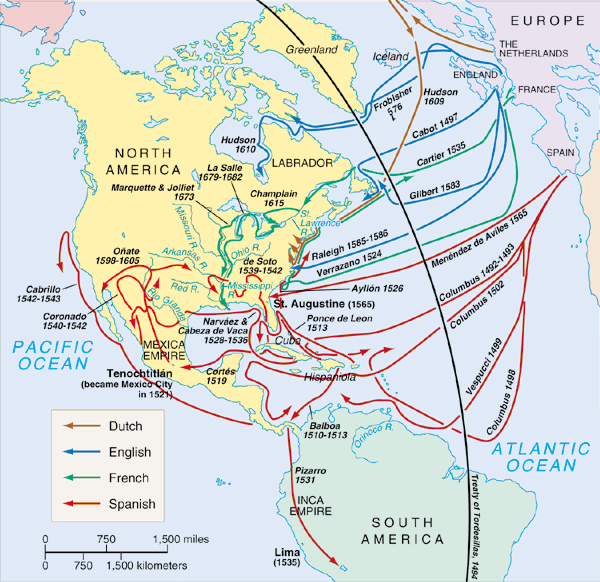
Efforts to set up a permanent settlement by the Spanish in the 16th century were mostly unfruitful, until French Huguenots threatened their trade routes by settling at the St. John’s River in modern day Jacksonville at Fort Caroline.

Almost immediately after the Spanish founded St. Augustine and massacred their French rivals at Fort Caroline, Spanish priests were starting Indian missions. The first Indian mission was founded by a secular priest, Sebastian Montero from 1566-1572.

With relative success in the Florida area, missions spread to Texas, New Mexico, and California with varying degrees of accomplishment converting Native American groups throughout the Spanish colonial period.

French Catholics also settled in the New World on Maine’s Scoodic River in 1604. French missionaries also missionized to Native Americans, particularly to tribes in their Northern territories. French missionaries converted the entire Abanaki tribe of Native Americans.

The French blended conversion with economic partnerships to use Native groups as allies against the encroaching English settlement in colonial North America. (American Catholic History Research Center and University Archives)

British Catholics in the New World

Unlike the French and Spanish settlements in North America, the British colonists were mostly Protestant and very weary of Catholicism. Catholics did however find their way to the colonies in the 17th century, most notably in Maryland and Pennsylvania, where they found a relative degree of freedom to worship.

Because of the Catholic religion of the Spanish and French, Catholicism’s perceived ties to a distant papal ruler, and warfare between Catholics and Protestants in England, many British colonists felt uneasy accepting Catholics into British colonial society. (American Catholic History Research Center)

The religious persecution that drove settlers from Europe to the British North American colonies sprang from the conviction, held by Protestants and Catholics alike, that uniformity of religion must exist in any given society.

This conviction rested on the belief that there was one true religion and that it was the duty of the civil authorities to impose it, forcibly if necessary, in the interest of saving the souls of all citizens. Nonconformists could expect no mercy and might be executed as heretics.

In some areas Catholics persecuted Protestants, in others Protestants persecuted Catholics, and in still others Catholics and Protestants persecuted wayward coreligionists.

Although England renounced religious persecution in 1689, it persisted on the European continent. Religious persecution, as observers in every century have commented, is often bloody and implacable and is remembered and resented for generations. (LOC)

In the British New World colonies, settlers considered themselves to be loyal Englishmen and aligned typically along the sides that divided England. Catholics and most Anglicans sided with their sovereign, whereas Puritans and Dissenters in Jamestown supported Parliament.

Conventional Thought on the First Catholics to the British Colonies

The recognition for the first group of Catholics to arrive at the British colonies had been assumed to be the Europeans who landed in Maryland in 1634, on Lord Baltimore’s charter. In 1634, two ships, the Ark and the Dove, brought the first settlers to Maryland. Approximately two hundred people were aboard.

Among the passengers were two Catholic priests who had been forced to board surreptitiously to escape the reach of English anti-Catholic laws. Upon landing in Maryland the Catholics, led spiritually by the Jesuits, were transported by a profound reverence, similar to that experienced by John Winthrop and the Puritans when they set foot in New England. (LOC)

The Actual First Catholics Into the British Colonies

The first group of Catholics actually arrived in English North America in 1619.

They were the thirty-odd black Christians among the sixty Angolans that the White Lion and the Treasurer stole from the Spanish slaver Bautista. (Hashaw)

Catholic missionaries had been active in Angola an entire century before 1619 and had won thousands of voluntary converts among the Bakongo and Mbundu nations.

Antonio, Maria, Juan Pedro, Francisco, and Margarida were voluntary Christians and the children of black Christians in Angola from the eastern provinces of Ndongo and Kongo.

They had already taken their Christian names while in Africa. They had not been forcibly baptized by a Catholic bishop just hours before boarding the slave ship departing from Luanda. Imbangala mercenaries had raided Christian and non-Christian Bantu provinces alike and mingled the captives together before trading them to the Portuguese for export to America.

Angolans arrived in Virginia in 1619 when Jamestown still teetered on the brink and seemed about to disappear like the many doomed Spanish and English colonies before it. Their arrival coincided with the Virginia Company’s decision to change its course from seeking treasure to building communities.

Religion did not present a difficult obstacle for the Angolans in interacting with the Jamestown settlers. Many had been exposed to Christianity as children in the late 1500s. Priests such as the Jesuit Francisco de Gouveia had served in royal Kabasa by invitation of the Angola since the 1560s, and other missionaries came before him. (Hashaw)

Catholic fortunes fluctuated in Maryland during the rest of the seventeenth century, as they became an increasingly smaller minority of the population.

After the Glorious Revolution of 1689 in England, the Church of England was legally established in the colony and English penal laws, which deprived Catholics of the right to vote, hold office, or worship publicly, were enforced.

Until the American Revolution, Catholics in Maryland were dissenters in their own country, living at times under a state of siege, but keeping loyal to their convictions, a faithful remnant, awaiting better times. (LOC)

Click the following link to a general summary about the First Catholics:
https://imagesofoldhawaii.com/wp-content/uploads/First-Catholics.pdf

© 2022 Hoʻokuleana LLC

Filed Under: Mayflower Summaries Tagged With: Mayflower, Catholics

May 16, 2022 by Peter T Young Leave a Comment

First Encounter

The Pilgrims decided to emigrate to America despite the perils and dangers.

On September 6 (September 16), 1620, the Mayflower departed from Plymouth, England, and headed for America.  The first half of the voyage went fairly smoothly, the only major problem was sea-sickness.  But by October, they began encountering a number of Atlantic storms that made the voyage treacherous.

Arrival at Cape Cod

The voyage itself across the Atlantic Ocean took 66 days; November 9 (November 19), 1620 they sighted Cape Cod.  The Pilgrims safe arrival at Cape Cod aboard the Mayflower:

“Being thus arived in a good harbor and brought safe to land, they fell upon their knees & blessed ye God of heaven, who had brought them over ye vast & furious ocean, and delivered them from all ye periles & miseries therof, againe to set their feete on ye firme and stable earth, their proper elemente.”

“And no marvell if they were thus joyefull, seeing wise Seneca was so affected with sailing a few miles on ye coast of his owne Italy; as he affirmed, that he had rather remaine twentie years on his way by land, then pass by sea to any place in a short time; so tedious & dreadfull was ye same unto him.”  (Bradford)

Native Americans

As the chill of an approaching winter settled in, the native people who lived 400 years ago in what is now the outermost region of Cape Cod were likely spending their days preparing for the change in weather and moving inland to be away from winds coming off the sea.

The men would have been stockpiling meat and catching fish to provide food for their families; the women foraging, gathering nuts and fallenbranches as firewood. In the evenings, family members would have been sharpening tools or making mats and pottery.  (Bragg, USA Today Network)

Initial Exploring Party

William Bradford writes of how the exploring party from the Mayflower, sailing in the shallop, survived a storm and landed on Clark’s Island. After spending the Sabbath on the island, the party finally landed for the first time in Plymouth.

“Wednesday, the 6th of December, it was resolved our discoverers should set forth, for the day before was too foul weather, and so they did, though it was well o’er the day ere all things could be ready.”

“So ten of our men were appointed who were of themselves willing to undertake it, to wit, Captain Standish, Master Carver, William Bradford, Edward Winslow, John Tilley, Edward Tilley, John Howland, and three of London, Richard Warren, Stephen Hopkins, and Edward Doty, and two of our seamen, John Allerton and Thomas English.”

“Of the ship’s company there went two of the master’s mates, Master Clarke and Master Coppin, the master gunner, and three sailors.” (Bradford) The narration of which discovery follows, penned by one of the company.

“We landed a league or two from them, and had much ado to put ashore anywhere, it lay so full of flat sands. When we came to shore, we made us a barricade, and got firewood, and set out our sentinels, and betook us to our lodging, such as it was. We saw the smoke of the fire which the savages made that night, about four or five miles from us.”

“In the morning we divided our company, some eight in the shallop, and the rest on the shore went to discover this place, but we found it only to be a bay, without either river or creek coming into it. Yet we deemed it to be as good a harbor as Cape Cod, for they that sounded it found a ship might ride in five fathom water.”

“We on the land found it to be a level soil, though none of the fruitfullest. We saw two becks of fresh water, which were the first running streams that we saw in the country, but one might stride over them. …”

“We then directed our course along the sea sands, to the place where we first saw the Indians. When we were there, we saw it was also a grampus which they were cutting up; they cut it into long rands or pieces, about an ell long, and two handful broad. We found here and there a piece scattered by the way, as it seemed, for haste. …”

“Anon we found a great burying place, one part whereof was encompassed with a large palisade, like a churchyard, with young spires for or five yards long, set as close one by another as they could, two or three feet in the ground. Within it was full of graves, some bigger and some less; some were also paled about, and others had like an Indian house made over them, but not matted.

“Those graves were more sumptuous than those at Cornhill, yet we digged none of them up, but only viewed them, and went our way. …”

“About midnight we heard a great and hideous cry, and our sentinels called, “Arm! Arm!” So we bestirred ourselves and shot off a couple of muskets, and the noise ceased; we concluded that it was a company of wolves or foxes, for one told us he had heard such a noise in Newfoundland.”  (Mourt’s Relation)

First Encounter

“About five o’clock in the morning [December 8, 1620] we began to be stirring, and two or three which doubted whether their pieces would go off or no made trial of them, and shot them off, but thought nothing at all.”

“After prayer we prepared ourselves for breakfast and for a journey, and it being now the twilight in the morning, it was thought meet to carry the things down to the shallop. Some said it was not best to carry the armor down; others said they would be readier; two or three said they would not carry theirs till they went themselves, but mistrusting nothing at all.”

“As it fell out, the water not being high enough, they laid the things down upon the shore and came up to breakfast. Anon, all upon a sudden, we heard a great and strange cry, which we knew to be the same voices, though they varied their notes.”

“One of our company, being abroad, came running in and cried, ‘They are men! Indians! Indians!’ and withal, their arrows came flying amongst us. …”

“The cry of our enemies was dreadful, especially when our men ran out to recover their arms; their note was after this manner, ‘Woach woach ha ha hach woach.’ Our men were no sooner come to their arms, but the enemy was ready to assault them. …”

“We followed them about a quarter of a mile, but we left six to keep our shallop, for we were careful about our business. Then we shouted all together two several times, and shot off a couple of muskets and so returned; this we did that they might see we were not afraid of them nor discouraged.”

“Thus it pleased God to vanquish our enemies and give us deliverance. By their noise we could not guess that they were less than thirty or forty, though some thought that they were many more.”

“Yet in the dark of the morning we could not so well discern them among the trees, as they could see us by our fireside.”

“We took up eighteen of their arrows which we have sent to England by Master Jones, some whereof were headed with brass, others with harts’ horn, and others with eagles’ claws. … Many more no doubt were shot”….

“So after we had given God thanks for our deliverance, we took our shallop and went on our journey, and called this place, The First Encounter.”  (Mourt’s Relation)

Click the following link to a general summary about the First Encounter:

https://imagesofoldhawaii.com/wp-content/uploads/First-Encounter.pdf

© 2022 Hoʻokuleana LLC

Filed Under: Mayflower Summaries Tagged With: Mayflower, Pilgrims, Cape Cod, First Encounter

May 9, 2022 by Peter T Young Leave a Comment

Thirteen Colonies

After numerous conquests by the Spanish and French, in 1578 Humphrey Gilbert, the author of a treatise on the search for the Northwest Passage, received a patent from Queen Elizabeth to colonize the “heathen and barbarous landes” in the New World which other European nations had not yet claimed. It would be five years before his efforts could begin. When he was lost at sea, his half-brother, Walter Raleigh, took up the mission.

In 1585 Raleigh established the first British colony in North America with a group of colonists (91 men, 17 women and nine children) on Roanoke Island off the coast of North Carolina. The first act was to restore to their friends the two Indians who had been previously taken to England.

The colony was later abandoned. Sir Walter Raleigh fitted out another colony, which sailed in the spring of 1587; the second effort also proved a failure.  Mysteriously, by 1590 the Roanoke colony had vanished entirely. Historians still do not know what became of its inhabitants.

The failure that attended all these efforts of the hopeful and energetic Raleigh was probably due, if not wholly, to the fact that he did not himself accompany and command any of his expeditions.  And, the main reason that he did not go with the ships was, that he was a great favorite with Queen Elizabeth, and she was not willing to let him risk himself in such adventures.  (Johnson)

British First Success at Jamestown

It would be 20 years before the British would try again. This time – at Jamestown in 1607 – the colony would succeed, and North America would enter a new era. (Alonzo L Hamby)

The early 1600s saw the beginning of a great tide of emigration from Europe to North America. Spanning more than three centuries, this movement grew from a trickle of a few hundred English colonists to a flood of millions of newcomers. Impelled by powerful and diverse motivations, they built a new civilization on the northern part of the continent.

Most European emigrants left their homelands to escape political oppression, to seek the freedom to practice their religion, or for adventure and opportunities denied them at home.

In 1606, King James I divided the Atlantic seaboard in two, giving the southern half to the London Company (later the Virginia Company) and the northern half to the Plymouth Company.

Just a few months after James I issued its charter, the London Company sent 144 men to Virginia on three ships: the Godspeed, the Discovery and the Susan Constant. They reached the Chesapeake Bay in the spring of 1607 and headed about 60 miles up the James River, where they built a settlement they called Jamestown.

Then, the first English emigrants to what would become the New England colonies were a small group of religious separatists, later called the Pilgrims, who arrived in Plymouth in 1620 on the Mayflower to found Plymouth Colony.

Ten years later, a wealthy syndicate known as the Massachusetts Bay Company sent a much larger (and more liberal) group of Puritans to establish another Massachusetts settlement. With the help of local natives, the colonists soon got the hang of farming, fishing and hunting, and Massachusetts prospered.   As the Massachusetts settlements expanded, they generated new colonies in New England.

Between 1620 and 1635, economic difficulties swept England. Many people could not find work. Even skilled artisans could earn little more than a bare living. Poor crop yields added to the distress. In addition, the Industrial Revolution had created a burgeoning textile industry, which demanded an ever-increasing supply of wool to keep the looms running. Landlords enclosed farmlands and evicted the peasants in favor of sheep cultivation. Colonial expansion became an outlet for this displaced peasant population.

Later, more came and expansion was occurring across the Eastern Seaboard.

By 1750, some 80 per cent of the North American continent was controlled or influenced by France or Spain. Their presence was a source of tension and paranoia among those in the 13 British colonies, who feared encirclement, invasion and the influence of Catholicism.

In 1700, there were about 250,000 European settlers and enslaved Africans in North America’s English colonies. By 1775, on the eve of revolution, there were an estimated 2.5 million. The colonists did not have much in common, but they were able to band together and fight for their independence.

The American Revolutionary War (1775-1783) was sparked after American colonists chafed over issues like taxation without representation, embodied by laws like The Stamp Act and The Townshend Acts. Mounting tensions came to a head during the Battles of Lexington and Concord on April 19, 1775, when the “shot heard round the world” was fired.

It was not without warning; the Boston Massacre on March 5, 1770 and the Boston Tea Party on December 16, 1773 showed the colonists’ increasing dissatisfaction with British rule in the colonies.

The Declaration of Independence, issued on July 4, 1776, enumerated the reasons the Founding Fathers felt compelled to break from the rule of King George III and parliament to start a new nation. In September of that year, the Continental Congress declared the “United Colonies” of America to be the “United States of America.”

France joined the war on the side of the colonists in 1778, helping the Continental Army conquer the British at the Battle of Yorktown in 1781. The Treaty of Paris ending the American Revolution and granting the 13 original colonies independence was signed on September 3, 1783. (History-com)

Here is a list of the thirteen colonies (now states) with the year they were founded: Virginia (1607); New Hampshire (1623); Massachusetts (1630); Maryland (1633); Connecticut (1636); Rhode Island (1636); Delaware (1638); North Carolina (1663); South Carolina (1663); New York (1664); New Jersey (1664); Pennsylvania (1681) and Georgia (1732).

Vermont, which was not one of the 13 colonies, is named because, after seeing the Green Mountains, French explorer Samuel de Champlain referred to it as “Verd Mont” (green mountains) on a map in his native French.

Click the following link to a general summary about the Thirteen Colonies:

https://imagesofoldhawaii.com/wp-content/uploads/Thirteen-Colonies.pdf

© 2022 Hoʻokuleana LLC

Filed Under: Mayflower Summaries Tagged With: Mayflower, Colonies, New World

  • « Previous Page
  • 1
  • 2
  • 3
  • 4
  • …
  • 8
  • Next Page »

Images of Old Hawaiʻi

People, places, and events in Hawaiʻi’s past come alive through text and media in “Images of Old Hawaiʻi.” These posts are informal historic summaries presented for personal, non-commercial, and educational purposes.

Info@Hookuleana.com

Connect with Us

  • Email
  • Facebook
  • LinkedIn
  • Twitter
  • YouTube

Recent Posts

  • Until Death Should Us Part
  • Royal Twins
  • Battery Pennsylvania
  • 250 Years Ago … Hawai‘i at the Time of the American Revolution
  • Hawaiians Study Abroad
  • Kaʻawaloa
  • The Reef

Categories

  • Schools
  • Sailing, Shipping & Shipwrecks
  • Economy
  • Voyage of the Thaddeus
  • Mayflower Summaries
  • American Revolution
  • General
  • Ali'i / Chiefs / Governance
  • Buildings
  • Missionaries / Churches / Religious Buildings
  • Hawaiian Traditions
  • Military
  • Place Names
  • Prominent People

Tags

Albatross Al Capone Ane Keohokalole Archibald Campbell Bernice Pauahi Bishop Charles Reed Bishop Downtown Honolulu Eruption Founder's Day George Patton Great Wall of Kuakini Green Sea Turtle Hawaii Hawaii Island Hermes Hilo Holoikauaua Honolulu Isaac Davis James Robinson Kamae Kamaeokalani Kamanawa Kameeiamoku Kamehameha Schools Lalani Village Lava Flow Lelia Byrd Liliuokalani Mao Math Mauna Loa Midway Monk Seal Northwestern Hawaiian Islands Oahu Papahanaumokuakea Marine National Monument Pearl Pualani Mossman Queen Liliuokalani Thomas Jaggar Volcano Waikiki Wake Wisdom

Hoʻokuleana LLC

Hoʻokuleana LLC is a Planning and Consulting firm assisting property owners with Land Use Planning efforts, including Environmental Review, Entitlement Process, Permitting, Community Outreach, etc. We are uniquely positioned to assist you in a variety of needs.

Info@Hookuleana.com

Copyright © 2012-2024 Peter T Young, Hoʻokuleana LLC


Loading Comments...