Images of Old Hawaiʻi

  • Home
  • About
  • Categories
    • Ali’i / Chiefs / Governance
    • American Protestant Mission
    • Buildings
    • Collections
    • Economy
    • Missionaries / Churches / Religious Buildings
    • General
    • Hawaiian Traditions
    • Other Summaries
    • Mayflower Summaries
    • Mayflower Full Summaries
    • Military
    • Place Names
    • Prominent People
    • Schools
    • Sailing, Shipping & Shipwrecks
    • Voyage of the Thaddeus
  • Collections
  • Contact
  • Follow

February 3, 2022 by Peter T Young 1 Comment

Georges Phillipe Trousseau

Georges Trousseau was born in Paris on May 1, 1833 to a prominent Parisian family. His father, Armand Trousseau, a distinguished physician and surgeon, was also the author of medical books used throughout the world.  (Greenwell)

He received the usual education of a wealthy Frenchman and entered the ecole de medicine in Paris at the early age of 15.  (Hawaiʻi Holomua, May 5, 1894)

From the days in 1848 and 1852, when he as a student fought in the streets of Paris, he has unswervingly believed in the rights of the people – and early or late was he found ready to serve them as a physician as a friend or simply as a fellow-man.  (Hawaiʻi Holomua, May 5, 1894)

Trousseau married Edna Vaunois, who was also from Paris; they had two children, Armond and Rene in 1856 and 1857.  In 1865, the couple was legally separated (but never divorced.)

He followed his father’s footsteps and graduated from the Paris School of Medicine as a physician in 1858.  He became an army surgeon, seeing service in Algiers early in the fifties. He also served at Solferino and Magenta, Italy.  (Greenwell)

For personal reasons, he left France and went to Australia and New Zealand.  In part, he was at the Australian gold mines, but did not strike it rich; in fact, his estranged wife loaned him money while he was there.  (Greenwell, Hawaiʻi Holomua, May 5, 1894)

He left there and arrived in Hawaiʻi in 1872.  Almost immediately upon his arrival, he was appointed by the Board of Health to serve as Port Physician for Honolulu (there was no salary attached to the office; fees for services were worked out between the Port Physician and the ship/agent the usual charge was $25.)  (Greenwell)

He soon gained great fame as a doctor.  He served on the Board of Health for 20-years, serving as a Board member and as President.   He took an interest in Leprosy and supervised the leper treatment center in Kalihi.

In 1865, the legislature of the Hawaiian Islands had passed “An Act to Prevent the Spread of Leprosy.” This law called for a place to be set aside for the isolation of those found to have leprosy in order to curb the spread of the disease.  It was not until 1873, however, on Doctor Trousseau’s recommendation, that a vigorous effort was made to segregate lepers.  (Greenwell)

“Trousseau strongly urging that the only method, at all likely to be successful, was the immediate, energetic, and to a certain extent, unsympathetic isolation of all who were afflicted with the disease, and even that would require a generation in all probability to prove successful.”  (Board of Health, March 1, 1873)

He diagnosed Father (now Saint) Damien’s leprosy.  “… In January, 1885 Damien visited Honolulu … (and accidentally) scalded his left foot. Father Leonore, the provincial of the mission, phoned for Dr George Trousseau, whose examination of the priest’s foot and leg proved they were devoid of feeling … this discovery indicated that the peroneal nerve and its branches were dead due to leprosy.”  (Mouritz; Bushnell)

Though not an official title, Trousseau served as royal physician.  He was called on as a consultant by Doctor Ferdinand W Hutchison, Minister of the Interior, during Kamehameha V’s last illness and was at the King’s bedside when he died.

In August 1873, when it was apparent that King Lunalilo was ill, Trousseau accompanied the King and stayed with Lunalilo at Huliheʻe Palace in Kailua- Kona, from mid-November to the middle of January 1874.  After it became apparent that Lunalilo was not going to recover, and the royal party returned to Honolulu where Lunalilo died on February 3.  (Greenwell)

The rulers of Hawaiʻi honored him.   Lunalilo made him a major in his staff and his personal physician. Kalākaua befriended him and appointed him the executor of his will and the administrator of his estate.  (Hawaiʻi Holomua, May 5, 1894)

“(H)e was always ready to promote any now industry that might prove a source of benefit to his adopted country.”  This got him involved in sheep, sugar and ostriches.  (Hawaiʻi Holomua, May 5, 1894)

In 1875, he gave up his Honolulu medical practice and moved to Kona, Hawaiʻi, where he purchased a sheep and cattle ranch at Kanahaha high on the slopes of Mauna Loa.  Wool was baled at Kanahaha and transported by cart to Kainaliu Beach, from where it was shipped. (Greenwell)

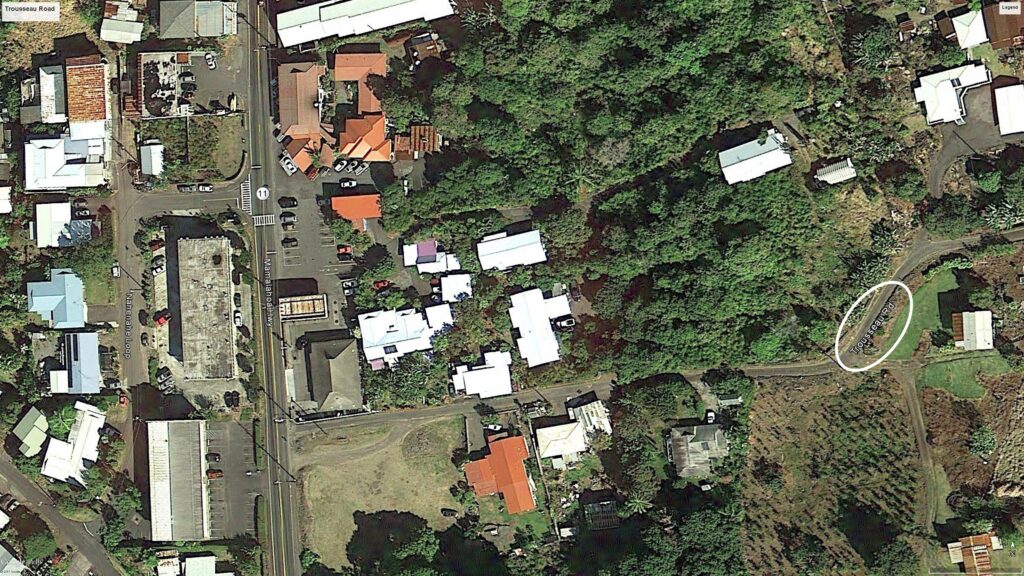
A road was constructed which ran from Kanahaha on Mauna Loa, to the beach at Kainaliu (where he also had a home.) (This old cart road is used by jeeps today and is known as the Trousseau Trail.)  Early in 1879, Trousseau sold all of his holdings in Kona to Henry N Greenwell.

After selling the sheep ranch, Trousseau bought out two sugar planters at Kukuihaele on the Hāmākua coast. He became partners in the Pacific Sugar Mill with the Purvis family. Trousseau had an excellent relationship with John Purvis and his son Herbert.  (Greenwell)

The plantation thrived for a time.  However, defects in the furnace caused difficulties.  In 1881, Trousseau suddenly and unexpectedly sold his half in the plantation to his partners.  He moved back to Honolulu and resumed his medical practice.

He tried one last agricultural venture there.  “The doctor started a new industry for these islands a few years ago (1890) by establishing an ostrich farm at Kapiʻolani Park. Many young birds have been bred from the original stock, and some of the feathers have gone into domestic exports. The farm was under the management of Captain John Morriseau (Trousseau’s nephew.)”  (Daily Bulletin, May 5, 1894)

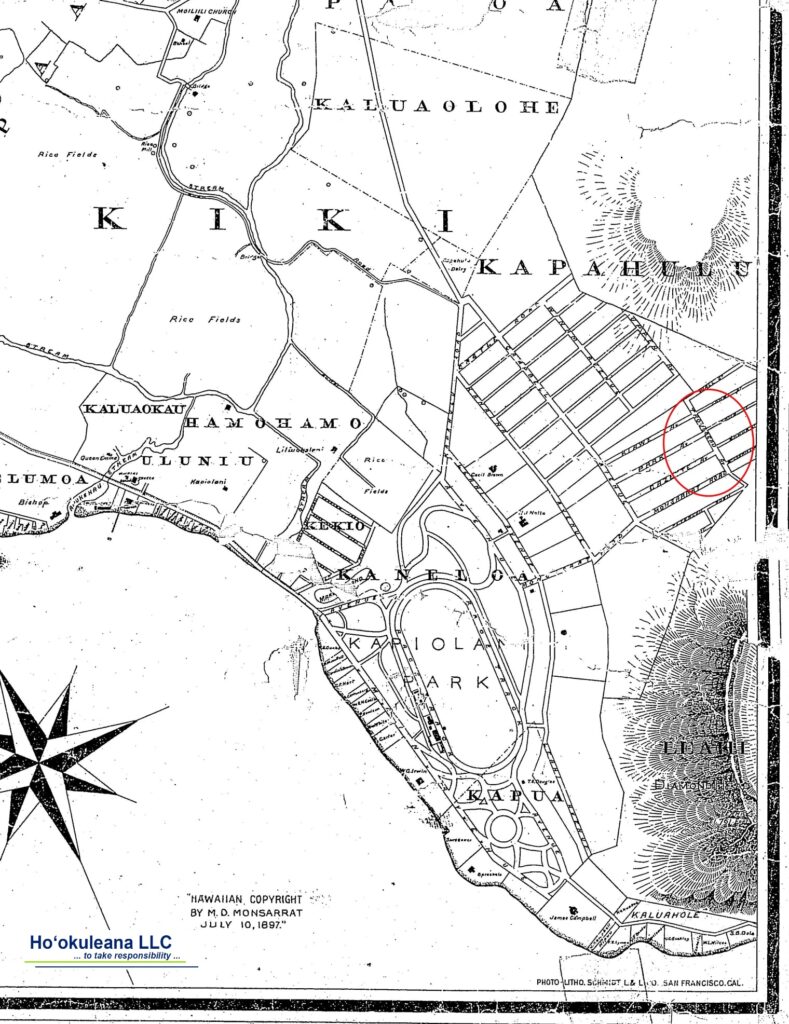
The 1,000-acre farm (purchased from the Lunalilo Estate) was located in the Kapahulu area near the present zoo; Paul Isenberg, who owned a nearby cattle ranch, later purchased the farm (Trousseau Street notes the general location.)

Though Trousseau never divorced, he did have a mistress, Makanoe; Makanoe was also married (to Kaʻaepa.)  (This relationship is referred to as ‘punalua;’ an association in which, typically, two women, often sisters, share one husband, or, as in Makanoeʻs case, two men share the affection of one woman.)  (Greenwell)

Trousseau died May 4, 1894, shortly after Kaʻaepa’s death.  Makanoe buried her husband and Trousseau side by side in a wrought iron fenced plot at Makiki Cemetery on Oʻahu.  Trousseau left all of his estate to Makanoe (she eventually moved to Salt Lake City, Utah.)

Trousseau faithfully supported the Hawaiian Monarchy and stood up for the royalists which caused bitter feelings among many of his associates who backed the annexationists.

In spite of this, his obituary noted, “It is seldom that people of all classes, opposed to each other socially and politically can gather around the bier of a fellow-citizen and unite in saying, ‘we have lost a friend.’”  (Hawaiʻi Holomua, May 5, 1894)

“Dr. Trousseau was a strong nationalist of Hawaiʻi, who believed that none but born or naturalized subjects should have a determining voice in national affairs. The Hawaiian people, who revered and confided in him, will take his death as a sort bereavement.”  (Daily Bulletin, May 5, 1894)  (Lots of information here from Jean Greenwell.)

© 2022 Hoʻokuleana LLC


Filed Under: Prominent People Tagged With: Hansen's Disease, Georges Trousseau, Hawaii, Hawaii Island, Oahu, King Kalakaua, Lunalilo, Molokai, Saint Damien

February 29, 2020 by Peter T Young Leave a Comment

“Miss Ball Won The Fight For Others”

A healer touches people.

A good healer touches a person’s body, mind and spirit.

A great healer touches many people’s lives.

In attempting to describe a healer who touches the lives of thousands of sufferers around the world may lead us to call that individual a saint.

Saint Damien is appropriately recognized for his commitment in easing the suffering and caring for the thousands of suffering souls, banished to Kalaupapa because they had Hansen’s disease.

An almost forgotten healer was a young (24-years old) Black chemist and pharmacist, who made a revolutionary discovery that changed the lives of Hansen’s disease sufferers.

Once known as leprosy, the disease was renamed after Dr. Gerharad Armauer Hansen, a Norwegian physician, when he discovered the causative microorganism in 1873, the same year that Father Damien volunteered to serve at Kalaupapa.

Born on July 24, 1892 in Seattle, Washington, Alice Augusta Ball was the daughter of James P Ball and his wife, Laura; she lived in a middle or even upper-middle class household.

Ball’s grandfather, JP Ball, Sr, a photographer, was one of the first Blacks in the US to learn the art of daguerreotype and created in Cincinnati one of the more famous daguerreotype galleries. During his lifetime, Ball also opened photography galleries in Minneapolis, Helena, Montana, Seattle and Honolulu, where he died at the age of 79.

After moving to Hawaiʻi in 1903 and attending elementary school here, Alice Ball and her family moved back to the continent where she attended high school in Seattle, earning excellent grades, especially in the sciences.

After a stint with the family living in Montana and then returning to Seattle, Alice Ball entered the University of Washington and graduated with two degrees in pharmaceutical chemistry in 1912 and pharmacy in 1914.

In the fall of 1914, she entered the College of Hawaiʻi (later called the University of Hawaiʻi) as a graduate student in chemistry.

On June 1, 1915, she was the first African American and the first woman to graduate with a Master of Science degree in chemistry from the University of Hawaiʻi. In the 1915-1916 academic year, she also became the first woman to teach chemistry at the institution.

But the significant contribution Ball made to medicine was a successful injectable treatment for those suffering from Hansen’s disease.

She isolated the ethyl ester of chaulmoogra oil (from the tree native to India) which, when injected, proved extremely effective in relieving some of the symptoms of Hansen’s disease.

Although not a full cure, Ball’s discovery was a significant victory in the fight against a disease that has plagued nations for thousands of years. The discovery was coined, at least for the time being, the “Ball Method.”

A College of Hawaiʻi chemistry laboratory began producing large quantities of the new injectable chaulmoogra. During the four years between 1919 and 1923, no patients were sent to Kalaupapa – and, for the first time, some Kalaupapa patients were released.

Ball’s injectable compound seemed to provide effective treatment for the disease, and as a result the lab began to receive “requests for their chaulmoogra oil preparations from all over the world.”

“The annals of medical science are incomplete unless full credit is given for the work of Alice Ball. … It was no easy task. One after another the various preparations were tried and put aside. … It led to the discovery of the preparation which bids fair to become a specific in the treatment of leprosy. Miss Ball won the fight for others”. (American Missionary Association, April 1922)

The “Ball Method” continued to be the most effective method of treatment until the 1940s and as late as 1999 one medical journal indicated the “Ball Method” was still being used to treat Hansen disease patients in remote areas.

At the time of her research Ball became ill. She worked under extreme pressure to produce injectable chaulmoogra oil and, according to some observers, became exhausted in the process.

Unfortunately, Ball never lived to witness the results of her discovery. She returned to Seattle and died at the age of 24 on December 31, 1916. The cause of her death was unknown.

On February 29, 2000, the Governor of Hawaiʻi issued a proclamation, declaring it “Alice Ball Day.” On the same day the University of Hawaiʻi recognized its first woman graduate and pioneering chemist with a bronze plaque mounted at the base of the lone chaulmoogra tree on campus near Bachman Hall.

In January 2007, Alice Augusta Ball was presented posthumously the University of Hawaiʻi Regents’ Medal of Distinction, an award to individuals of exceptional accomplishment and distinction who have made significant contributions to the University, state, region or nation or within their field of endeavor.

Follow Peter T Young on Facebook 

Follow Peter T Young on Google+ 

Follow Peter T Young on LinkedIn  

Follow Peter T Young on Blogger

© 2020 Hoʻokuleana LLC

Filed Under: General, Prominent People Tagged With: Bachman Hall, Chaulmoogra, Hawaii, Oahu, University of Hawaii, Hansen's Disease, Manoa, Alice Ball, Ball Method

  • « Previous Page
  • 1
  • 2

Images of Old Hawaiʻi

People, places, and events in Hawaiʻi’s past come alive through text and media in “Images of Old Hawaiʻi.” These posts are informal historic summaries presented for personal, non-commercial, and educational purposes.

Info@Hookuleana.com

Connect with Us

  • Email
  • Facebook
  • LinkedIn
  • Twitter
  • YouTube

Recent Posts

  • About 250 Years Ago … Boston Massacre
  • Oceanic Steamship Company
  • Charles Hinckley Wetmore
  • Kauikeōlani
  • About 250 Years Ago … Articles of Confederation and Perpetual Union
  • Kukona
  • Hāmākua Ditch

Categories

  • Buildings
  • Missionaries / Churches / Religious Buildings
  • Hawaiian Traditions
  • Military
  • Place Names
  • Prominent People
  • Schools
  • Sailing, Shipping & Shipwrecks
  • Economy
  • Voyage of the Thaddeus
  • Mayflower Summaries
  • American Revolution
  • General
  • Ali'i / Chiefs / Governance

Tags

Albatross Al Capone Ane Keohokalole Archibald Campbell Bernice Pauahi Bishop Charles Reed Bishop Downtown Honolulu Eruption Founder's Day George Patton Great Wall of Kuakini Green Sea Turtle Hawaii Hawaii Island Hermes Hilo Holoikauaua Honolulu Isaac Davis James Robinson Kamae Kamaeokalani Kameeiamoku Kamehameha Schools Lalani Village Lava Flow Lelia Byrd Liberty Ship Liliuokalani Mao Math Mauna Loa Midway Monk Seal Northwestern Hawaiian Islands Oahu Papahanaumokuakea Marine National Monument Pearl Pualani Mossman Quartette Thomas Jaggar Volcano Waikiki Wake Wisdom

Hoʻokuleana LLC

Hoʻokuleana LLC is a Planning and Consulting firm assisting property owners with Land Use Planning efforts, including Environmental Review, Entitlement Process, Permitting, Community Outreach, etc. We are uniquely positioned to assist you in a variety of needs.

Info@Hookuleana.com

Copyright © 2012-2024 Peter T Young, Hoʻokuleana LLC


Loading Comments...