Images of Old Hawaiʻi

  • Home
  • About
  • Categories
    • Ali’i / Chiefs / Governance
    • American Protestant Mission
    • Buildings
    • Collections
    • Economy
    • Missionaries / Churches / Religious Buildings
    • General
    • Hawaiian Traditions
    • Other Summaries
    • Mayflower Summaries
    • Mayflower Full Summaries
    • Military
    • Place Names
    • Prominent People
    • Schools
    • Sailing, Shipping & Shipwrecks
    • Voyage of the Thaddeus
  • Collections
  • Contact
  • Follow

July 24, 2023 by Peter T Young Leave a Comment

Royal Hawaiian Hotel

The first Royal Hawaiian Hotel was not in Waikīkī.  It was in downtown Honolulu where the “One Capitol District” building now stands.  By the 1900s, the Royal Hawaiian lost its guests to the newer Alexander Young hotel a few blocks away.

The downtown Royal Hawaiian was converted to a YMCA building in 1917.  The building was demolished in 1926, and a new YMCA in a similar style was built in its place.

For centuries, Helumoa in Waikīkī was the home to Hawaiʻi’s royalty.  Portions of this area would eventually become the home to the new Royal Hawaiian Hotel.

In the 1890s, the property was leased as a seaside annex to the downtown Royal Hawaiian Hotel located at Richards and Hotel streets.

In 1907, the Seaside Hotel opened on the property, and was later acquired by Alexander Young’s Territorial Hotel Company, which operated the Alexander Young hotel in downtown Honolulu.

In 1924, the Seaside Hotel’s lease of the land at Helumoa was soon to expire and the land’s owners (Bishop Estate) put out a request for proposals to build a hotel.

This was the time before flight; Matson Navigation Co. had luxury ocean liners bringing wealthy tourists to Hawaii – but, they needed a hotel equally lavish to accommodate their passengers at Waikīkī (at that time, the 650 passengers arriving in Honolulu every two weeks were typically staying at Hawaiʻi’s two largest hotels, the Alexander Hotel and the Moana.)

The availability of the Waikīkī land began putting wheels into motion.  A new hotel was planned and conceived as a luxurious resort for Matson passengers, the brainchild of Ed Tenney (who headed the “big five” firm of Castle and Cooke and Matson Navigation) and Matson manager William Roth (son-in-law to William Matson founder of Matson Navigation.)

Castle & Cooke, Matson Navigation and the Territorial Hotel Company successfully proposed a plan to build a luxury hotel, The Royal Hawaiian, with 400 rooms on the 15-acre parcel of Waikiki beach to be leased from Bishop Estate.

The ground-breaking ceremony took place on July 26, 1925.  However, the official building permits were delayed while city officials changed the building code to allow increased building heights.  After $4 million and 18 months, the resort was completed.

On February 1, 1927, the Royal Hawaiian (nicknamed The Pink Palace) was officially opened with the gala event of the decade.  At the same time, and associated with the hotel, the Territorial Hotel Co opened the Waiʻalae Golf Course.

Duke Kahanamoku, the legendary Olympic swimmer and surfer, frequented the Royal Hawaiian Hotel restaurants and private beachfront. The Royal Hawaiian Hotel became a favorite stomping ground for Kahanamoku’s famed group, dubbed the “Waikiki Beach Boys”.

Over the following decades, the Royal Hawaiian was THE place to stay and the Pink Palace hosted world celebrities, financiers, heads of state and the elite from around the world.

World War II, with its associated martial law and blackout measures, meant significant changes at the Royal Hawaiian.  In January of 1942, the U.S. Navy signed a lease with the Royal Hawaiian to use the facilities as a rest and relaxation center for officers and enlisted personnel serving in the Pacific.

During the war, over 200,000 men stayed at the Royal Hawaiian. Each day as many as 5,500 service-related visitors (most of who were not staying at the hotel) passed through the front gates to enjoy the beach or social activities.

At the conclusion of World War II, the hotel was given a makeover to restore her to the level of luxury her guests would expect.

ITT Sheraton purchased The Royal Hawaiian from Matson in June 1959.  The Royal Tower Wing was added to the existing structure in 1969.  The resort was sold in 1974 to Kyo-ya Company, Ltd., with Starwood Hotels & Resorts operating it under a long-term management contract.

In 2008, the Royal Hawaiian again underwent significant renovation (to the tune of $85-million) and held its official grand reopening on March 7, 2009.  The Tower section was renovated yet again in November 2010 and reopened as The Royal Beach Tower with upgraded rooms.

Why the color pink?  Bob Krauss once reported that the Royal Hawaiian’s pink color is due to the typically pink-painted homes in Lisbon, Portugal.

Friends of William Roth (Kimo and Sarah Wilder) had visited Lisbon and upon returning repainted their home pink with blue-green shutters.  Roth commented, “I love what you’ve done to your house. Can I paint my hotel the same color?”

© 2023 Hoʻokuleana LLC

Filed Under: Economy, Buildings Tagged With: Moana Hotel, Matson, Duke Kahanamoku, Royal Hawaiian Hotel, Alexander Hotel, Hawaii, Waikiki, Oahu

June 14, 2023 by Peter T Young Leave a Comment

The Thelma

Clifford Carlton “Gavvy” “Cactus” Cravath (March 23, 1881 – May 23, 1963,) was an American right fielder and right-handed batter in Major League Baseball who played primarily for the Philadelphia Phillies.

In the seven years from 1913 to 1920 he led the National League in home runs six times, in runs batted in, total bases and slugging average twice each, and in hits, runs and walks once each.  Cravath had part-ownership in a 40-foot boat, the Thelma.

On June 14, 1925, the Thelma was leaving Newport Harbor with 17-people, going out for a fishing expedition.

“The fishing party, including high school boys, left early and found a smooth sea until within 150 feet of the Jetty, Bland (the skipper) testified, when one wave turned the craft sideways. The boat rode the second, but the third, said to be at least 20 feet high, crashed over the boat.” (San Bernardino County Sun, June 15, 1925)

“When she neared the end of the breakwater a large wave smashed the engine room hatch, disabling the motor. Another wave, closely following, carried away part of the rigging, leaving the craft overturned, but another wave righted it.”  (San Bernardino County Sun, June 15, 1925)

“Big green walls of water were sliding in from the horizon, building up to bar like heights, then curling and crashing on the shore.  Only a porpoise, a shark or a sea lion (ought) to be out there.”

Some surfers were nearby; one had his board with him the others ran for theirs.  What follows is a recounting of the events that followed.

“It was obvious that the Thelma had capsized and thrown her passengers into the boiling sea.  Neither I nor my pals were thinking heroics; we were simply sunning – me with a board, and the others to get their boards – hoping we could save lives.”

“I hit the water hard and flat with all the forward thrust I could generate, for those bobbing heads in the water could not remain long above the surface of that churning surge.”

“Fully clothed persons have little chance in a wild sea like that, and even the several who were clinging to the slick hull of the overturned boat could not last long under the pounding.”

“It was some surf to try and push through! But I gave it all I had, paddling until my arms begged for mercy. I fought each towering breaker that threatened to heave me clear back onto the beach, and some of the combers almost creamed me for good.”

“I hoped my pals were already running toward the surf with their boards. Help would be at a premium. Don’t ask me how I made it, for it was just one long nightmare of trying to shove through what looked like a low Niagara Falls.”

“The waves were pounding so furiously that when a breaker came in, he had to scramble beneath the board and hold on with all fours as the waves broke over him. Fighting his way out, he came upon the havoc of the sinking boat and began grabbing its occupants and shoving them onto the board, begging them to hold on.”  (Sports Illustrated)

“The prospects for picking up victims looked impossible. Arm-weary, I got into that area of screaming, gagging victims, and began grabbing at frantic hands, thrashing legs.”

“I didn’t know what was going on with my friends and their boards. All I was sure of was that I brought one victim in on my board, then two on another trip, possibly three on another – then back to one.”

“It was a delirious shuttle system working itself out. In a matter of a few minutes, all of us were making rescues. Some victims we could not save at all, for they went under before we could get to them.”

“We lost count of the number of trips we made out to that tangle of drowning people. All we were sure of was that on each return trip we had a panicked passenger or two on our boards. Without the boards we would probably not have been able to rescue a single person.”   (as quoted by Burnett and HawaiianSwimBoat))

After the ordeal, 5 had died, 12 were saved (8 were saved by the primary rescuer.)

“At an inquest held at the Smith & Tuthill parlors at Santa Ana yesterday afternoon the Jury brought in a verdict of ‘unavoidable accident’ and thus absolved Bland, a cigar store owner and pilot of the craft, from blame.”  (San Bernardino County Sun, June 15, 1925)

The primary rescuer, known to many, received a hero’s welcome.

The Los Angeles Times reportedly noted, “His role on the beach that day was more dramatic than the scores he played in four decades of intermittent bit-part acting in Hollywood films. For one thing, that day he was the star.”

The Hawaiian Society of Los Angeles presented a medal of heroism on September 25, 1925.  On Christmas Day 1925, the Los Angeles Athletic Club honored him with a gold watch.

Several decades later (1957,) three of the survivors thanked him in person before a national television audience of ‘This is Your Life.’

The humble hero, Duke Kahanamoku, reportedly simply replied, “That’s okay.”

This is Your Life – Duke Kahanamoku
https://archive.org/details/this_is_your_life_duke_kahanamoku

The Newport Beach, Calif., chief of police was quoted in the newspapers as saying, “Kahanamoku’s performance was the most superhuman rescue act and the finest display of surfboard riding that has ever been seen in the world.”  (Sports Illustrated)

In addition to Duke, rescuers included Antar Deraga, captain of the Newport lifeguards; Charles Plummer, lifeguard; Thomas Sheffield, captain of the Corona del Mar Swimming Club; Gerard Vultee, William Herig and Owen Hale.

© 2023 Hoʻokuleana LLC

Filed Under: Economy, Prominent People Tagged With: Duke Kahanamoku, Hawaii, Surfing, Newport Beach, The Thelma

August 29, 2022 by Peter T Young 1 Comment

Kaluaokau

Kaluaokau, an ʻili in Waikīkī, has been interpreted with several possible meanings.  Henry Kekahuna, a Hawaiian ethnologist, pronounced Kaluaokau as ka-lu‘a-o-ka‘u, which translates as “the grave of Ka‘u” (lu‘a means “heap, pile or grave.”)

The term Kaluaokau can also be divided as ka-lua-o-Kau, which literally translates as ka (the) lua (pit) o (of) Kau (a personal name), or “the pit of Kau.”  There are others.

Whatever the purpose of the prior naming and its meaning, this portion of Waikīkī (including Helumoa, Kaluaokau and adjacent ‘ili) was important in the lives of the Hawaiian Ali’i.

The ‘ili of Kaluaokau was eventually granted to William Lunalilo (the first democratically elected King, who defeated Kalākaua in 1873.)

The first structure on the property was a simple grass hut; Lunalilo later built and referred to his Waikīkī home as the “Marine Residence;” it consisted of a residence, a detached cottage and outbuildings, surrounded by a fence. The estate included a small section that extended makai to the sea and included several small outbuildings and a canoe shed.

Following Lunalilo’s death in 1874, his Kaluaokau home and land were bequeathed to Queen Emma, the widow of Kamehameha IV (Alexander Liholiho – who had died in 1863.)

Queen Emma had Papaʻenaʻena Heiau on the slopes of Diamond Head dismantled, and she used the rocks to build a fence to surround her Waikīkī estate.

Later litigation confirmed that the Queen Emma parcel included access to the water (ʻĀpuakēhau Stream) and the taro growing on the ‘Marine Residence” property.  Queen Emma is known to have resided occasionally on the Waikīkī property before her death.

Her will stated that her lands be put in trust with the proceeds to benefit the Queen’s Hospital in Honolulu, which Queen Emma, along with her husband, Kamehameha IV, had helped to found.

Records indicate Henry Macfarlane, an entrepreneur from New Zealand who had settled on O‘ahu owned and/or leased property within the Kaluaokau ʻili.

Reportedly, it was Macfarlane and his wife who planted the banyan tree currently growing in the center of the property. They lived on this property for a while, eventually raising six children, some of who became financiers for sugar plantations and for the early tourist industry in Waikīkī.

The site was also used by immigrant Japanese workers.  During the construction of hotels (Moana Hotel, Royal Hawaiian Hotel) in the early twentieth century (and later the Surfrider in 1952) by the Matson Navigation Company, cottages were built for housing the mostly Japanese immigrant workers and their families, and called “Japanese Camps.”  More buildings were built.

By the mid-1950s, there were more than fifty hotels and apartments from the Kālia area to the Diamond Head end of Kapiʻolani Park. The Waikīkī population by the mid-1950s was not limited to transient tourists; it included 11,000 permanent residents, living in 4,000 single dwellings and apartment buildings.

On January 16, 1955, entrepreneur Donn Beach (Don the Beachcomber) announced plans for a “Waikīkī Village” that was to be called “The International Market Place.”

The International Market Place first opened in 1957. Envisioned as a commercial center with the Dagger Bar and Bazaar Buildings, and featuring the arts, crafts, entertainment and foods of Hawaiʻi’s multicultural people, it may have been one of the earliest cultural tourist attractions in the Islands.

Designed originally to encompass 14-acres between the Waikīkī Theater and the Princess Kaʻiulani Hotel, extending from Kalākaua Avenue halfway to Kūhiō Avenue, the International Market Place was to be a “casual, tropical village with arts, crafts, entertainment, and foods of Hawai‘i’s truly diverse people … including Hawaiian, South Sea islander, Japanese, Chinese, Indian, and Filipino…” (Queen Emma Foundation)

By the late-1950s, a row of retail shops had been constructed along Kalākaua Avenue.  Other elements of the International Market Place included the Hawaiian Halau, Japanese Tea House and Esplanade buildings. The banyan tree, which still remains to this day, was also once home to Don’s tree house.

Matson sold all of its Waikīkī hotel properties to the Sheraton Company in 1959 and no longer required housing for its hotel staff. Additionally, properties were likely cleared in anticipation of the extensive development that occurred throughout Waikīkī in the 1960s and 1970s.

In 1964, Waikīkī’s entertainment hub was International Market Place; and it’s where the first Crazy Shirts shop was born (initially known as Ricky’s Crazy Shirts.) T-shirts with a message sold. Some were silly (“Suck ’em Up!”), some were logos (“Surfboards Hawaii”), and some were political (“Draft Beer Not Students”). (Crazy Shirts)

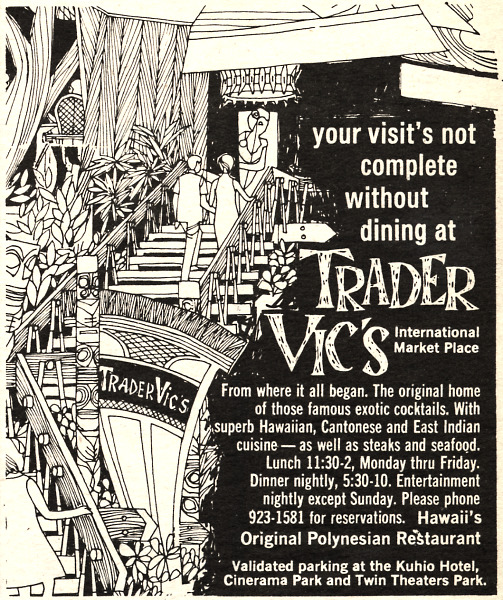
The famous Duke Kahanamoku’s (Duke’s,) where Don Ho gained fame, was once housed there. Don the Beachcomber, one of Waikīkī’s long-gone landmark restaurants, as well as Trader Vic’s also called it home.

Hawaiʻi radio icon, Hal Lewis (the self-named “J Akuhead Pupule,” best known to Island radio listeners as “Aku,”) once broadcast his popular morning talk show from the tree house in the Banyan tree.

However, over the last half-century, as the rest of Waikīkī evolved, the Market Place kept its 1960s look, as visitors wind through the carts and kiosks, hawking T-shirts, plastic hula skirts, volcano-shaped candles, and other tiki and tacky souvenirs.

Landowner Queen Emma Foundation changed that. Working with the Taubman Company, the International Market Place, Waikīkī Town Center and Miramar Hotel were demolished, and new structures took their place.

Aiming to restore “a sense of Hawaiianness,” the new International Market Place features low-rise structures, open-air shops and restaurants, paths, gardens, a storytelling hearth, a performance amphitheater and, yes, parking. And the banyan tree stays.

Today, as successor to The Queen’s Hospital, The Queen’s Medical Center is the largest private nonprofit hospital in Hawaiʻi, licensed to operate with 505 acute care beds and 28 sub-acute beds. As the leading medical referral center in the Pacific Basin, Queen’s has more than 3,500 employees and over 1,100 physicians on staff.

The royal mission and vision of The Queen’s Health Systems is directly supported through revenues generated by the lands bequeathed by Queen Emma when she passed away in 1885, including the International Market Place.

© 2022 Hoʻokuleana LLC

Filed Under: Place Names, Prominent People, Economy Tagged With: Queen Emma, Duke Kahanamoku, Don Ho, Trader Vic's, Kaluaokau, Hawaii, Don the Beachcomber, Waikiki, Oahu, Lunalilo, Kamehameha IV, Matson

October 28, 2019 by Peter T Young Leave a Comment

Bradley, Voorhees & Day

“At one time hoop skirt manufactories were numerous, and a large capital was engaged in the business. Since the hoop skirt went out of fashion, the factories have nearly all disappeared, and the capital has gone into other enterprises.”

“The New York Sun reports Mr Bradley, of Bradley, Voorhees & Day, as saying:

“‘It was in 1857 that hoop skirts first came into use. I remember the first article, of the kind which were imported from Europe. They were cumbrous affairs, the hoops made of bamboo, cane or rattan. Iron was considered too heavy a material.’”

“‘Steel hoops were introduced by American makers. It was a long process to get the right quality of steel. If made too hard the steel would snap, and if too soft the hoop would bend in wear and lose its shape.’”

“‘Now the steel is so well tempered that the hoop skirt retains its shape and at the same time conforms to changes of attitude in the like a woven fabric.’”

“‘The weight of a wearer skirt like that now coming into fashion is less than one-fourth of that of the old style of skirt, and the new skirt will wear four times as long as the old.’”

“‘I recollect the time when we employed 1,200 hands, and our product was 10,000 skirts a day. That was during the war, but about 1868 the hoop skirt went out of fashion and the trade died out.’”

“‘There was a transient revival in 1870, but it disappeared, and from then until now the hoop skirt trade has been a very small part of our business.’”

“‘We have always continued the manufacture to some extent, getting orders every now and then, mostly from the South and West.’” (Yorkville Enquirer, August 4, 1881)

The company then got into ‘union suits;’ reportedly they were the first. The union suit involves the combination of both a shirt and pants (drawers) in a one piece suit. The garment commonly included a drop seat. This term began to be used in the 1890s.

A spokesperson for the company was Johnny Weissmuller; in 1924, he and Duke Kahanamoku raced in the Olympics. Weissmuller beat Duke (Duke was 2nd) in the 100-meter freestyle final. (Duke’s brother Sam came in 3rd.)

After becoming one of the most famous swimmers in the world, Weissmuller translated his success into being a spokesperson for Bradley, Voorhees & Day.

In 1929, he signed a 5-year contract that paid him $500 per week. He was to tour the country giving swimming exhibitions.

Weissmuller then turned that into a long series of hit films playing first Tarzan, King of the Jungle (it was Weissmuller’s films that debuted the legendary ‘Tarzan yell.’)

At the beginning of the 1930s, Bradley, Voorhees & Day was purchased by the Atlas Underwear company located in Piqua, Ohio.

During the Great Depression they were successful in manufacturing swimsuits for men, women and children. They patented their own fabric, Sea Satin, a rayon woven satin backed with latex for stretch.

Later, in the 1940s and 50s, Bradley, Voorhees & Day, using Rayon, started to make Hawaiian Aloha Shirts; sometimes with island-related themes, sometimes not.

They also used knits of cotton, wool and Rayon, and cellophane. Their swimsuits were featured in major fashion magazines and high fashion stores. In 1951, the brand was purchased by Superior Mills.

Bradley, Voorhees & Day were first to start packaging underwear in plastic bags for the mass market. In the 1960s and 1970s, they started introducing sportops, a pocket T-shirt, and fashionable underwear made of nylon.

In 1976, Bradley, Voorhees & Day was purchased by Fruit of the Loom, which brought the brand to a worldwide market. On April 9, 2002, Berkshire Hathaway purchased Fruit of the Loom.

Over time, the products were simply known as BVD (using the first letters of founders’ names;) ‘BVDs’ became a genericized trademark in reference to any brand of underwear.

Follow Peter T Young on Facebook 

Follow Peter T Young on Google+ 

Follow Peter T Young on LinkedIn  

Follow Peter T Young on Blogger

© 2019 Hoʻokuleana LLC

BVD Flying Fish Shirt
BVD Aloha Nui
BVD Aloha Nui
BVD-Rayon
BVD-Rayon
bvd-shirt-001
bvd-shirt-001
bvd-shirt-001-collar
BVD-swim trunks
BVD-swim trunks
BVD_Weissmuller
BVD_Weissmuller
Johnny_Weissmuller_and_Duke_Kahanamoku_at_Olympics
BVD-Weissmuller
BVD-Weissmuller
Oldest-Underwear-Brand-Image
BVD-Men
BVD-Men
BVD Swimsuits 1932
BVD Swimsuits 1932
BVD Swimsuits 1934
BVD Swimsuits 1934
BVD Swimsuits 1935
BVD Swimsuits 1935
BVD Swimsuits 1937
BVD Swimsuits 1937
BVD Swimsuits 1938
BVD Swimsuits 1938
BVD-label
BVD-label

Filed Under: General, Economy Tagged With: Hoop Skirt, Drop Seat, Underwear, Hawaii, Union Suit, Duke Kahanamoku, Aloha Shirt, Johnny Weissmuller, Sam Kahanamoku, Bradley Voorhees & Day, BVD

July 4, 2019 by Peter T Young 3 Comments

Independence Day

Independence Day celebrates the adoption of the Declaration of Independence on July 4, 1776, declaring independence from the Kingdom of Great Britain.

Drafted by Thomas Jefferson between June 11 and June 28, 1776, the Declaration of Independence is the nation’s most cherished symbol of liberty and Jefferson’s most enduring monument.

The political philosophy of the Declaration was not new; its ideals of individual liberty had already been expressed by John Locke and the Continental philosophers.

What Jefferson did was to summarize this philosophy in “self-evident truths” and set forth a list of grievances against the King in order to justify before the world the breaking of ties between the colonies and the mother country.

Fifty-six men from each of the original 13 colonies signed the Declaration of Independence – they mutually pledged “to each other our lives, our fortunes and our sacred honor.”

Nine of the signers were immigrants, two were brothers and two were cousins. Eighteen of the signers were merchants or businessmen, 14 were farmers and four were doctors. Twenty-two were lawyers and nine were judges.

The average age of a signer was 45. Benjamin Franklin was the oldest delegate at 70. The youngest was Thomas Lynch Jr. of South Carolina at 27.

At the time of the signing, the American Revolutionary War was already underway (1775-1783.)

The British captured five signers during the war. Edward Rutledge, Thomas Heyward and Arthur Middleton were captured at the Battle of Charleston in 1780. George Walton was wounded and captured at the Battle of Savannah; Richard Stockton was incarcerated at the hands of British Loyalists.

Eleven signers had their homes and property destroyed. Francis Lewis’s New York home was razed and his wife taken prisoner. John Hart’s farm and mills were destroyed when the British invaded New Jersey, and he died while fleeing capture.

Fifteen of the signers participated in their states’ constitutional conventions, and six – Roger Sherman, Robert Morris, Benjamin Franklin, George Clymer, James Wilson and George Reed – signed the US Constitution.

Here are some other brief Revolutionary War highlights (and some other July 4 events:)

1775
March 23 – Patrick Henry’s “Give me liberty or give me death” speech
April 18 – The rides of Paul Revere and William Davis
April 19 – Minutemen and redcoats clash at Lexington and Concord “The shot heard round the world”
June 17 – Battle of Bunker Hill (Boston) – the British drive the Americans
Throughout the year, skirmishes occurred from Canada to South Carolina

Initially, fighting was through local militias; then, the Continental Congress established (on paper) a regular army on June 14, 1775, and appointed George Washington as commander-in-chief.

The development of the Continental Army was a work in progress, and Washington used both his regulars and state militia throughout the war.

1776
January 15 – Thomas Paine’s ‘Common Sense’ challenged the authority of the British government and the royal monarchy
March 17 – the British evacuate Boston

Ultimately, on September 3, 1783, the war ended with the signing of the Treaty of Paris. The treaty document was signed by John Adams, Benjamin Franklin and John Jay (representing the United States) and David Hartley (a member of the British Parliament representing the British Monarch, King George III).

On June 21, 1788, the US Constitution was adopted (with all states ratifying it by that time.)

John Adams, Thomas Jefferson and Charles Carroll were the longest surviving signers of the Declaration of Independence. Adams and Jefferson both died on July 4, 1826, the 50th anniversary of the Declaration of Independence; Carroll was the last signer to die – in 1832 at the age of 95.

July 4, 1894, the Republic of Hawai‘i was established at Ali‘iōlani Hale; Sanford B. Dole became its first president.

July 4, 1913 – Duke Kahanamoku established three new West Coast records in swimming, winning the 50-yard, 440-yard and 220-yard races in a San Francisco regatta.

Following statehood of Hawaiʻi, the new flag of the United States of America, containing a union of 50 stars, flew for the first time at 12:01 am, July 4, 1960, when it was raised at the Fort McHenry National Monument in Baltimore, Maryland.

Today, we celebrate the signing of America’s Declaration of Independence – however, the freedoms, rights and privileges we share because of this event continue to be protected by the sacrifices of many men and women across the globe; we honor and celebrate their service, as well.

American Revolutionary War

By the time the Declaration of Independence was adopted in July 1776, the Thirteen Colonies (New Hampshire, Massachusetts, Rhode Island, Connecticut, New York, New Jersey, Pennsylvania, Delaware, Maryland, Virginia, North Carolina, South Carolina and Georgia) and Great Britain had been at war for more than a year.

That war lasted from April 19, 1775 (with the Battles of Lexington and Concord) to September 3, 1783 (with the signing of the Treaty of Paris.) It lasted 8 years, 4 months, 2 weeks and 1 day …

… then, the sovereignty of the United States was recognized over the territory bounded roughly by what is now Canada to the north, Florida to the south, and the Mississippi River to the west.

In the Islands at the Time

At the time of the American Revolutionary War, the Hawaiian Islands were divided into four kingdoms: (1) the island of Hawaiʻi under the rule of Kalaniʻōpuʻu, who also had possession of the Hāna district of east Maui; (2) Maui (except the Hāna district,) Molokai, Lānaʻi and Kahoʻolawe, ruled by Kahekili; (3) Oʻahu, under the rule of Kahahana; and (4) Kauai and Niʻihau, Kamakahelei was ruler.

Shortly after Kalaniʻōpuʻū’s death in 1782, Kamehameha began his conquest to unify the islands under his rule. After several battles on several of the islands, and subsequent agreement with King Kaumualiʻi of Kauaʻi, Kamehameha became sole ruler of the Islands in 1810 (a couple years later, on the continent, the US and Britain engaged in the war of 1812.)\

Follow Peter T Young on Facebook 

Follow Peter T Young on Google+ 

Follow Peter T Young on LinkedIn  

Follow Peter T Young on Blogger

© 2019 Hoʻokuleana LLC

Declaration of Independence

Filed Under: General, Ali'i / Chiefs / Governance Tagged With: Independence Day, Hawaii, Declaration of Independence, Duke Kahanamoku

  • « Previous Page
  • 1
  • 2
  • 3
  • 4
  • Next Page »

Images of Old Hawaiʻi

People, places, and events in Hawaiʻi’s past come alive through text and media in “Images of Old Hawaiʻi.” These posts are informal historic summaries presented for personal, non-commercial, and educational purposes.

Info@Hookuleana.com

Connect with Us

  • Email
  • Facebook
  • LinkedIn
  • Twitter
  • YouTube

Recent Posts

  • About 250 Years Ago … Battles of Saratoga
  • ‘A Swarm of B’s Has Come’
  • About 250 Years Ago … US Constitution
  • Hiram Bingham: I – IV
  • Haui ka Lani
  • Niuhelewai
  • St Mary’s – St Joseph’s

Categories

  • Mayflower Summaries
  • American Revolution
  • General
  • Ali'i / Chiefs / Governance
  • Buildings
  • Missionaries / Churches / Religious Buildings
  • Hawaiian Traditions
  • Military
  • Place Names
  • Prominent People
  • Schools
  • Sailing, Shipping & Shipwrecks
  • Economy
  • Voyage of the Thaddeus

Tags

Albatross Al Capone Ane Keohokalole Archibald Campbell Bernice Pauahi Bishop Charles Reed Bishop Downtown Honolulu Eruption Founder's Day George Patton Great Wall of Kuakini Green Sea Turtle Hawaii Hawaii Island Hermes Hilo Holoikauaua Honolulu Isaac Davis James Robinson Kamae Kamaeokalani Kameeiamoku Kamehameha Schools Lalani Village Lava Flow Lelia Byrd Liberty Ship Liliuokalani Mao Math Mauna Loa Midway Monk Seal Northwestern Hawaiian Islands Oahu Papahanaumokuakea Marine National Monument Pearl Pualani Mossman Quartette Thomas Jaggar Volcano Waikiki Wake Wisdom

Hoʻokuleana LLC

Hoʻokuleana LLC is a Planning and Consulting firm assisting property owners with Land Use Planning efforts, including Environmental Review, Entitlement Process, Permitting, Community Outreach, etc. We are uniquely positioned to assist you in a variety of needs.

Info@Hookuleana.com

Copyright © 2012-2024 Peter T Young, Hoʻokuleana LLC

Loading Comments...