Images of Old Hawaiʻi

  • Home
  • About
  • Categories
    • Ali’i / Chiefs / Governance
    • American Protestant Mission
    • Buildings
    • Collections
    • Economy
    • Missionaries / Churches / Religious Buildings
    • General
    • Hawaiian Traditions
    • Other Summaries
    • Mayflower Summaries
    • Mayflower Full Summaries
    • Military
    • Place Names
    • Prominent People
    • Schools
    • Sailing, Shipping & Shipwrecks
    • Voyage of the Thaddeus
  • Collections
  • Contact
  • Follow

January 8, 2016 by Peter T Young 2 Comments

Mule Tunnel

With its panoramic view from Koko Head to Waiʻanae, the summit of Diamond Head was an ideal site for the coastal defense of O‘ahu. In 1904, Diamond Head was purchased by the Federal government and designated for military use.

In 1906, Secretary of War William H Taft convened the National Coast Defense Board (Taft Board) “to consider and report upon the coast defenses of the United States and the insular possessions (including Hawai‘i.)” They recommended a system of Coast Artillery batteries to protect Pearl Harbor and Honolulu.

Fortification of Diamond Head began in 1908 with the construction of gun emplacements and an entry tunnel through the north wall of the crater from Fort Ruger known as the Mule Tunnel.

Originally, the tunnel was 5-feet wide and 7-feet high which is what was required for mules. Mules were used primarily to pull narrow gauge rail cars loaded with material in and out of the crater and to the various construction points.

Fort Ruger Military Reservation was established at Diamond Head (Leʻahi) in 1906. The Reservation was named in honor of Major General Thomas H. Ruger, who served from 1871 to 1876 as the superintendent of the United States Military Academy at West Point.

The trail to the Diamond Head summit was built in 1908 as part of the US Army Coastal Artillery defense system. Entering the crater from Fort Ruger, through the Mule Tunnel, the trail scaled the steep interior western slopes of the crater to the summit.

The dirt trail with numerous switchbacks was designed for mule and foot traffic. The mules hauled materials on this trail for the construction of Fire Control Station Diamond Head located at the summit. Other materials were hoisted from the crater floor by a winch and cable to a midway point along the trail. (DLNR)

In about 1910, there was a narrow gauge railway running from the mule tunnel across the center of the crater

Between 1909-1921, the Hawaiian Coast Artillery Command had its headquarters at Fort Ruger and defenses included artillery regiments stationed at Fort Armstrong, Fort Barrette, Fort DeRussy, Diamond Head, Fort Kamehameha, Kuwa‘aohe Military Reservation (Fort Hase – later known as Marine Corps Base Hawaiʻi) and Fort Weaver.

The forts and battery emplacements were dispersed for concealment and to insure that a projectile striking one would not thereby endanger a neighbor.

The fort included Battery Harlow (1910-1943 – northern exterior;) Battery Hulings (1915-1925- (tunnels through crater wall;) Battery Dodge (1915-1925 – tunnels through east crater wall;) Battery Mills (1916-1925 – on Black Point;) Battery Birkhimer (1916-1943 – mostly below ground inside the crater;) Battery Granger Adams (1935-1946 – on Black Point (replaced Battery Mills;)) Battery 407 (1944 – tunnels through south crater wall;) and Battery Ruger (1937-1943).

In 1922, Mule Tunnel was enlarged to 15 feet wide by 14 feet high. A Fire Control Switchboard that had been in a shed outside the tunnel was moved into a room carved into the wall about 100 feet from the outside end. (Its name later changed to the Kapahulu Tunnel.)

The headquarters of the Harbor Defenses of Honolulu came to Fort Ruger in January 1927. In 1932 work began on a bombproof Harbor Defense Command Post (HDCP or “H” Station) built into the Kapahulu Tunnel.

During the widening of the tunnel, a larger cavern was cut into the wall of the tunnel at the downhill end, creating rooms for a Harbor Defense Command Post.

The new complex of eight rooms included the old fire control switchboard room and became the Harbor Defense Command Post. (Those rooms are now used by the Hawaii Red Cross as storage.)

In 1932 the tunnel was enlarged again, to 17 feet high to allow truck traffic. During the widening a larger cavern was cut into the wall of the tunnel at the downhill end, creating rooms for a Harbor Defense Command Post.

The Kahala Tunnel was built in the 1940s and is the public entrance today. (The Kapahulu Tunnel is used only when the Kahala Tunnel is closed for repairs or problems.)

In January 1950 Fort Ruger became the headquarters of the Hawaii National Guard. In 1955 most of the Fort Ruger reservation was turned over to Hawaii with the U.S. Army retaining the parade and Palm Circle until 1974 and the Cannon Club (officers’ club) until 1997.

The fort’s barracks area became the University of Hawaii’s Kapiʻolani Community College. (Lots of information is from DiamondHeadHike.)

Follow Peter T Young on Facebook 

Follow Peter T Young on Google+ 

Follow Peter T Young on LinkedIn  

Follow Peter T Young on Blogger

© 2016 Hoʻokuleana LLC

Diamond_Head-Mule-Team-StarAdv
Kapahulu_Tunnel-diamondheadhike
Originally Harbor Defense Command Post offices, now Red Cross Storage-diamondheadhike
Brian Miyamoto of Hawaii Civil Defense and Denby Fawcett walk through the Kapahulu or Mule Tunnel-StarAdv
Old Mule trail - now hike to summit
Old Mule trail – now hike to summit
Old Mule trail-now hike to summit
Hike to summit
Hike to summit
Near summit
Near summit
Kahala Tunnel
Kahala Tunnel
Tunnel on hike to summit
Ft_Ruger-1938
Ft_Ruger-1938
State Monument interpretive sign
Diamond_Head_State_Park-Summit_Trail-map
Fort_Ruger_1922_Main_Post_Plan-WC
Fort_Ruger_Harbor Defense Command Post (HDCP)
Diamond_Head_State_Park-Master_Plan-Layout

Filed Under: Military Tagged With: Mule Tunnell, Kahala Tunnel, Hawaii, Leahi, Diamond Head, Coastal Defense, Kapahulu Tunnel

December 28, 2015 by Peter T Young 8 Comments

Haleiwa Airfield

The date of construction of the Haleiwa airfield has not been determined. The earliest depiction of the field which has been located was a 1933 aerial photo, which depicted a group of B-6A biplanes on a grass field.

Haleiwa Field on the northwest coast of Oahu, 30-miles from Honolulu, was originally (prewar) a center for private flying.

“On the 3rd of December 1941 the 47th Pursuit Squadron was assigned to this base …. This was not a regular runway, just something comparable to an old country road rather than an airstrip. (HIAVPS)

Originally used as an emergency landing field, it had only an unpaved landing strip. Those on temporary duty there had to bring their own tents & equipment.

On December 7, 1941, combined forces of the Japanese Imperial Navy struck at Naval and Army installations on Oahu – and the secondary target was the fleet of American aircraft scattered about the island, aircraft that could disrupt the aerial assault and then follow the fleeing Japanese back to their carriers.

The first targets hit were the airfields: Wheeler, Kaneohe, Ewa, Hickam, Ford Island, Bellows and the civilian airport serving Honolulu. In the strafing and bombing, scores of American aircraft were destroyed in a few minutes. The Imperial bombers could then concentrate on the American fleet at Pearl Harbor.

Haleiwa Field earned its place in history when it became the only airfield able to provide defense against the sneak attack on Pearl Harbor.

The Japanese heavily strafed the aircraft at Wheeler Field and few aircraft were able to get airborne to fend them off. Haleiwa was an auxiliary field to Wheeler and contained a collection of aircraft temporarily assigned to the field including aircraft from the 47th Pursuit Squadron.

A total of eight Curtiss P-40 Kitty Hawk and 2 Curtiss P-36 Mohawk pursuit planes were at the field on the morning of 7 December 1941.

Lt. George S. Welch (heir to the grape juice family) and 2nd Lt. Kenneth M. Taylor (on his first assignment,) both P-40 pilots, were at Wheeler when the attack began.

They had previously flown their P-40B fighters over to the small airfield at Haleiwa as part of a plan to disperse the squadron’s planes away from Wheeler.

Not waiting for instructions the pilots called ahead to Haleiwa and had both their fighters fueled, armed and warmed up. Both men raced in their cars to Haleiwa Field completing the 16-mile trip in about 15 minutes.

With their P-40s, now warmed up and ready, they jumped into their cockpits. The crew chiefs informed them that they should disperse their planes. “The hell with that”, said Welch. Ignoring the usual pre-takeoff checklists the aircraft took off down the narrow airstrip.

Once in the air they spotted a large number of aircraft in the direction of Ewa and Pearl Harbor. Only then did they realize what they were up against. “There were between 200 and 300 Japanese aircraft,” said Taylor; “there were just two of us!”

The two P-40s engaged the aircraft attacking Ewa Mooring Mast and shot down five Japanese planes. They then returned to Wheeler to replenish their ammunition. While there, another wave of dive bombers appeared and Lt. Taylor raced back into the air. His P-40’s cockpit was damaged as a Japanese plane chased him.

Lt. Welch was able to down the plane following him and they both returned back to Wheeler. Lt. Welch was credited with a total of four Japanese planes shot down and Lt. Taylor downed two.

Just as suddenly as it began, the sky was empty of enemy aircraft. Both are credited with being the first “Aces” of World War II. Taylor & Welch were both awarded the Distinguished Service Cross. Walsh & Taylor’s dramatic ride & takeoff was shown in the movie Tora, Tora, Tora. (Trojan)

The Army improved the field during the early part of World War II and it was in use to simulate real battle conditions for gunnery training. In 1944 the Navy took the field over for carrier-landing training.

After the war Haleiwa Fighter Strip was apparently reused as a civilian airport for some period of time. Haleiwa was depicted as a civilian airport on the 1947 Hawaiian Islands Sectional Chart.

It was described as having a 4,800′ hard-surface runway. The Haleiwa Airport was apparently abandoned at some point between 1947-1961, as it was not depicted at all on the 1961 Honolulu Sectional Chart. (Trojan)

Follow Peter T Young on Facebook 

Follow Peter T Young on Google+ 

Follow Peter T Young on LinkedIn  

Follow Peter T Young on Blogger

© 2015 Hoʻokuleana LLC

Haleiwa_Airfield
Haleiwa Field, September 7, 1941
Haleiwa Field, September 4, 1941
Haleiwa-Airfield
Haleiwa-Airfield
Haleiwa_HI_43-44_A-24
Bell P-39 aircraft at Haleiwa Field 1943-1944
Haleiwa_HI_42-43_NW_P-40s
Haleiwa_HI_42_overhead
Haleiwa_HI_40s_P-47
Haleiwa_HI_40s_P-47
Haleiwa_HI_40s_P-40
Haleiwa_HI_40s_P-40
P-39 in background
P-39 in background
Haleiwa Field, August 20, 1942
Haleiwa Field, 1942.
with A-24 and 2 PQ-8A target aircraft.
4 Bell P-39s fly over Haleiwa Field as maintenance work progresses at left.

Filed Under: Military Tagged With: Hawaii, Haleiwa, North Shore, Haleiwa Airfield

December 12, 2015 by Peter T Young 2 Comments

John Kendrick

Sea Captain John Kendrick fought in the French and Indian Wars in 1762, threw tea overboard in the Boston Tea Party in 1773, and was in charge of the Fanny, one of the United States’ first ships, during the Revolutionary War.

He survived all that, and was later killed on December 12, 1794 in a 13-canon saluting round in Fair Haven (now known as Honolulu Harbor.) (Lytle)

Let’s look back …

Kendrick was born in 1740 on a small hilly farm in East Harwich, Cape Cod, the third of seven children of Solomon Kendrick and Elizabeth Atkins.

Kendrick’s grandfather, Edward Kendrick, had arrived in Harwich around 1700 and married Elizabeth Snow, the granddaughter of Nicholas Snow, a holder of extensive lands and one of the ‘old-comers’ from Plymouth who first settled the Cape.

Kendrick’s father, Solomon, born sometime during the winter of 1705, was master of a whaling vessel who was famous in local lore. He followed his father and went to sea by the time he was fourteen. By his late-teens, he was crewing on local sailing vessels.

“John Kendrick came of age in the defiant atmosphere of the coffeehouses and taverns of Boston. Here, he was in the midst of the firestorm of opposition to the Parliament’s Stamp Act of 1765 and the hated Townshend Acts, which usurped local authority and levied an array of onerous taxes.”

“As strife increased on the waterfront, he may have been involved in the widespread boycott of British goods and the burning of Boston’s customs house, or riots over seizure and impressment of American sailors for British ships.”

“(O)n the rainy night of December 16, 1773, John Kendrick was part of the legendary band that boarded two East India Company ships at Griffin’s Wharf in Boston and dumped 342 chests of tea into the harbor. Thumbing his nose at the British shortly after, he is said to have been master of the brig Undutied Tea.”

He fought in the American Revolutionary War and at its outbreak, he smuggled powder and arms from the Caribbean with the sloop Fanny, whose owners were under contract with a secret committee of the Continental Congress and later captured a couple ships, which helped to precipitate the entry of France into the war.

“Shortly before the British surrendered at Yorktown in 1781, Kendrick came ashore. In his sporadic visits home he had managed to father six children, and now he buckled down to making his way in the new nation.”

“After the victorious Revolution and the euphoria of the Peace Treaty of 1783, an economic depression had settled over villages and farms. Port cities and their harbors were left reeling from the war. Inflation was rampant.”

“There was no common currency, state governments were weak, and representatives to the Congress of the Confederation bickered over fundamental issues, threatening to secede.”

“Heavy debts owed to Britain for damages in the war were due, and the prospects for international trade and revenue were bleak. In a punching move, the king had closed all British ports from Canada and the British Isles to the Caribbean to the remaining American ships.”

Without trade, without customs revenue, without taxes, it would be impossible to support a new central government and succeed in securing independence.

Shipping was the soul of early commerce; the Pacific voyages of James Cook revealed the high prices sea otter furs from the Northwest Coast would bring in China.

That took Kendrick and his crew to the Pacific, where they traded with the local population and explored the northwest of the American continent. They eventually (January 1790) went to China to trade the Northwest furs and eventually made it to Japan, arriving on May 6, 1791, probably becoming the first official Americans to meet the Japanese.

On December 3, 1794, Kendrick arrived in Fair Haven (Honolulu) Hawaiʻi aboard the Lady Washington; a war was waging between Kalanikupule and his half-brother Kaʻeokulani (Kaʻeo.)

Also in Honolulu were Captain William Brown (the first credited with entering Honolulu Harbor) in general command of the Jackall and the Prince Lee Boo, Captain Gordon.

At the death of Kahekili in 1793, Kaʻeo became ruling chief of Maui, Molokai and Lānaʻi. Kalanikupule was ruler of Oʻahu. Homesick for his friends, Kaʻeo set out to return to Kauai by way of Waialua and then to Waimea. He learned of a conspiracy to kill him. (Kamakau)

Captain Brown of the Jackall helped Kalanikupule. While Kaʻeo was successful after some initial skirmishes. A great battle was fought in the area between Kalauao and ‘Aiea in ‘Ewa. Kalanikupule’s forces surrounded Kaʻeo. (Cultural Surveys) The ship’s men successfully aided in the defense and Kaʻeo was defeated.

To celebrate the victory, on December 12, 1794, Kendrick’s brig fired a thirteen-gun salute in celebration the British ship of Captain Brown.

The tradition of rendering a salute by cannon originated in the 14th century as firearms and cannons came into use. Since these early devices contained only one projectile, discharging them rendered them harmless.

Initially, the tradition began as a custom among ships, whose captains had volleys fired upon entering a friendly port to release its arsenal, which demonstrated their peaceful intentions (by placing their weapons in a position that rendered them ineffective.)

Following Kendrick’s salute, Brown answered with a round of fire.

Unfortunately, through an oversight, one of the saluting guns on the Jackall was loaded with round and grape shot, and this shot passed through the side of the Lady Washington, killing Captain Kendrick and several of his crew. (Kuykendall) (Lots of information here is from Ridley; Daughters of the American Revolution)

Follow Peter T Young on Facebook 

Follow Peter T Young on Google+ 

Follow Peter T Young on LinkedIn  

Follow Peter T Young on Blogger

© 2015 Hoʻokuleana LLC

Captain John Kendrick

Filed Under: Military, Prominent People, Sailing, Shipping & Shipwrecks Tagged With: Hawaii, Honolulu Harbor, John Kendrick, Saluting

December 7, 2015 by Peter T Young 3 Comments

A Dauntless Collides With a Val

Pilot, Ensign John HL Vogt; Radioman-gunner, Third Class Sidney Pierce
Pilot, Petty Officer 2nd Class Koreyoshi Toyama (Sotoyama); Flier 1st Class Hajime Murao

A pair of enemy planes apparently collided on the morning of December 7, 1941 – reports from the scene at the time suggest they also crashed at the same spot on the ʻEwa Plain.

Let’s look back …

In the early morning of December 7, 1941, Japanese pilots flew toward the island of Oʻahu from six aircraft carriers (the Akagi, Kaga, Soryu, Hiryu, Shokaku and Zuikaku;) two attack waves of planes attacked various military installations on Oʻahu (a third group attacked ʻEwa as part of a rear guard action.)

The prearranged coded signal “East wind, rain,” part of the weather forecast broadcast over Radio Tokyo, alerted Japanese Consul General Nagao Kita in Honolulu, and others, that the attack on Pearl Harbor had begun.

The first wave of 183-planes (43-fighters, 49-high-level bombers, 51-dive bombers and 40-torpedo planes) struck its targets at 7:55 am. The second wave of 167-Japanese planes (35-fighters, 54-horizontal bombers and 78-dive bombers) struck Oʻahu beginning at 8:40 am.

Perhaps twenty American fighter planes managed to get off the ground the morning of December 7, 1941. Most of them were shot down, but their actions accounted for six victories in the one-sided aerial battle. (Castagnaro and Padilla)

The USS Enterprise was at sea during the attack, it was shuttling Army Air Force, as well as Navy planes, from West Coast ports to Pearl Harbor, and to outlying detachments on Wake and Guam further west.

She departed on November 28 carrying Marine pilots and their planes to Wake Island, flying them off on December 2 before turning east to return to Pearl Harbor.

Forced to slow by a storm system, which also sheltered the Japanese Combined Fleet advancing on Oʻahu, Enterprise missed her expected return date to Pearl Harbor: December 6. Instead, she was 150-miles west when the Japanese attacked. (CV6-org)

When approaching the Islands, the Enterprise sent out scout dive bombers, which flew in ahead of the ship; unaware of the attack, they were caught in the initial Japanese attack.

One of those was a ‘Dauntless’ manned by Ensign John HL Vogt (pilot) and Third Class Sidney Pierce (radioman-gunner.) Vogt had become separated from his section leader during the Pearl-bound flight in from the carrier; he may have circled off-shore, and then arrived to encounter the dive bombers near ʻEwa. (Cressmand & Wenger)

The Japanese were flying Aichi D3A (Type 99 Navy Dive Bomber – later referred to as ‘Val’ aircraft.) During the Pearl Harbor attack the Japanese dive bombers flew in units of three who looked out for one another.

The Val was the first Japanese aircraft to bomb American targets in WWII. It was the primary dive bomber in the Imperial Japanese Navy, and participated in almost all actions in the war.

One of those was manned by Petty Officer 2nd Class Koreyoshi Toyama (Sotoyama) (pilot) and Flier 1st Class Hajime Murao. Toyama attacked the USS Pennsylvania in Drydock 1. His bomb missed and hit the dock itself. (Cole)

Other than flying over Pearl Harbor, flying back to their aircraft carrier was the second most difficult part of their mission because the air units had to regroup initially over ʻEwa and then proceed to further geographic points – Barbers Point and Kaʻena Point, before heading out to sea northwest of Oʻahu and finding their respective aircraft carriers approximately 200-miles away. (Bond)

Neither of these planes made it back to their respective ships.

One report notes Vogt entered a low altitude dogfight with at least two Japanese planes. He trailed one as best it could until the Japanese plane pulled up sharply and stalled, causing the two to collide in an explosion that brought both plans down. (AECOM)

This was confirmed by Lieutenant Colonel Larkin who saw an American plane and a Japanese plane collide in mid-air a short distance away from the ʻEwa Field. In all probability, Larkin saw the Dauntless collide with a Val. (marines-mil) (Other reports note each was separately shot down.)

The American crew bailed out, but were too low an altitude; both were found dead in the trees when their chutes failed to deploy. Neither of the Japanese crewmen escaped their Val when it crashed. (Cressmand & Wenger)

According to several reports, the two planes ended up in the same spot, at what is today the vicinity of the Hoakalei Golf Course club house. (Bond)

“Investigation disclosed two of our fliers, Ensign JHB Vogt, USNR, and Pierce Sidney, RM 3c, both of the USS Enterprise, were casualties. Two Japanese pilots, both badly burned, were also in the wreck.” (Milz)

Toyama’s two wingmen flew over the crash site, possibly trying to determine if either of the Japanese crew had somehow made it out of the burning crash. They then made a strafing pass before flying away. (Lots of information here from Bond)

The image shows the crash site on the ʻEwa Plain (note the two Japanese support planes circling the site.) (Photographed by Staff Sergeant Lee Embree from a US Army 38th Reconnaissance Squadron B-17E that arrived over Oahu during the Japanese attack. (navy-mil, notation by Bond)

Follow Peter T Young on Facebook 

Follow Peter T Young on Google+ 

Follow Peter T Young on LinkedIn  

Follow Peter T Young on Blogger

© 2015 Hoʻokuleana LLC

LEmbree-1B
LEmbree-1B
LEmbree-2B
LEmbree-2B
Lee-Embree1B
Lee-Embree1B
Japanese Val
Japanese Val
Crash Site-05-1942
Crash Site-05-1942
Ewa-Crash-2
Ewa-Crash-2
Dauntless flies over Enterprise-Dec1942
Akagi_D3A1
Akagi_D3A1
Ewa_1933-Map-1
Ewa_1933-Map-1
Haseko-Crash-1B
Haseko-Crash-1B
Notebook-1
Notebook-1
Hiryu 1st Chutai_001
Ewa_23May1942 (2)
Ewa_23May1942 (2)
Ewa_9Dec1941
Ewa_9Dec1941
Pearl Harbor-First Attack

Filed Under: Military Tagged With: Japanese, Pearl Harbor, World War II, Hawaii

November 24, 2015 by Peter T Young 1 Comment

Kahoʻolawe

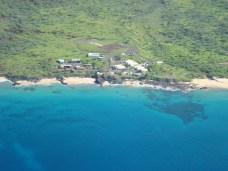
Kaho‘olawe is the smallest of the eight Main Hawaiian Islands, 11-miles long and 7-miles wide (approximately 28,800-acres,) rising to a height of 1,477-feet. It is seven miles southwest of Maui.

Archaeological evidence suggests human habitation began as early as 1000 AD; it is known as a navigational and religious center, as well as the site of an adze quarry. Subsistence farmers and fishers formerly populated Kaho‘olawe.

Interestingly, the entire island of Kaho‘olawe is part of an ahupua‘a from the Maui district of Honua‘ula. The island is divided into ʻili (smaller land units within ahupua‘a.)

Kekāuluohi “made Kahoʻolawe and Lānaʻi penal settlements for law breakers to punish them for such crimes as rebellion, theft, divorce, breaking marriage vows, murder and prostitution.” (Kamakau)

The first prisoners exiled to Kahoʻolawe were a Hawaiian man convicted of theft, and a woman accused of prostitution, both of whom were sent to the island on June 13, 1826. (Reeve; KIRC)

“The village is a collection of eight huts, and an unfinished adobe church. The chief has three large canoes for his use. In passing over the island, the walking had been found very tedious; for they sunk ankle-deep at each step.”

“The whole south part is covered with a light soil, composed of decomposed lava; and is destitute of vegetation, except a few stunted shrubs.”

“On the northern side of the island, there is a better soil, of a reddish colour, which is in places susceptible of cultivation. Many tracks of wild hogs were seen, but only one of the animals was met with.”

“The only article produced on the island is the sweet-potato, and but a small quantity of these. All the inhabitants are convicts, and receive their food from Maui: their number at present is about fifteen.”

“Besides this little cluster of convicts’ huts, there are one or two houses on the north end, inhabited by old women. Some of the convicts are allowed to visit the other islands, but not to remain.” (Wilkes, 1845)

The “Act of Grace” of Kamehameha III, in commemoration of the restoration of the flag by Admiral Thomas July 31, 1843, let “all prisoners of every description” committed for offenses during the period of cession “from Hawaiʻi to Niʻihau be immediately discharged,” royal clemency was apparently extended to include prisoners of earlier conviction. (Thrum)

Located in the “rain shadow” of Maui’s Haleakala, rainfall has been in short supply on Kaho‘olawe. Historically, a “cloud bridge” connected the island to the slopes of Haleakalā. The Naulu winds brought the Naulu rains that are associated with Kaho‘olawe (a heavy mist and shower of fine rain that would cover the island.)

In 1858 the first lease of Kahoʻolawe was sold at public auction. Plans were made to turn the Island into a sheep ranch. From then until World War II, Kahoʻolawe was effectively used as a livestock ranch.

A constant theme from 1858 on was elimination of wild animals that were destroying the vegetation. At first wild dogs, hogs, and goats were the predators. By the end of the 19th century, grazing of cattle, goats and sheep were the destroyers. (King; KIRC)

“The Island of Kahoolawe consists of one government land, at present under an expiring lease held by Mr Eben P Low, that runs out on January 1, 1913. This lease was formerly held by Mr. CC Conradt, now of Pukoʻo, Molokai, and was transferred by him to Mr Low a few years since.”

“Prior to that time the island had passed through many hands. It has been used continuously for many years for the grazing of cattle, and especially of sheep.” (Hawaiian Forester, 1910)

“A great part of the time it has been badly overstocked, a condition which has resulted in the destruction of the original cover of vegetation, followed by erosion and the loss of large quantities of valuable soil, much of which has literally been blown away to sea by the strong trade wind.”

“As the result of long years of overstocking, Kahoolawe has become locally a name practically synonymous with desolation and waste. The object of declaring the island a forest reserve is to put it in a position where, upon the expiration of the existing lease, effective steps could be taken toward its reclamation.” (Hawaiian Forester, 1910)

The Island was a forest reserve from August 25, 1910 to April 20, 1918. But, it was determined, “(I)t would be a foolish waste of money to attempt to reforest the bare top of the island; that for the good of the island the remaining sheep and goats should be exterminated or entirely removed”. (Hawaiian Forester, 1918)

“(T)here is a vast area of pili grass valuable for fattening cattle for the market and tons of algaroba beans on the island going to waste annually; that under a carefully prepared lease of the island with due restrictions and limitations good use could be made of these and at the same time the goats could be required to be exterminated.” (Hawaiian Forester, 1918)

While ranching restarted with a lease to Kahoʻolawe Ranch, it was a later use that further impacted the Island. Military practice bombing of the island is reported to have begun as early as 1920. (Lewis; american-edu)

Then, in May 1941, Kahoʻolawe Ranch signed a sublease for a portion of the island with the US Navy for $1 per year to 1952, when the Ranch’s lease expired. Seven months later, following the attack on Pearl Harbor and initiation of martial law, the military took over the whole island and ranching operations ended. (PKO)

Bombing of the island continued to 1990. Then, in 1992, the State of Hawai‘i designated Kahoʻolawe as a natural and cultural reserve, “to be used exclusively for the preservation and practice of all rights customarily and traditionally exercised by Native Hawaiians for cultural, spiritual, and subsistence purposes.” (KIRC)

In 1993, Congress voted to end military use of the Island and authorized $400-million for ordnance removal. In 2004, The Navy ended the Kahoʻolawe UXO Clearance Project.

At its completion, approximately 75% of the island was surface cleared of unexploded ordnance (UXO). Of this area, 10% of the island, or 2,647 acres, was additionally cleared to the depth of four feet. Twenty-five percent, or 6,692 acres, was not cleared and unescorted access to these areas remains unsafe. (KIRC)

With the help of hard work by volunteers and Kahoolawe Island Reserve Commission (KIRC) staff, the island is healing and recovering. Kahoʻolawe is being planted with native species that include trees, shrubs, vines, grasses and herbs.

Every year, the planting season begins with a ceremony that consists of appropriate protocols, chants, and hoʻokupu given at a series of rain koʻa shrines that were built in 1997.

The shrines link ʻUlupalakua on Maui to Luamakika, located at the summit of Kahoʻolawe, seeking to call back the cloud bridge and the rains that come with it.

I was fortunate to have served on the Kahoʻolawe Island Reserve Commission (KIRC) for 4½-years and had the opportunity to visit and stay overnight on Kaho‘olawe; the experiences were memorable and rewarding.

Follow Peter T Young on Facebook 

Follow Peter T Young on Google+ 

Follow Peter T Young on LinkedIn  

Follow Peter T Young on Blogger

© 2015 Hoʻokuleana LLC

Kahoolawe-USGS-(LOC)-1926
aerial-kahoolawe
aerial-kahoolawe
Cloud Bridge - Kahoolawe to Maui
Cloud Bridge – Kahoolawe to Maui
Cloud Bridge - Maui to Kahoolawe
Cloud Bridge – Maui to Kahoolawe
Kahoolawe-PP-46-10-03400001
Kahoolawe-PP-46-10-038
Kahoolawe-PP-46-10-034
Kahoolawe-PP-46-10-033
Kahoolawe-PP-46-10-032
Kahoolawe-PP-46-10-017
Kahoolawe-PP-46-10-015
Kahoolawe-PP-46-10-041
Kahoolawe South-hellers
Kahoolawe_South-hellers
Kahoolawe-planting-hellers
KIRC Place names
KIRC Place names

Filed Under: Ali'i / Chiefs / Governance, Military, Place Names, Economy Tagged With: Hawaii, Kahoolawe

  • « Previous Page
  • 1
  • …
  • 40
  • 41
  • 42
  • 43
  • 44
  • Next Page »

Images of Old Hawaiʻi

People, places, and events in Hawaiʻi’s past come alive through text and media in “Images of Old Hawaiʻi.” These posts are informal historic summaries presented for personal, non-commercial, and educational purposes.

Info@Hookuleana.com

Connect with Us

  • Email
  • Facebook
  • LinkedIn
  • Twitter
  • YouTube

Recent Posts

  • Foreign Mission School
  • 250 Years Ago … Common Sense
  • Molokini
  • Russell Hubbard
  • Kaʻau
  • 250 Years Ago … New York Provincial Company of Artillery is Formed
  • Tree-named Hotels

Categories

  • Mayflower Summaries
  • American Revolution
  • General
  • Ali'i / Chiefs / Governance
  • Buildings
  • Missionaries / Churches / Religious Buildings
  • Hawaiian Traditions
  • Military
  • Place Names
  • Prominent People
  • Schools
  • Sailing, Shipping & Shipwrecks
  • Economy
  • Voyage of the Thaddeus

Tags

Albatross Al Capone Ane Keohokalole Archibald Campbell Bernice Pauahi Bishop Charles Reed Bishop Downtown Honolulu Eruption Founder's Day George Patton Great Wall of Kuakini Green Sea Turtle Hawaii Hawaii Island Hermes Hilo Holoikauaua Honolulu Isaac Davis James Robinson Kamae Kamaeokalani Kameeiamoku Kamehameha Schools Lalani Village Lava Flow Lelia Byrd Liberty Ship Liliuokalani Mao Math Mauna Loa Midway Monk Seal Northwestern Hawaiian Islands Oahu Papahanaumokuakea Marine National Monument Pearl Pualani Mossman Quartette Thomas Jaggar Volcano Waikiki Wake Wisdom

Hoʻokuleana LLC

Hoʻokuleana LLC is a Planning and Consulting firm assisting property owners with Land Use Planning efforts, including Environmental Review, Entitlement Process, Permitting, Community Outreach, etc. We are uniquely positioned to assist you in a variety of needs.

Info@Hookuleana.com

Copyright © 2012-2024 Peter T Young, Hoʻokuleana LLC


Loading Comments...