Images of Old Hawaiʻi

  • Home
  • About
  • Categories
    • Ali’i / Chiefs / Governance
    • American Protestant Mission
    • Buildings
    • Collections
    • Economy
    • Missionaries / Churches / Religious Buildings
    • General
    • Hawaiian Traditions
    • Other Summaries
    • Mayflower Summaries
    • Mayflower Full Summaries
    • Military
    • Place Names
    • Prominent People
    • Schools
    • Sailing, Shipping & Shipwrecks
    • Voyage of the Thaddeus
  • Collections
  • Contact
  • Follow
You are here: Home / Categories

September 12, 2019 by Peter T Young 1 Comment

Anthony Allen

The history of the Black presence in Hawaiʻi goes back to the early sailors; Blacks were crewmembers of Cook’s second and third Pacific voyages.

There is a “high likelihood” for the presence of Blacks on many of the ships that crossed the Pacific.  Free and unfree Blacks had been serving onboard these ships in a variety of capacities.

Between about 1820 and 1880, hundreds of whaling ships annually pulled into (primarily) Honolulu and Lāhainā, and a significant number of Blacks stayed behind in the islands and became permanent residents where they worked as cooks, barbers, tailors, sailors on interisland vessels and members of musical groups.

Discussion of early African-American presence in Hawaiʻi usually starts with Anthony D. Allen.  He was born a slave on the German Flats, in New York, in 1774.   At about the age of 24, fearing his old master’s widow (Dougal) might sell him and he would have to leave his mother, he arranged for a new slave master and he was bought for $300.

Shortly thereafter, in 1800, he made a flight for freedom from Schenectady, NY, and made his way to Boston.  He went to work at sea, sailing with the same sea captain for eight years, seven as steward and one as cook.

Many other African Americans worked in the maritime industry during this period as crew members, pilots, cooks, stewards, stevedores, builders and captains. In the coming decades, Americans with African lineage would account for up to 50 percent of the maritime forces. (Scruggs, HJH)

In 1806, he ran into his former slave master and was almost forced back into slavery.  Mr. Coolege, the ship owner on which he worked, agreed to pay the former owner $300; the former owner agreed.

In return, Allen gave Coolege a promissory note to pay him back.  In April 1807, Allen paid the note back.  He spent the next few years sailing across the globe – Boston, France, Haiti, Havana China, Northwest US and eventually, in 1811, Hawaiʻi.

Called Alani by the Native Hawaiians, Allen served as steward to Kamehameha the Great and he acquired a parcel of about six acres.  He married a Hawaiian woman and had three children who survived into adulthood.  (HHS)

He “resided at Waikiki, lived as comfortably, and treated us as courteously, as any who had adopted that country before our arrival.”  (Hiram Bingham)

John Papa ʻĪʻī, a neighbor of Allen, in his testimony confirming rights to the land, told how Allen acquired his land: “The Allens got this land from an old high Priest – Hewa hewa. … this land was given him in the time of ‘’Kamehameha I’.”  (HJH)

By 1820, Allen owned a dozen houses, “within the enclosure were his dwelling, eating and cooking houses, with many more for a numerous train of dependents. There was also a well, a garden containing principally squashes, and in one part, a sheepfold in which was one cow, several sheep, and three hundred goats.”  (Sybil Bingham Journal)

Allen’s land held a variety of business enterprises, including animal husbandry, farming, a boarding house, a hospital, a bowling alley and a grog shop. Besides keeping his own animals, Allen boarded cattle for others.  Allen may have operated the first commercial dairy in Hawaiʻi.

“Waikīkī” was once a vast marshland whose boundaries encompassed more than 2,000-acres (as compared to its present 500-acres below the Ala Wai Canal we call Waikīkī, today).

Allen’s six-acres and home were about two miles from downtown at Pawaʻa, between what we now call Waikīkī and Mānoa at what is now the corner of Punahou and King Streets.  This is where Washington Intermediate School is now situated.  (Washington was the first intermediate school built on Oʻahu; it opened in 1926.)

In addition to his farming, Allen provided overnight accommodations – one of the earliest known hotel uses in Waikīkī.  Several references note his property as a “resort.”  (Hawaiʻi’s first “hotel” may be attributed to Don Francisco de Paula Marin, sometime after 1810 on Marin’s property at Honolulu Harbor.)

Reverend Charles Stewart notes of Allen’s place in his journal, “… it is a favourite resort of the more respectable of the seamen who visit Honoruru. …” With it, he had a popular bowling alley.

He entertained often and made his property available for special occasions.  “King (Kauikeaouli – Kamehameha III) had a Grand Dinner at A. D. Allen’s. The company came up at sunset. Music played very late.”  (Reynolds – Scruggs, HJH)

He even operated a hospital where ill or injured seamen and sea captains were taken ashore to recuperate; however, it is not clear if he had medical training or who else there did.

It appears that Allen helped oversee the construction and maintenance of one of the first improved roads in Honolulu, probably what today is known as Punahou Street, which becomes Mānoa Road.

In the “… valley of Manoa … this afternoon Mr. Bingham drove me in a wagon to it. There is now a good carriage road … as far as the country house of Kaahumanu … five miles from Honolulu.” (Reynolds, Scruggs, HJH)

Allen, the former slave, died of a stroke on December 31, 1835, leaving behind a considerable fortune to his children.

In tribute to Allen, Reverend John Diell noted, “The last sun of the departed year went down upon the dying bed of another man who has long resided upon the island. He was a colored man, but shared, to a large extent, in the respect of this whole community. …”

“He has been a pattern of industry and perseverance, and of care for the education of his children. … In justice to his memory, and to my own feelings, I must take this opportunity to acknowledge the many expressions of kindness which we received from him from the moment of our arrival.”

The image shows an 1874 map (Waikiki DAGS Reg-797-(portion)) that notes the property owned by Anthony D Allen.

Follow Peter T Young on Facebook 

Follow Peter T Young on Google+ 

Follow Peter T Young on LinkedIn  

Follow Peter T Young on Blogger

© 2019 Hoʻokuleana LLC

Filed Under: Economy, Prominent People Tagged With: Blacks in Hawaii, Blacks, Allen, Hawaii, Anthony Allen

September 12, 2019 by Peter T Young Leave a Comment

Day 042 – December 3, 1819

December 3, 1819 – no entry. (Thaddeus Journal)

3rd. Continue to sail rapidly in the latitude of the Sandwich Isles. The weather is not so warm as I supposed it would be in this region, though I am to remember that it is now the coldest season in the year. Some of the family complain of sickness today, others of extreme stupidity. For my own part I feel unusually dull. I suppose it is in part owing to the continual motion of the vessel. Why is it, that, when every thing about seems to demand the most lively exercise of all the Christian graces, the soul should become in a great measure insensible to divine things.
“Rise, rise my soul and leave the ground,
Stretch all thy thoughts abroad,
And rouse up every tuneful sound,
To praise the eternal God.” (Samuel & Nancy Ruggles)

Dec. 3. Yesterday we left the northern temperate zone, expecting never to enter it again. The weather is yet very cool and comfortable. (Mercy Partridge Whitney Journal)

3. – The lord is giving us favorable winds & wafting us at the rate of 7 or 8 miles an hour towards the land of our destination. Bless the lord O my soul & let all that is within me bless his holy name. (Samuel Whitney Journal)

Follow Peter T Young on Facebook 

Follow Peter T Young on Google+ 

Follow Peter T Young on LinkedIn  

Follow Peter T Young on Blogger

© 2019 Hoʻokuleana LLC

Filed Under: Voyage of the Thaddeus, Missionaries / Churches / Religious Buildings Tagged With: thevoyageofthethaddeus

September 11, 2019 by Peter T Young Leave a Comment

Day 043 – December 4, 1819

December 4, 1819 – no entry. (Thaddeus Journal)

4th. Our dear mother may now look at the Atlas and find the I. of cape verd, and imagine she sees her children sailing along by it about three degrees to the westward, in the enjoyment of comfortable health, and good spirits. Your N. (Samuel & Nancy Ruggles)

Dec. 4. We have been at sea six weeks and for most of the time have been driven about by contrary winds. At length we have entered the trades, which are rapidly wasting us on our passage to the heathen world. In the last 24 hours, we sailed about 180 miles. We are now within 2 or 3 deg. of Cape Verd Islands. (Mercy Partridge Whitney Journal)

4. – Six weeks to day since I embarked for the heathen. My desire to be engaged in bringing souls to Christ is increasing. My thoughts lately have dwelt much on Yale. How pleasant once more to meet in that praying circle, to walk with my classmates, & converse on subjects which relate to the rising glories of the church! Perhaps before this the Lord has poured out his spirit, & many of those thought youth have become the subjects of renewing grace. Perhaps my friend E. is among the sons of the Prophets. (Samuel Whitney Journal)

Follow Peter T Young on Facebook 

Follow Peter T Young on Google+ 

Follow Peter T Young on LinkedIn  

Follow Peter T Young on Blogger

© 2019 Hoʻokuleana LLC

Filed Under: Missionaries / Churches / Religious Buildings, Voyage of the Thaddeus Tagged With: thevoyageofthethaddeus

September 10, 2019 by Peter T Young 1 Comment

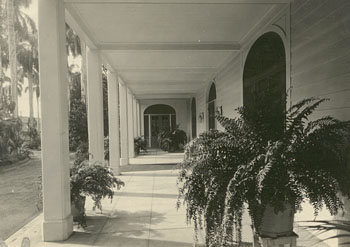
The Cathedral of Saint Andrew

Saint Andrew’s Cathedral is a branch of Christ’s One, Holy, Catholic and Apostolic Church; belonging to the Anglican Communion (also called “Episcopal” in the United States and Scotland).

Kamehameha IV and his Queen Emma rejoiced at the birth of their son, Albert Kauikeaouli Leiopapa a Kamehameha, on May 20, 1858.

They were both very interested in the Anglican/Episcopal Church and in 1859 asked Queen Victoria to send them clergy of the Church of England. In part, they wished their young son to be baptized and “be instructed in the fundamentals of Church of England worship.”

In 1861, the King and Queen gave land, part of their royal garden, on which a Cathedral was to be built. While planning and fund-raising began a small Pro-Cathedral was constructed of wood on the corner of Nuʻuanu and Kuakini Streets in 1862.

This would remain in use for more than twenty years, the time it would take for the first phase of the cathedral to reach completion.

Thomas Staley was consecrated in England to become the first Bishop of Hawaiʻi. In anticipation of the arrival of the Bishop, the King translated much of the Book of Common Prayer into the Hawaiian language.

After the Bishop’s arrival in Honolulu, the King and Queen were baptized and confirmed in the Anglican Church. (This was the second baptism for each; in their childhood they had been baptized in the Calvinist faith.)

The first services of the church were held on October 12, 1862 (150-years ago today,) amidst a time of mourning for the young Prince of Hawaiʻi, the only son of the King and Queen who died shortly before the arrival of the Bishop.

The subsequent untimely death of King Kamehameha IV on St. Andrew’s Day, November 30, 1863, led his brother, Lot (King Kamehameha V) to dedicate the cathedral to St. Andrew as a fitting memorial to a King.

Queen Emma proceeded alone to lead the project. She traveled to England to raise money, to commission architects, and to purchase stone from Caen in Normandy, which was shipped to Hawaiʻi as ballast in sailing ships.

The corner stone was laid March 5, 1867 by King Kamehameha V and work was begun on the foundation and choir sections of the building (he viewed building the cathedral as a tribute to his brother.)

The first twenty years were a struggle with and for money, materials and men, but with the aid of supporters, the nave (the main body and central approach to the high altar) of the cathedral was completed in time for Christmas, 1886.

Queen Emma did not live to worship in the Cathedral. She had died the previous year on St. Mark’s Day, 1885.

The first two bays of the building were completed in 1902 and the building was consecrated at that time. Also in that year, the Church of England deemed it appropriate to transfer its responsibility for the church in Hawaiʻi to the Episcopal Church of the United States.

In 1908, a plan for a tower in the same gothic style as the church was conceived and it was dedicated in 1912. It was not until 1958 that the final two bays of the nave were completed, along with the entrance area, vestibule and the Great West Window.

The new Anglican Church in Hawaii was called the Hawaiian Reformed Catholic Church, indicative of the evolution of the Church of England of the time. The name would change in 1870 to the Anglican Church in Hawaii.

Kamehameha IV and his Queen Emma dedicated their marriage to serving the health, educational and spiritual needs of their people.

To these ends they founded The Queen’s Hospital (now The Queen’s Medical Center), several schools, including The St Andrew’s Priory School and St. Albans (now ʻIolani School), and were instrumental in bringing the Anglican church to the islands.

While St. Andrew’s Cathedral was begun in what has been called the Golden Age of the Hawaiian monarchy, it continued through the upheaval of the overthrow of the monarchy, garnering in those troubled times the allegiance of both Queen Liliʻuokalani, Hawaiʻi’s last monarch, and Sanford Dole, President of the Republic of Hawaiʻi.

Queen Liliʻuokalani took on Queen Emma’s role as a visible and energetic leader in the work of the church, moving into the twentieth century.

In the Hawaiian tradition, two red and yellow kahili stand at the front of the cathedral, serving as physical reminders of the royal patrons of the cathedral.

Historically, there were two congregations. One congregation was at first composed of Hawaiian-speaking worshipers, and the other was composed of English-speaking worshipers. The Hawaiian language is still used in some of the services.

In 2002, the Royal Patrons Chapel was created, the Wahi Kapu, or Sacred Space, dedicated to the memory of King Kamehameha IV and Queen Emma.

Follow Peter T Young on Facebook 

Follow Peter T Young on Google+ 

Follow Peter T Young on LinkedIn  

Follow Peter T Young on Blogger
© 2019 Hoʻokuleana LLC

  • OLYMPUS DIGITAL CAMERA
  • OLYMPUS DIGITAL CAMERA
  • OLYMPUS DIGITAL CAMERA
  • OLYMPUS DIGITAL CAMERA

Filed Under: Missionaries / Churches / Religious Buildings Tagged With: Hawaii, Queen Emma, St. Andrews Cathedral

September 10, 2019 by Peter T Young 2 Comments

Day 044 – December 5, 1819

December 5, 1819 – Social worship only in the cabin. (Thaddeus Journal)

5th. How vast are our obligations to our covenant God. His mercies are new every morning, fresh every evening, and repeated every moment. This is the first day that my dear companion has been able to sit up the whole time since we came on board. (Samuel & Nancy Ruggles)

Dec. 5. We have family prayers regularly morning and evening in the cabin. The Capt and his officers generally attend. (Mercy Partridge Whitney Journal)

5. – Another Sabbath is now past. Alas what indifference to the word & ordinances of God. No preaching today owing to high winds. Sabbath evening is a time when I think much of home. The image of those dear friends who were meeting for the worship of God is brought up a fresh by that principle which associates past circumstances with like duties. But soon I shall meet them not in the likeness of human flesh but in the image of Christ their redeemer. (Samuel Whitney Journal)

Follow Peter T Young on Facebook 

Follow Peter T Young on Google+ 

Follow Peter T Young on LinkedIn  

Follow Peter T Young on Blogger

© 2019 Hoʻokuleana LLC

Filed Under: Missionaries / Churches / Religious Buildings, Voyage of the Thaddeus Tagged With: thevoyageofthethaddeus

  • « Previous Page
  • 1
  • …
  • 349
  • 350
  • 351
  • 352
  • 353
  • …
  • 659
  • Next Page »

Images of Old Hawaiʻi

People, places, and events in Hawaiʻi’s past come alive through text and media in “Images of Old Hawaiʻi.” These posts are informal historic summaries presented for personal, non-commercial, and educational purposes.

Info@Hookuleana.com

Connect with Us

  • Email
  • Facebook
  • LinkedIn
  • Twitter
  • YouTube

Recent Posts

  • Central Fire Station
  • The Islands in 1828
  • Ranks of Chiefs
  • Martin Luther King at the Hawai‘i Legislature
  • Gilberts and Marshalls
  • It Wasn’t ‘Bloodless’
  • Universal Remedy

Categories

  • Military
  • Place Names
  • Prominent People
  • Schools
  • Sailing, Shipping & Shipwrecks
  • Economy
  • Voyage of the Thaddeus
  • Mayflower Summaries
  • American Revolution
  • General
  • Ali'i / Chiefs / Governance
  • Buildings
  • Missionaries / Churches / Religious Buildings
  • Hawaiian Traditions

Tags

Albatross Al Capone Ane Keohokalole Archibald Campbell Bernice Pauahi Bishop Charles Reed Bishop Downtown Honolulu Eruption Founder's Day George Patton Great Wall of Kuakini Green Sea Turtle Hawaii Hawaii Island Hermes Hilo Holoikauaua Honolulu Isaac Davis James Robinson Kamae Kamaeokalani Kameeiamoku Kamehameha Schools Lalani Village Lava Flow Lelia Byrd Liberty Ship Liliuokalani Mao Math Mauna Loa Midway Monk Seal Northwestern Hawaiian Islands Oahu Papahanaumokuakea Marine National Monument Pearl Pualani Mossman Quartette Thomas Jaggar Volcano Waikiki Wake Wisdom

Hoʻokuleana LLC

Hoʻokuleana LLC is a Planning and Consulting firm assisting property owners with Land Use Planning efforts, including Environmental Review, Entitlement Process, Permitting, Community Outreach, etc. We are uniquely positioned to assist you in a variety of needs.

Info@Hookuleana.com

Copyright © 2012-2024 Peter T Young, Hoʻokuleana LLC


Loading Comments...